
Working as a Game Composer for Free: When It Works, When It's a Trap
Game composer working for free: decision framework with the five-question test, three contract clauses, and a graduation plan from free to paid.
A decision framework for composers tired of being told "never work for free," and equally tired of getting burned when they do.
The median indie composer in the 2025 GameSoundCon survey made $8,500 a year. The median per-minute rate was $407, down 13% year over year. Those two numbers tell you everything about why "should I work for free?" is the wrong question. The right question is "what am I actually getting in exchange, and is it in writing?"
You already know the industry's default answer. Never work for free. It's wrong, and it's also right, and you need a sharper framework than that. This post gives you the five-question test that sorts honest early-career moves from the scams that eat your year, the three clauses to get in writing before you write a single note, and the graduation plan for turning free into paid inside one project.
What you need before you start
Before you say yes or no to any unpaid offer, have these four things in hand:
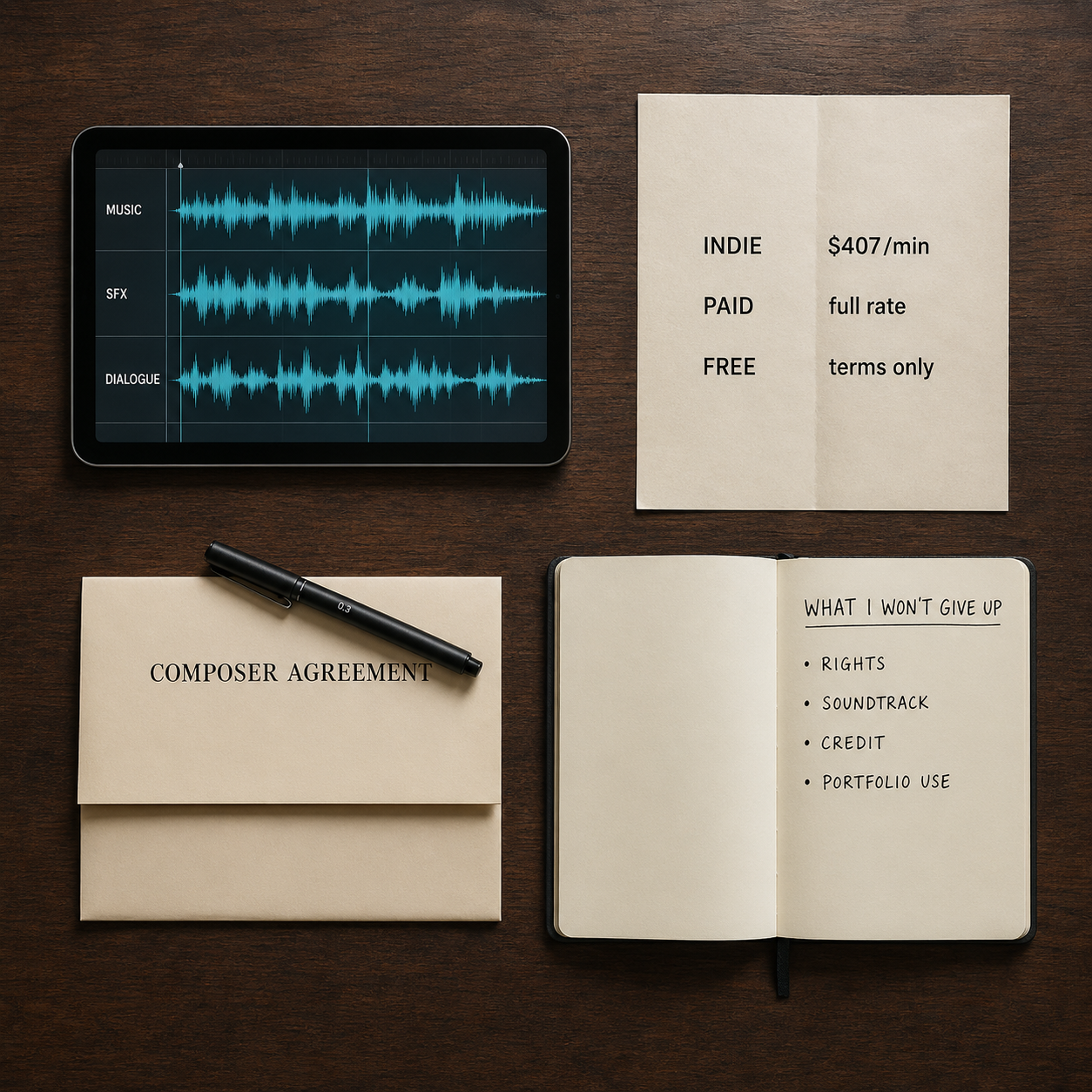
- Your current reel, shaped around the genre of the project you're being offered. A reel full of student work reads as a red flag to professional hirers, according to PowerUpAudio's Kevin Regamey. Personal side work beats school assignments.
- Your current market rate as a reality anchor. Even if the deal is free, you need to know what you're giving up. Use the 2025 GameSoundCon survey as the baseline.
- A one-page composer agreement template. We list the three non-negotiable clauses below. If you don't have one, Game Developer's contract guide is the best free starting point.
- A clear line on what you won't give up. Retained rights to your music. Soundtrack release permission. Credit language. The ability to use the work in your portfolio forever, regardless of whether the game ships.
If you can't articulate those four things before the offer arrives, the offer will push you into a bad deal before you notice.
The five-question test: is this free work or a trap?
Run any unpaid or "rev-share" offer through these five questions. If any answer is wrong, the offer is a trap regardless of how exciting the pitch sounds.
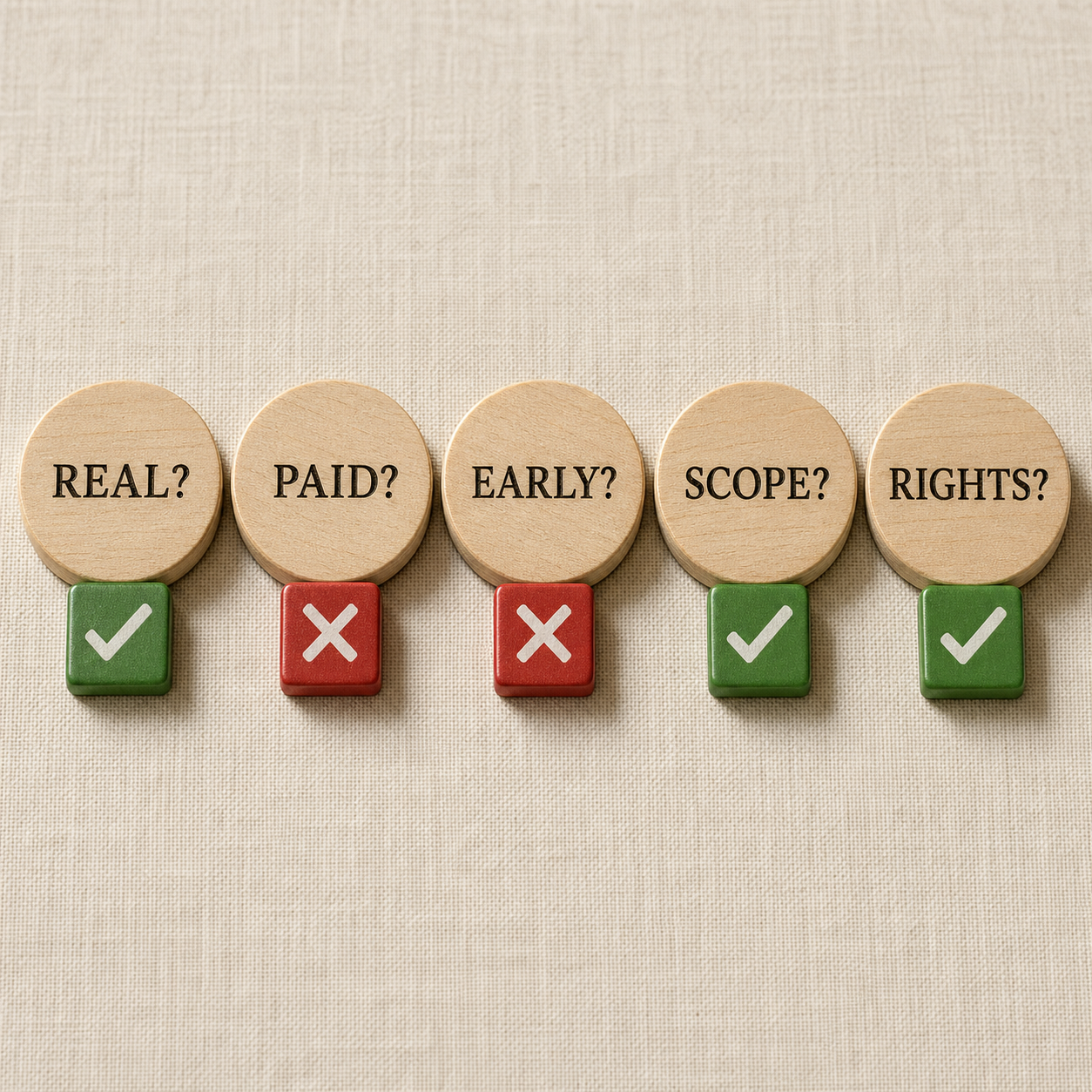
- Is the project real? A prototype, a build video, a repo with recent commits, a task board with completed work. If the only artifact is a Discord server and a Figma pitch deck, the project doesn't exist yet.
- Is anyone else getting paid? Nathan Madsen's rule is the cleanest line in the business: "If no one gets paid - work for free. If someone gets paid, everyone should get paid." If the programmer is on contract and you're not, you're the mark.
- Am I being brought in early or late? Composers brought in at week one get to shape the sound, talk to the designer about how music drives the systems, and build something they're proud of. Composers brought in at month eight are decorating someone else's already-finished cake. The late slot is almost always a trap.
- Is the scope in writing? Total minutes, number of tracks, stems, revisions, delivery format, deadline. "We'll figure it out" is how 40-track scope creep starts from a 10-track agreement.
- Are my rights retained, and is that in writing? The 2025 GameSoundCon survey reports 36% of indie composers retain music rights via licensing, up from effectively 0% at AAA. If you give up rights on an unpaid project, you've traded the single upside indie offers for nothing.
Every "yes" you can answer honestly is a point in the project's favor. Three or more clean "yes" answers, and the project is worth a longer look. Anything less and you're volunteering to be the labor that absorbs the project's risk.
When "free" is actually a career move
Free work isn't always a trap. Four specific situations turn it into legitimate career capital:
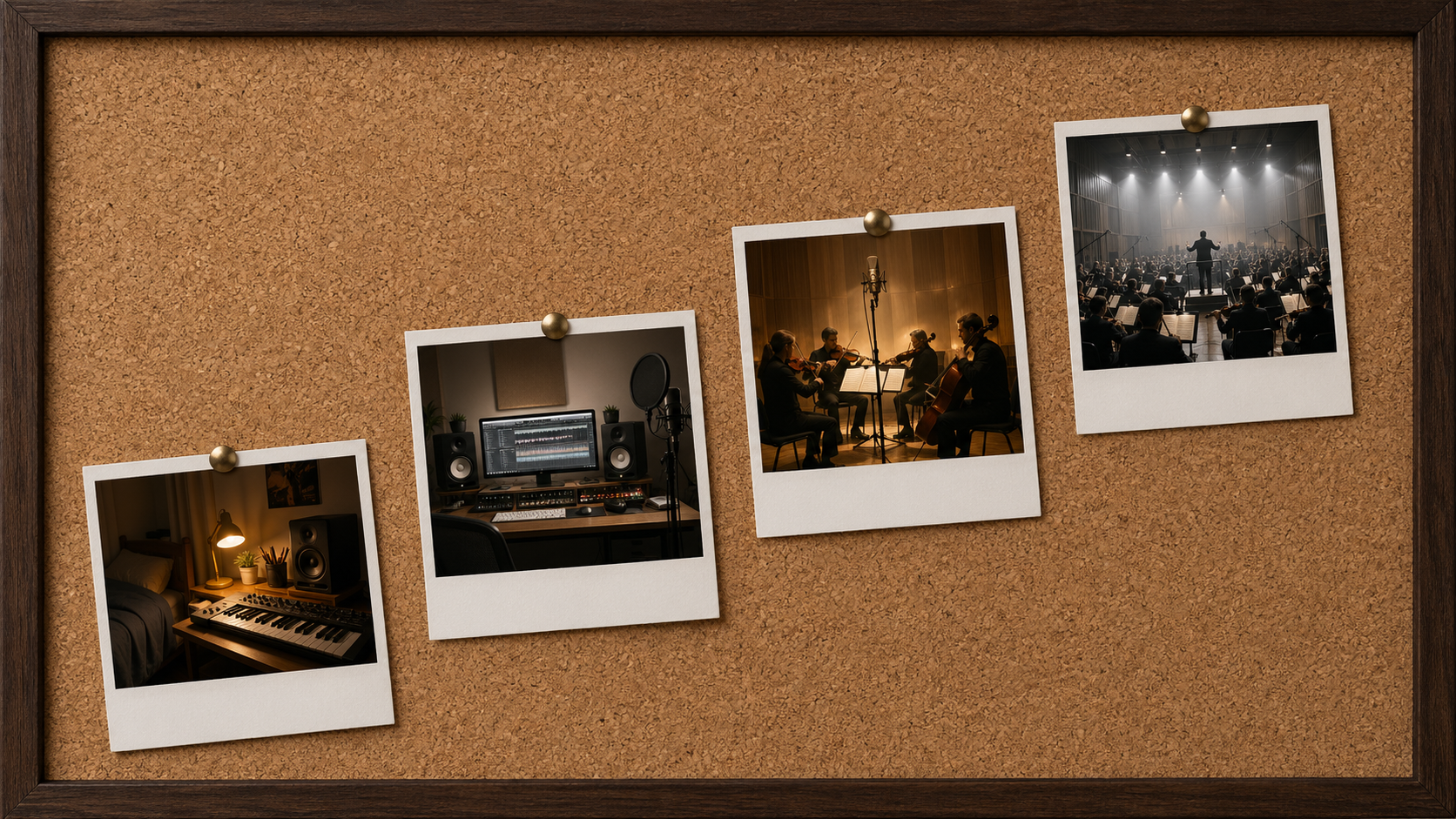
Case 1: The genre-defining portfolio piece. Akash Thakkar's first paid game credit (Tesla the Weatherman) came out of unpaid sound design at Global Game Jam 2011. "Making garbage with strangers over a weekend" turned into a real client, then a career. Game jams are one of the few free-work contexts where everyone is unpaid, the timeline is bounded to hours, and the social reciprocity is built into the format.
Case 2: The between-contracts gap, filled on your terms. Casey Edwards, who wrote for Devil May Cry 5 and Mortal Kombat 1, publicly posted on r/INAT looking for indie projects. Mid-career AAA composers often have empty weeks between studio contracts and would rather spend them on a small project they love than on nothing. They aren't working "free" in the desperate sense. They're trading money for creative freedom, retained rights, and a credit they can point to.
Case 3: The apprenticeship you chose with open eyes. Jason LaRocca interned unpaid for composer Mark Isham for six years while touring in a punk band. That unpaid studio time is what got him mixing surround for Brad Silberling at 21. This only works when (a) you're deliberately paying a tuition in the form of time, (b) you have a day job that covers rent, and (c) the mentor is actually teaching you, not just getting free labor.
Case 4: The indie game that becomes your launch pad. Austin Wintory's Journey score was the first game soundtrack nominated for a Grammy and outsold every prior game score on Billboard. Gareth Coker was hired off modbot.com to write 12-15 minutes for the Ori prototype pitched to Microsoft. Lena Raine left her full-time job to finish Celeste not knowing if indie composing was viable. Each of them took the indie slot over a safer paid job because the creative brief was specific and the collaborators were serious.
The pattern underneath all four: the composer was brought in early as a creative partner, kept their rights, and the project was either guaranteed to finish or structured so that not finishing still paid off in portfolio terms.
When "free" is a trap in disguise
These are the red flags that show up in the pitch itself, before you write a note. If you see two or more of them, the offer is a trap no matter how flattering the DM.
| Red flag in the pitch | What it actually means |
|---|---|
| "We'll pay you from sales" / "rev-share only" | The project has no budget and no validated audience. Ninichi's analysis: "If your game is not successful, they won't earn anything and will have spent quite a bit of time creating music." |
| "Fully funded when we hit our Kickstarter / find a publisher" | Conditional money is no money. 80% of Kickstarter game projects either fail to fund or fail to ship on time. Don't pre-commit labor against a future that hasn't happened. |
| No mention of scope, deadline, or revision count | You'll be asked for 45 tracks and 12 revision rounds each. |
| "Can you just do a test piece for us?" with no pay for the test | This is the spec-work trap. Offer a short paid demo (1-2 minutes, fixed fee) instead. |
| "We're a close-knit community of passionate devs" | Community language replaces contract language. That's the tell. |
| No credited team members you can verify | Nobody on the team has a shipped credit or a public footprint. You'll be the most experienced person on the project and still unpaid. |
| Vague or changing timeline | "We're aiming to ship by end of year, or maybe next summer, or when it's ready." Timeline dysphoria predicts ghost projects. |
| You're being brought in after art is locked | Music written to fit already-finished visuals has no creative pull and rarely becomes a track you're proud of. |
The Ludomusicology essay puts it sharply: "Why would they trust this person who posted on a forum offering to work for free? Is this the way a professional composer would act?" Offering free music as a lead magnet trains the market to see you as cheap, not generous.
The three things to get in writing before you write a note
Any unpaid or low-fee indie deal needs these three clauses in a signed one-pager. If the dev refuses to put them in writing, that's your answer.
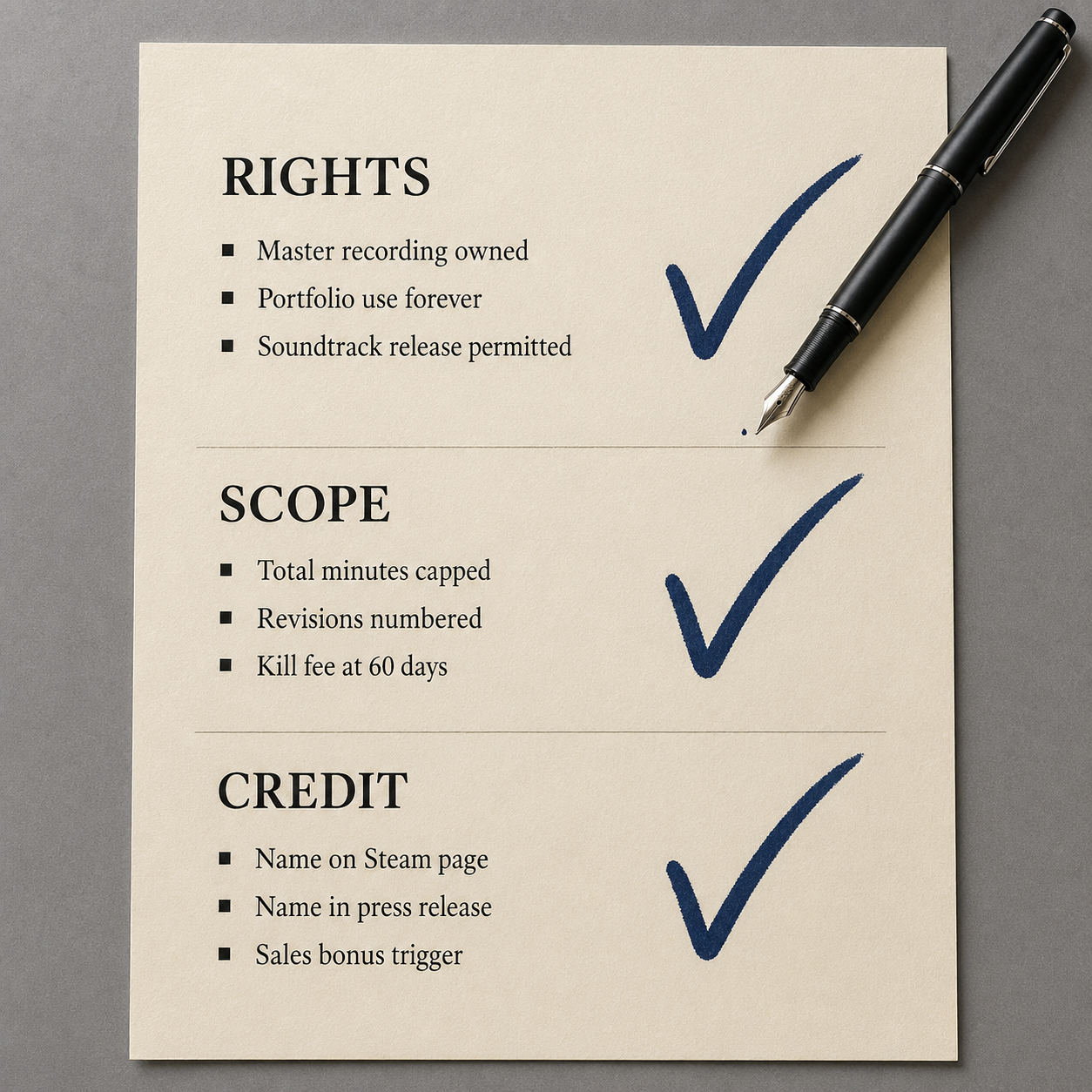
- Retained rights and portfolio use. You own the master recording. You can use the music on your reel, on your streaming profiles, and on a soundtrack release, regardless of whether the game ships. The dev gets a perpetual non-exclusive license for use in the game. This is the single non-negotiable clause. GameSoundCon 2025 data shows 44% of indie composers are eligible for soundtrack revenue - you can only get there if you keep your rights in writing from day one.
- Scope, revisions, and kill fee. Total minutes of music. Number of tracks. Number of revision rounds per track. Delivery format (stems, mix, mastering). Kill fee if the project is cancelled or paused more than 60 days. Game Developer's contract guide has the clause language. Without these, scope creep will consume 3x the hours you quoted.
- Credit and upside. Your name as Composer in the end credits, on the Steam page, and in any press release. A sales bonus trigger (e.g., 1% of net sales after first 10,000 copies). A rate guarantee if ports or sequels reuse your music. These are almost always negotiable because the dev assumes you won't ask.
A lawyer isn't required. A shared Google Doc both parties comment on, then PDF and e-sign, is enforceable in most jurisdictions for a deal this size. What matters is that it exists.
How to negotiate "free with terms"
If a project passes the five-question test but has no budget, you don't have to pick between "free" and "walk away." Four trade-in moves let you keep your rights and your leverage while saying yes:
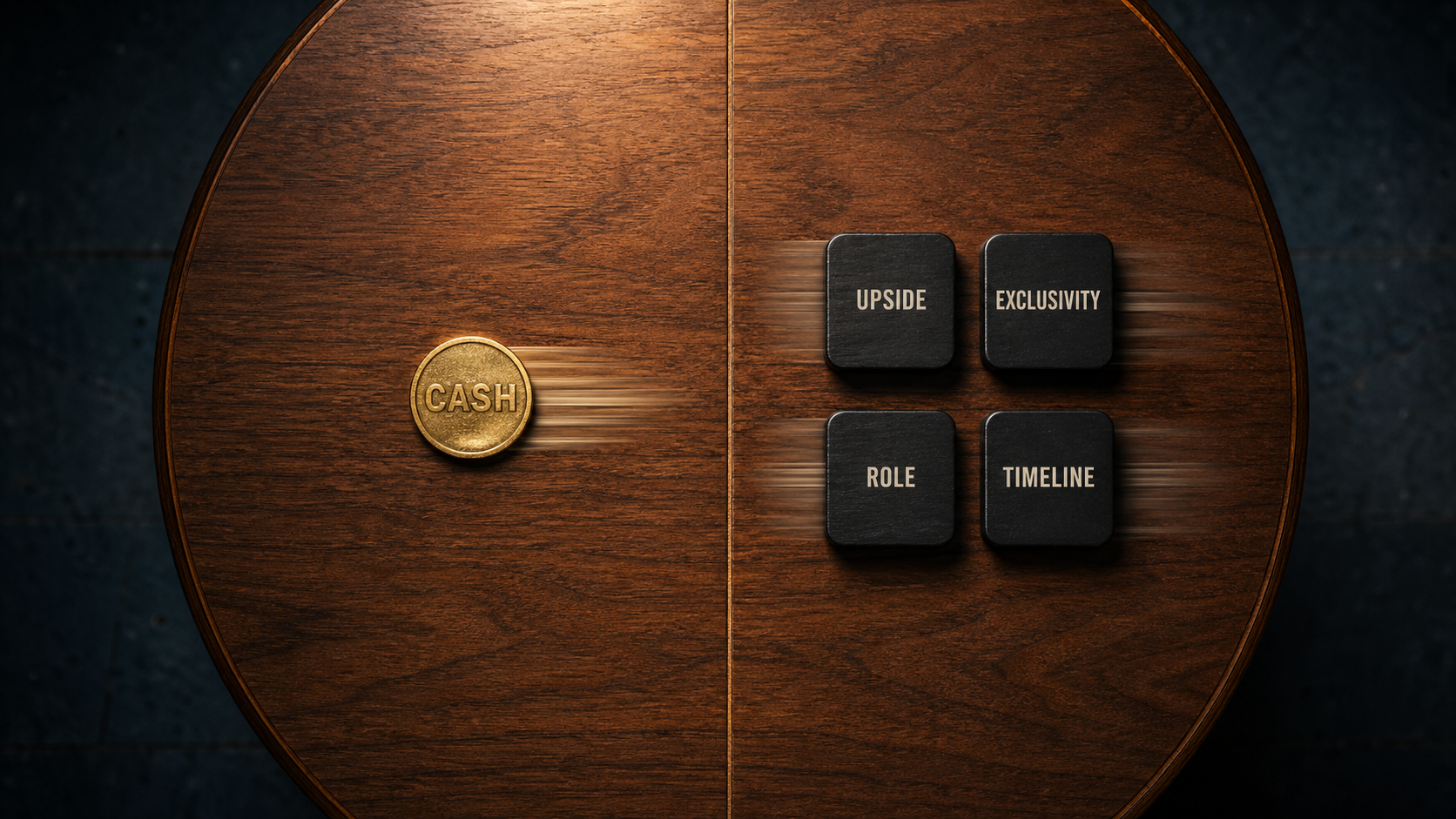
- Trade cash for upside. Waive the upfront fee in exchange for a larger share of net revenue (5% instead of the default 2%), a sales bonus trigger, and a port/sequel rate guarantee.
- Trade cash for exclusivity. You're free, but the dev commits to not adding another composer, not licensing additional stock music, and crediting you as sole composer. Disasterpeace did exactly this on Fez, pitching himself as sole composer to give the score conceptual focus.
- Trade cash for timeline. Reduced scope and a short deadline (4-8 weeks) in exchange for zero fee. Open-ended "work on it as we build the game" is how two-year ghost credits happen.
- Trade cash for role. You're free, but you're billed as Music Director or Audio Lead, you're in the design meetings, and your feedback on game flow is welcome. This one is the closest to the AAA-composer move: you're being brought in as a creative partner, not a vendor.
Notice what doesn't change: you still keep your rights, you still get scope in writing, you still get a kill fee. The fee is the only variable, and it's a variable in exchange for something.
The graduation plan: turning free into paid inside one project
Free at the start doesn't have to mean free forever. Build a milestone ladder into the written agreement so the project converts to paid as it proves itself:
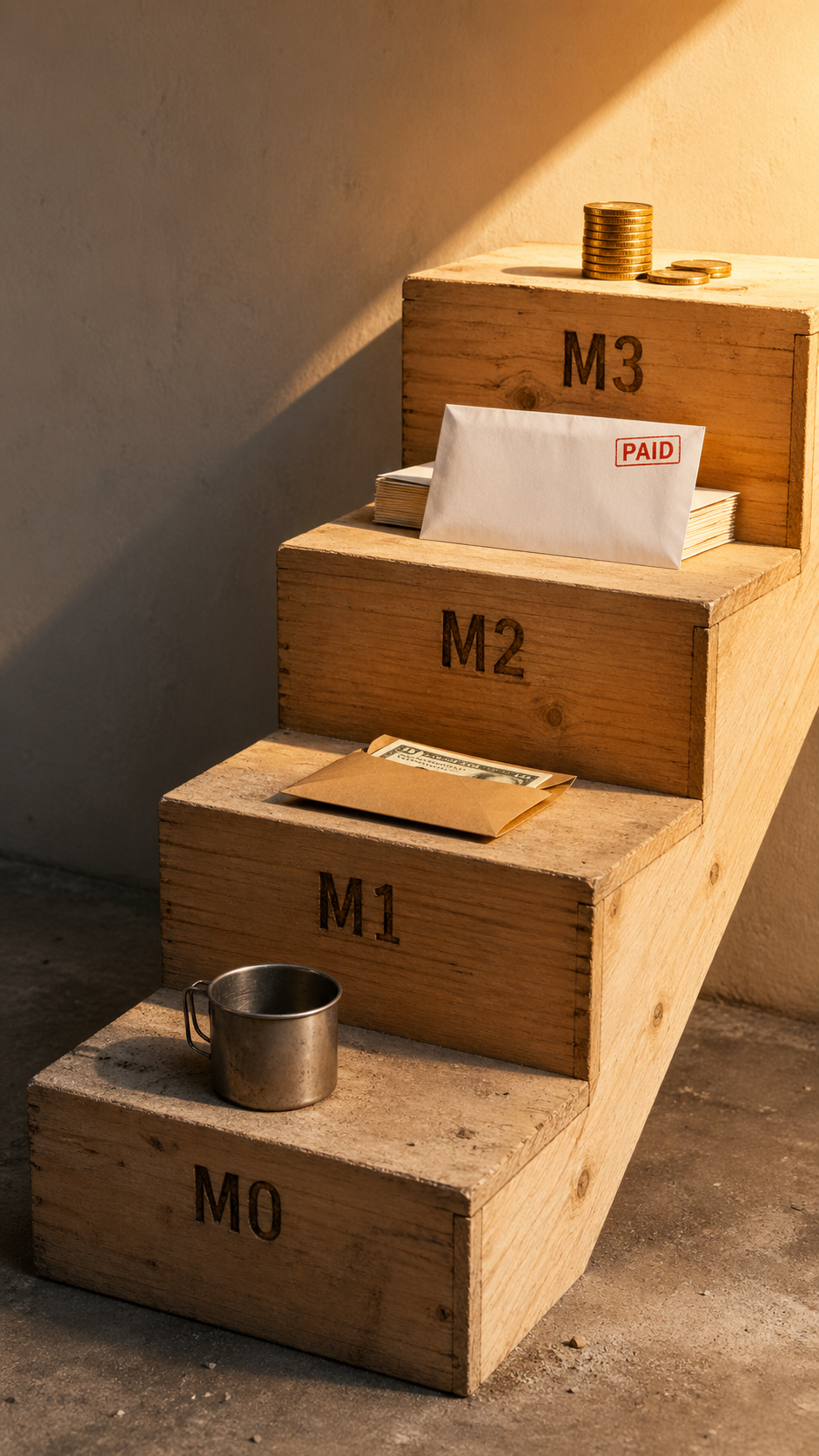
- Milestone 0 (free): Vertical-slice demo. 1-2 tracks, 3-5 minutes. The dev uses this to pitch publishers, run a Kickstarter, or validate on a Steam Next Fest demo.
- Milestone 1 (paid at half rate): Triggered when the project secures external funding, closes a publisher deal, or hits a Kickstarter target. Rate moves to 50% of your normal per-minute fee for all prior and future work.
- Milestone 2 (paid at full rate): Triggered by a confirmed release date and a funded audio budget. Full per-minute rate applies retroactively and forward. You're back-paid for Milestone 0 work.
- Milestone 3 (bonus + royalty): Triggered by commercial release. Sales bonus at 10,000 and 50,000 units. Perpetual royalty on soundtrack streams.
Written this way, you aren't working for free. You're working at a rate that scales with the project's ability to pay. The dev gets a composer who's invested. You get a legitimate path from portfolio piece to paid credit without leaving the project.
Common pitfalls
The foot-in-the-door fallacy. Ted Wennerström's hard-won take: "It took me almost four years before the jobs started to come more easily." One free project rarely opens the door. A portfolio of five shipped free projects sometimes does. If you go down this path, pre-commit to a budget of hours per year, not projects.
The low-priority slippage. From the Ninichi analysis: "You and your game will most likely not be top priority compared to a composer's paid work." The flip side is true for you too - the unpaid project will always lose to the paid one, and the dev will read your lateness as ghosting. Set explicit weekly hours in the agreement.
The rev-share flake. Ninichi again: "I've heard of composers disappearing half way through because they get bored, lose interest/belief in the project." This is the reputation you inherit if you take unpaid work and don't finish. Kill fee clauses protect both sides from the silent slow fade.
The friends-are-not-partners mismatch. "Unless they're your friends, it's not quite the same as you since it's not really their game - it's yours." Friends make this worse, not better. You owe friends more professional clarity, not less. Write the agreement first, work together second.
FAQ
Should a game composer ever work for free? Yes, in four specific situations: game jams where everyone is unpaid, between-contract gaps for mid-career composers, deliberate apprenticeships with a named mentor, and indie projects where you're brought in early with retained rights and a written agreement. Anywhere else, "free" is a trap.
How much does an indie game composer make? According to the 2025 GameSoundCon survey, the median per-minute indie composition rate is $407 and median annual indie composer income is $8,500. The spread is wide. A Grammy-credited composer and a first-year freelancer are both in that survey.
Is revenue share a good deal for indie composers? Usually no. Most indie games sell fewer than 1,000 copies. 2% of $15,000 gross is $300, against 40-80 hours of work. Revenue share makes sense only with a sales bonus trigger, a higher percentage than industry default (5%+, not 2%), and retained rights.
What should a composer agreement include for a free indie project? Retained rights and portfolio use, scope + revisions + kill fee, and credit + upside (sales bonus, port/sequel rate). A one-page Google Doc signed by both parties is enough. Game Developer's contract guide has boilerplate language.
How do I reach indie devs as a composer? Post your reel where indie devs already hang out (r/gamedev, r/INAT, itch.io, VI-Control threads), reach out before the dev is looking - AAA composers like Casey Edwards already figured out the team's composer is usually chosen before the project is publicly hiring. Pick projects and DM the team with specific notes about why their project resonates.
What to do next
The fix to "work for free or walk away" isn't a better rate list. It's finding indie teams that treat composers as creative partners from day one, with written agreements, retained rights, and a milestone ladder that converts to paid as the project earns it.
That's the platform we're building. Clowdr pairs composers with indie projects where scope is written down, rights are retained, and contributors commit to ship. No "exposure," no endless DMs, no week-three ghosting. Sign up here to be matched with projects where "free" is a temporary phase in a real partnership, not an extraction.
Related reading:
- Why AAA Composers Are Quietly Looking for Indie Projects - how to reach composers before they are already taken.
- How to Spot Rev-Share Red Flags Before You Join an Indie Game Project - the seven-step checklist for vetting indie offers.
- Your Game Art Portfolio Is a Graveyard. Here's How to Fix It. - the sibling piece for visual artists facing the same traps.
- How to Find Reliable Teammates for Your Indie Game - the cross-role version of this problem.