
Why AAA Composers Are Quietly Looking for Indie Projects (And How to Reach Them Before They Take a Job)
How to hire a composer for your indie game: why AAA composers quietly take indie work between studio contracts, and how to reach them early.
Why AAA composers are quietly taking indie work, and how to reach them before the answer is already no.
Composer allocation doesn't happen when you start looking. It happened months ago, quietly, through taste and trust. A Devil May Cry composer was openly searching for indie projects on r/INAT last year. Most of you scrolled past him.
A Devil May Cry composer posted on r/INAT. Most of you scrolled past it.
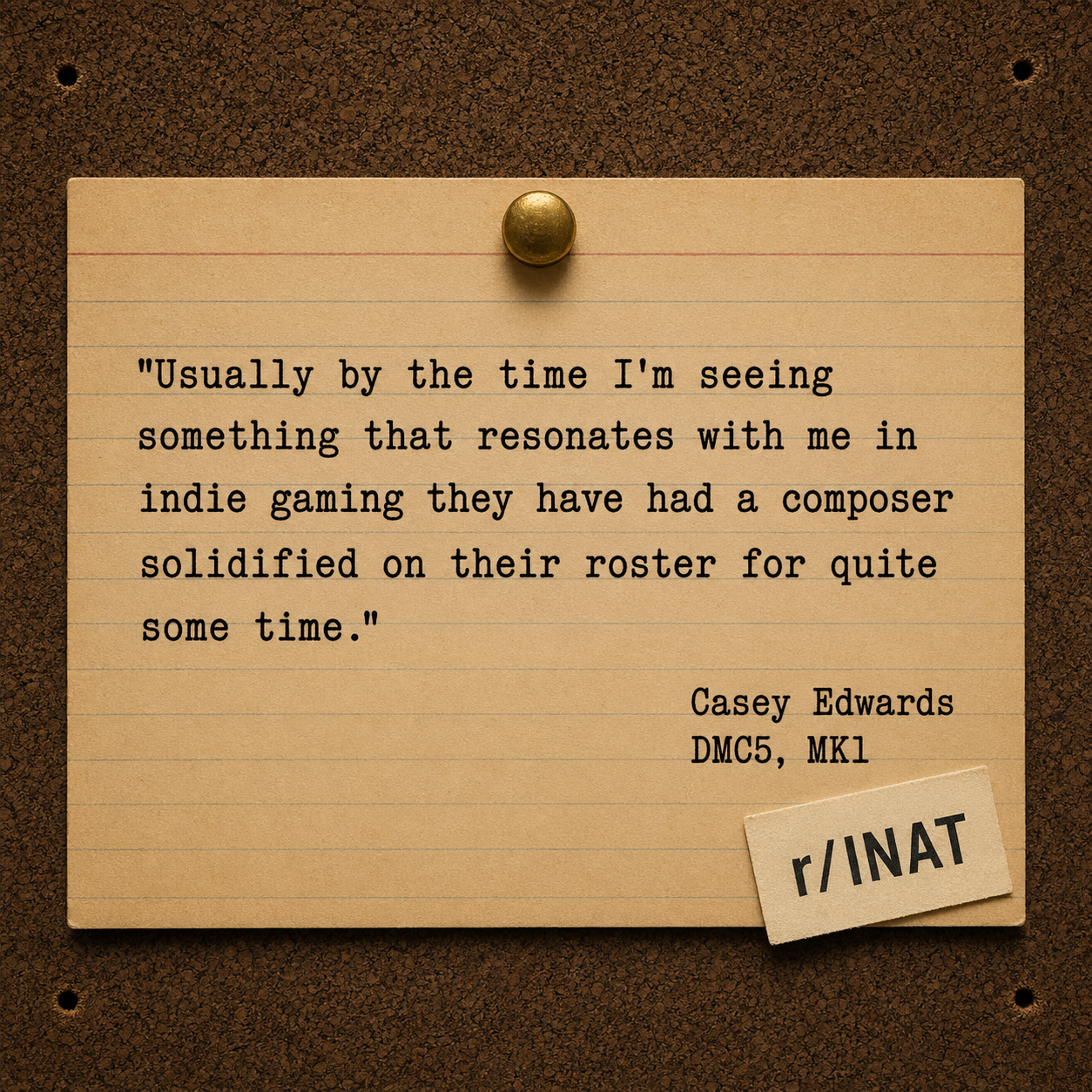
Casey Edwards, who wrote music for Devil May Cry 5 and Mortal Kombat 1, posted on r/INAT looking for indie projects. His own words:
"Usually by the time I'm seeing something that resonates with me in indie gaming they have had a composer solidified on their roster for quite some time."
Read that again. A composer who has worked on two of the loudest, most celebrated AAA soundtracks of the last decade is publicly telling indie devs he wants in. By the time he notices their project, someone else is already counting on it.
Nobody treated this post as news. No think pieces. No viral repost. No thread of indie devs going "holy shit, Casey Edwards is available." It sat there, like a hundred other r/INAT posts, visible to anyone who bothered to read it.
The part most devs miss is that the AAA composers they assume are unreachable are watching for indie projects worth saying yes to right now. They are not hiding. You were looking in the wrong frame.
As one audio industry page puts it, composers "often look to fill gaps between better-paying contract work with indie studio deals." That is the supply side of a conversation most indie devs never see from the composer's side.
The AAA-composer career path runs through indie, not the other way around.
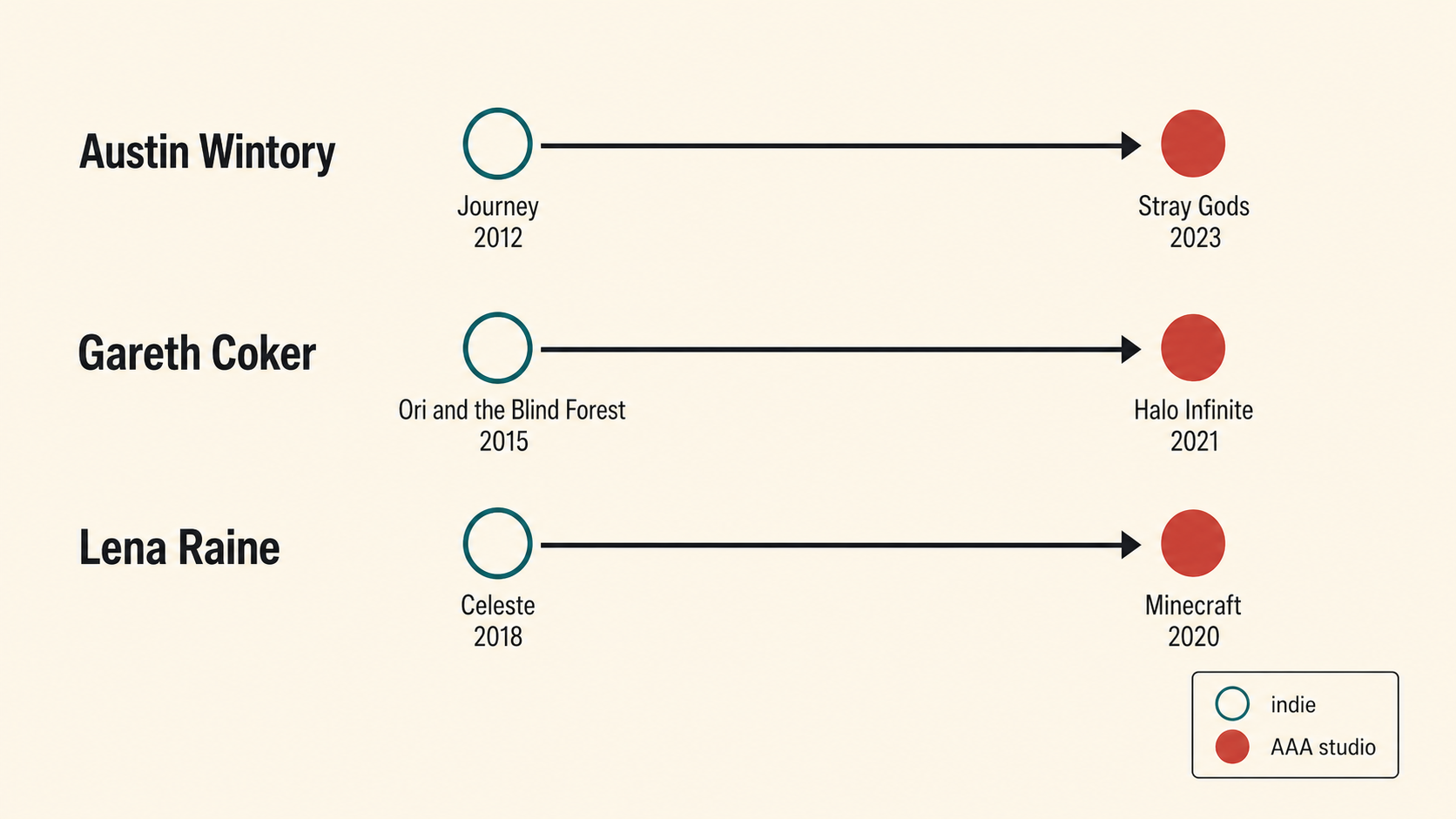
Almost none of the AAA composers you can name started there.
Austin Wintory's breakthrough was Journey at thatgamecompany, a small independent team making a strange, quiet game. He got an Oscar-nominated soundtrack out of it. Today he writes for major projects, including Stray Gods, and he still talks publicly about taking indie work on purpose.
Gareth Coker scored ARK: Survival Evolved and Halo Infinite. His name is on some of the largest titles in the industry. The game that put him on that path, according to his own interviews, was Ori and the Blind Forest, made by a tiny studio that almost did not make it. Without Ori, no Halo.
Lena Raine wrote the Celeste soundtrack. Mojang hired her for Minecraft, eventually, but the route there was not her Celeste credit. According to her own account, Mojang staff heard her personal Bandcamp album first. They knew her taste before they knew her resume.
The pattern is so common it is almost funny: indie credits are not a consolation prize. They are the launch pad. Once a composer is mid-career, they stay emotionally connected to indie because that is where the work they are proudest of got made. That is where they retained their rights, shaped a sound from scratch, and got a credit they can point their kids to in twenty years.
If you think the AAA composers you want are above indie work, you have the direction of travel backwards.
What indie offers that AAA doesn't: a credit they can still call theirs.
The financial surface of this looks obvious. AAA pays more. According to the GameSoundCon 2025 Game Audio Industry Survey, AAA composers average $1,871 per finished minute of music. Indie composers average $618. That's a real gap.
But pay attention to the other two numbers in the same survey, because they explain why Casey Edwards is on r/INAT while his AAA peers clock in at studios:
- Indie composers retain rights on their work 36% of the time. AAA composers retain rights 0% of the time.
- Indie composers are eligible for soundtrack revenue on 44% of their projects. AAA composers 29%.
The AAA deal is work-for-hire with more money and less ownership. Every note you write belongs to the studio. You cannot release the soundtrack. You cannot license the theme. You cannot put anything on your own record except a line in the credits.
Indie is the opposite trade. Less money, often, but you might actually own what you made. You can release the soundtrack on Bandcamp, license the theme elsewhere, and come out of three months of work with something you can still call yours ten years from now.
Austin Wintory has openly talked about taking indie projects at below his rate because the game itself was worth believing in. What he doesn't say out loud, because every working composer already knows it, is that believing in the game is also believing in the deal. A credit you get to keep is not the same as a credit you rent.
Artists go through a version of this too. Most game art never gets seen because the projects die; most of what does ship is work the artist cannot show publicly. Composers are doing the same calculation, one week at a time.
The hiring already happened. You just didn't see it.
Akash Thakkar is one of the most visible game audio professionals on YouTube. He said this in a career talk about studio hiring, and it applies almost word-for-word to composer hiring too:
"Anytime that anyone gets any sort of permission to hire anyone, they've been wanting to hire someone for that position for months if not years."
He was talking about AAA studio jobs. The same dynamic runs the other way, from the composer's side. Composers who are any good have a running mental list of projects they would say yes to. They have been watching devs on Twitter, on Bluesky, on itch.io, for months. They know whose demos feel alive. They know whose postmortems sound honest. They know whose games might actually ship.
By the time you post "looking for a composer" on Reddit, the composers you want have already decided which projects to watch. You are not sending a cold DM. You are submitting a late application to a list that has been quietly forming since before your vertical slice existed.
This is why shouting into r/INAT rarely works. It is not because r/INAT is full of flakes, although we have written about that problem too. It is because the good composers made their shortlist before you posted. The ones left watching the new-posts feed at 2am are, on average, not the Wintory tier.
If the composer you want is making decisions months before your call, you need to exist in their field of view months before your call.
Why composers ghost your cold DM (and what they're actually screening for).
When a composer opens your cold email, they are not reading for your budget. They are reading for signal. Three signals, roughly, in this order.
Is this going to ship? Winifred Phillips, who has scored more than a dozen published games, put it plainly in an AMA: "When we're brought in before the levels are finished, our music might actually have a big impact on the design of those levels." Composers who have been around a while know that being brought in early is the single clearest signal the project is real. An indie dev who wants music before the levels exist is an indie dev who is planning for a shipped game, not a demo.
Is there a creative brief, or just a budget? Austin Wintory again:
"For me it's always about proactively just engaging with people and saying how can I be a solution to the problem that you don't know you have and just be partners in it."
Composers want to solve a creative problem. If your email is a price request with no reference tracks, no emotional beats, no sense of what the game sounds like in your head, they assume you do not know what you want yet. They don't say no. They say "got it, I'll get back to you," and then don't.
Are you going to credit the work, or bury it? Grant Kirkhope, who scored GoldenEye 007 and Banjo-Kazooie, said this in a VGC roundtable about indie hiring:
"I just don't think some companies take game soundtracks very seriously, and it's a bit of a pain in the ass because it's like, you've done the work, the least you can do is credit me."
Screen three is the one indies fail the most. A composer reading your email is scanning for whether you will credit them visibly, let them release the soundtrack, or keep the work buried under an NDA that ends only when the project does.
Your cold DM does not ghost you because the composer is snobbish. It ghosts you because it failed one of these three screens, and you never knew they were running.
The obvious counterargument: "AAA composers are still out of my budget."
Honest steelman first. The GameSoundCon data says AAA composers charge roughly three times indie rates per minute. If you have a thousand dollars, you are not hiring Casey Edwards for a full soundtrack. That is real. Any piece that pretends otherwise is lying to you.
But here is the flip. Reach is not the same as rate.
A composer will sometimes take an indie project at below their usual rate if the project gives them something the rate cannot: creative freedom, a credit they own, a piece they can put on a record, a collaborator they enjoy. They will never take that deal with someone who leads with "we can't pay you much, but think of the exposure." That word is the fastest way to get blocked in game audio. It shows up right alongside the rev-share red flags that composers and artists learn to pattern-match inside a sentence.
The cheapest word in a composer's inbox is the word "exposure." The most expensive is "creative partner." One signals you are about to waste their time. The other signals you see them as a person with taste, and that their three months on your game might become a thing they are proud of.
Lead with the second framing, bring them in early, and rates stop being the conversation. The conversation becomes whether the project is a fit. A thousand dollars, a retained-rights clause, a soundtrack release, and a serious creative brief can land a composer whose public rate is five thousand. Without those, five thousand will not land them either.
How to reach them before the answer is already no.
If composer allocation happens months before the dev thinks it does, your job starts months before. Four moves, in order.
-
Reach out before the vertical slice, not after. Do it when you have an emotional-beats doc and a prototype, not when you have finished levels. Early contact says the game is real and they can shape it. Late contact says you want someone to score cutscenes you already locked.
-
Lead with a reference track you actually love, and one sentence on why it is wrong for your game. That one sentence is the most important sentence in the email. It shows you have taste, you have listened, and you know the difference between "I like this" and "this fits my game." Composers screen hard for taste, because taste is what makes the collaboration fun.
-
Put retained rights and soundtrack revenue in writing before the first note is written. Not at contract time. In the first substantive email. You do not have to offer a full backend. You have to signal that you treat the composer as an owner of their work, not a vendor of stems. This single move changes the shape of the conversation.
-
Treat the first conversation as a creative partnership, not a quote request. Ask what they would want to make, not what they would charge. Ask which composers they admire. Ask how they have worked in the past and what failed. You are not assembling a team of vendors. You are finding one person whose taste and your taste line up for the next year of your life. That is the same discipline you would use for any reliable teammate.
These four moves cost nothing and take about an hour of extra thought before you hit send. They are the difference between a cold application and a shortlisted candidate.
What this means for you.
The composer you want is already out there, scanning indie projects for one worth saying yes to. You do not have to convince them that indie work is worth their time. Wintory, Coker, Raine, Edwards, and most of their mid-career peers have already decided it is.
Your job is not to convince them. Your job is to not already be a no. Exist in their field of view before the week you need music. Send a first email that signals you know what a composer does. Put rights on the table before they have to ask. Treat the first three months as the part of the project that will decide everything, because it usually does.
For a lot of indie devs, this is the part where solo-vs-team turns into a question with a more obvious third answer. Not solo, where the composer is a vendor you chase at the end. Not a traditional studio, where the composer signs away every note. Something in between, where the person writing your soundtrack is a creative partner you brought in early, on retained rights, with a track record you built together.
That is the shape of team Clowdr exists to make ordinary. A dev, an artist, and a composer who start counting on each other before the vertical slice, with structure that keeps each of them owning what they make.
If you want the composer you are imagining to say yes to your next game, start that conversation now, not when the project is almost done. Sign up for Clowdr and build the team with the composer already in the room.