
How to Find Reliable Teammates for Your Indie Game Project
How to find teammates for indie game projects who follow through. Three sources, two vetting rituals, and the accountability call that keeps teams shipping.
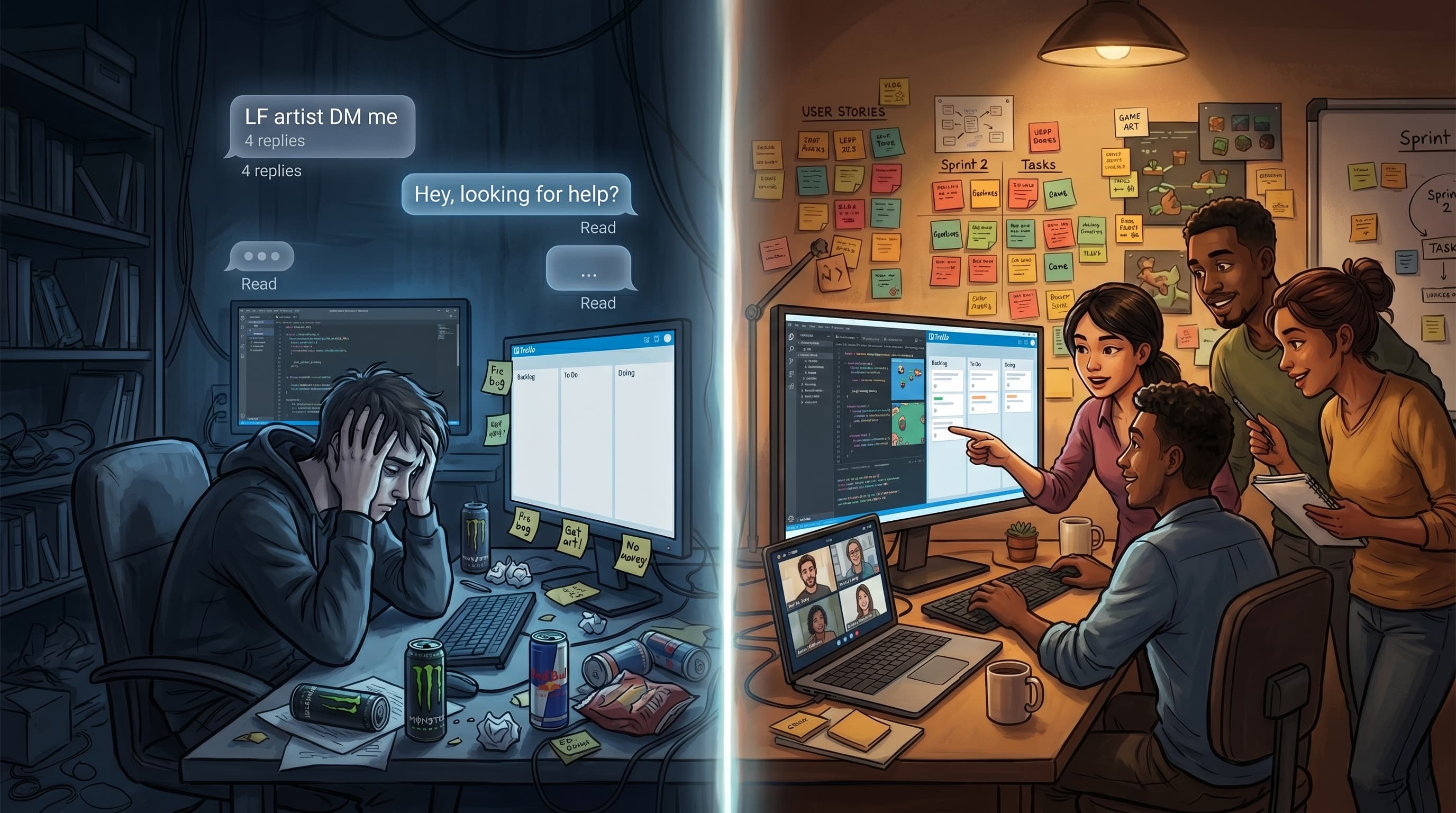
"LF artist, DM me." Posted at 2am. By week 2 you're left on read. By month 2 your project is back to being a one man army: you, your Trello board, and a prototype starting to feel like a guilt trip.
The fix is not more discipline. Solo work is structurally invisible. Nobody notices if you skip a week. Reliable teammates are the structure that replaces nobody noticing.
Short version: reliable indie game teammates come from game jams, regular spaces you've been contributing to for months, and disciplined people already in your life. "LF artist DM me" posts fail because they select for enthusiasm instead of follow-through. Vet with a one-week paired prototype, then run a weekly accountability call. The rest of this post is why that works.
Who this is for
Solo or near-solo indie devs with a real project underway who've posted in a Discord or two and watched the replies go dead. Not for: salaried studio hiring or pure hobbyists with zero intent to ship.
Why you can't find reliable teammates (it's structural, not personal)
The channels you're using select for the exact trait you're trying to filter out. A "Looking for artist, DM me" post on r/INAT is a net cast for anyone who was online and enthusiastic the moment they saw it. The people who actually finish things are head-down on their own game.
A veteran indie put it this way: "If you don't work on your game today nobody knows, you don't work on your game for the next month nobody knows, nobody notices." Without someone waiting on your next commit, the gravitational pull toward "maybe tomorrow" is infinite.
This is also why most indie games die in the idea phase. Real life happened. Real life always happens. You need teammates whose presence makes skipping a week cost something.
You're not lazy. You're unsupported.
The three mistakes that poison your search before it starts
Mistake 1: Teaming up with someone you just met
The same veteran indie: "First thing you shouldn't do is just join a team with someone you just met ever. I've done that multiple times and it almost always turns out bad."
Venture capitalists auto-pass on cofounders who just met. Same logic applies: you cannot know how someone handles stress, disagreement, or missed deadlines from a single conversation. Someone's enthusiasm tells you about their mood today. Nothing more.
Mistake 2: Recruiting at the idea stage
The second most common pattern in every dead Discord project: "I have an idea for an open-world survival crafting deckbuilder. Looking for programmer, artist, composer. Profit split when we ship." Nobody joins an idea.
As one indie dev put it: "A lot of people they start trying to recruit teammates at the idea of things — in reality people that would be joining that team, they're just looking at you like, what, this guy only has an idea." Build a week of prototype first. Show the real thing. Good teammates walk toward something working, not toward a pitch.
Mistake 3: Skipping the role conversation
You and another person get excited, start trading voice notes, and suddenly you're "making a game together" without anyone saying out loud who's doing what or by when.
One sentence in writing prevents most of the resentment that kills small indie teams: "you're doing combat and enemy AI, I'm doing tiles and saves, we're aiming for a vertical slice by April 30th." The rest is ego.
Where reliable teammates actually come from
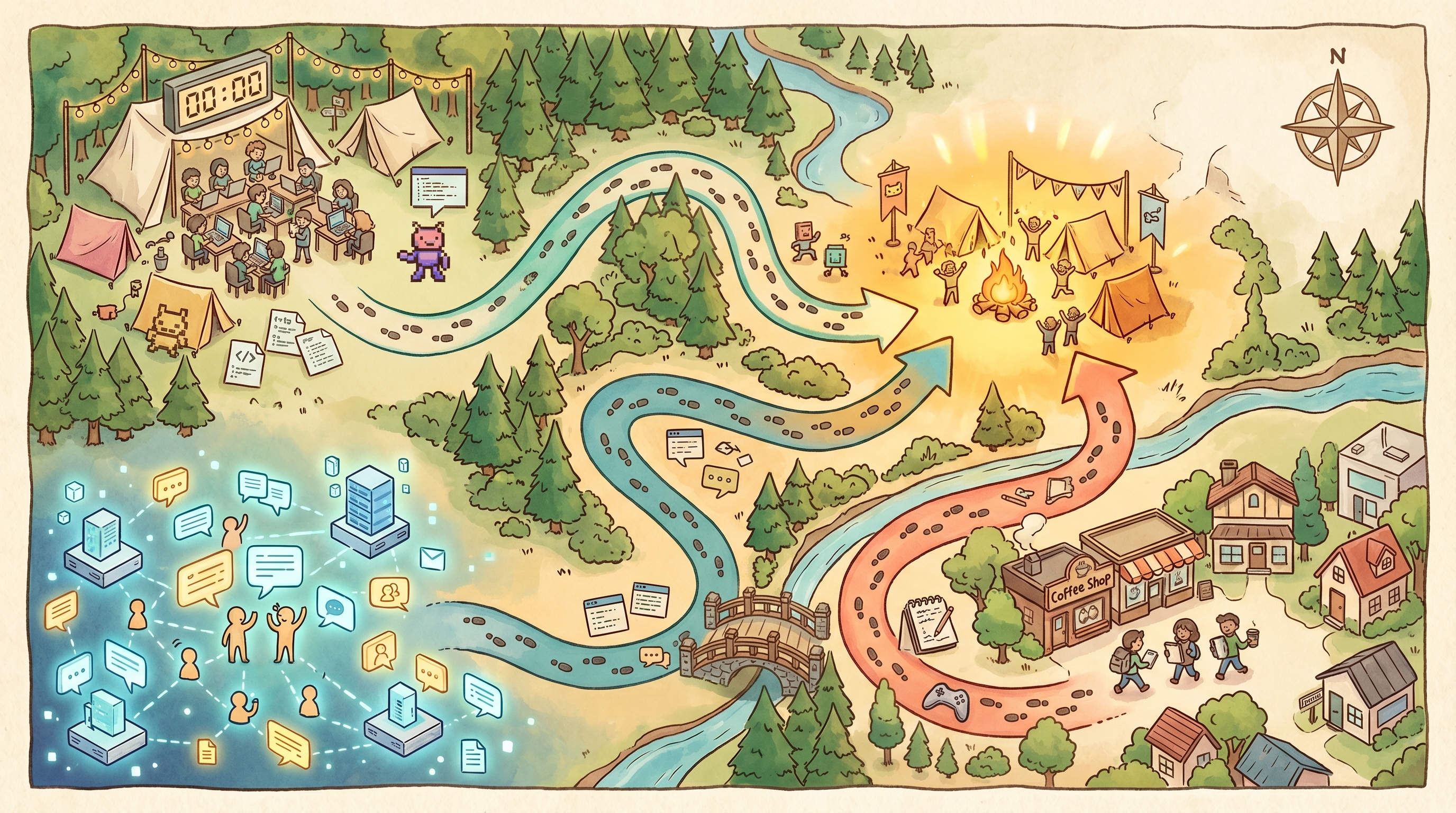
Three sources, in order of trust-per-hour-spent.
1. Game jams
A game jam lets you watch someone go through the whole cycle of making a game in 48 to 72 hours. You see how they brainstorm, handle pressure, and whether they ship. One weekend compresses an entire season of teammate behavior.
According to a systematic literature review published in ScienceDirect, indie devs attend jams primarily to find people to work with, and well-balanced jam teams report higher satisfaction and completion rates.
Where to go: Ludum Dare (online, 48 hours, quarterly), Global Game Jam (worldwide, annual, in-person), itch.io jams (running constantly), and local jams on Meetup. Physical beats online. You learn more in one cramped room at 4am than in 40 Discord DMs.
One indie dev found a random Halloween jam on Meetup while passing through Orlando and made two more games over the following year with someone he met that weekend. You don't go to the jam looking for a co-founder. You go to make a tiny thing. The co-founder is a side effect.
2. Spaces you've been contributing to for months
Discord servers, r/gamedev, genre-specific forums. The timing matters more than the channel. Don't join and immediately start looking. Join, then contribute. Give feedback. Help someone debug a shader. Post your own progress, even when it's ugly.
Over months, you notice who ships jam entries, who gives thoughtful feedback, who's still around. Those people are your candidates.
The same indie dev: "Before I actually make it official I have to do work with them in some capacity, whether it's a project, whether it's an outsourced thing, before you actually take on the role of teammate or co-founder."
3. People already in your life
Look around before searching online. A disciplined friend who's never touched a game engine. A co-worker who finishes every side project. An accountability partner does not need to be making games. They need to show up to a weekly call and say whether they did what they said they'd do.
The two rituals that turn a handshake into a shipping partnership
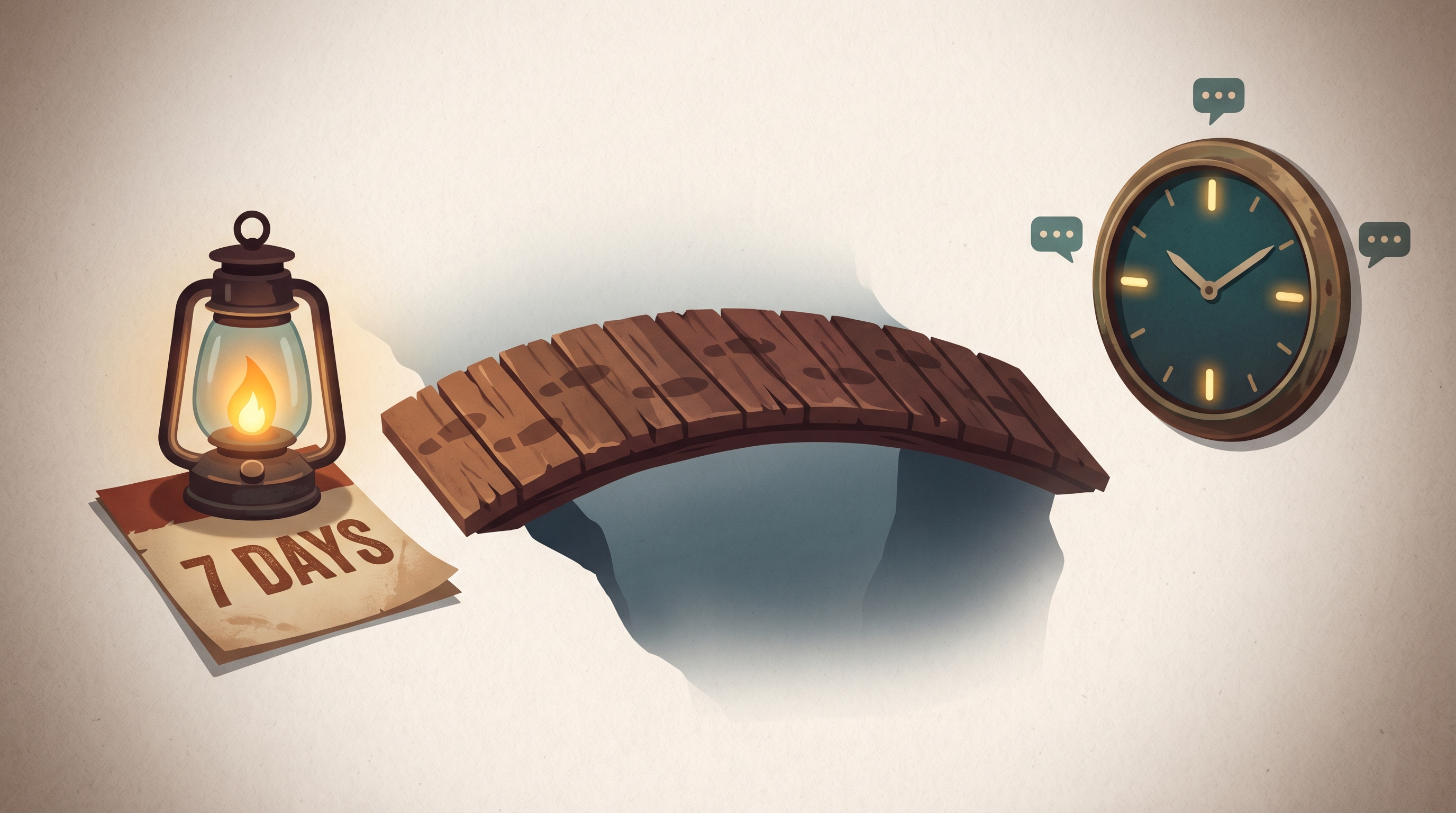
Ritual 1: The one-week trial sprint
Before you commit to a six-month game, do a one-week real thing together. Not a brainstorm. A sprint with a scope, a deliverable, and a deadline.
The prototype is a pretext. What you're testing is the working rhythm. After one week: Do they respond within a reasonable window? Did they ship what they said? Would you do it again? Yes to all three means you have something. If not, you've saved yourself six months.
According to Vincent Dumont at Tiebreaker Studio, writing in Game Developer, solo indie projects routinely balloon from three months to nine or more. Having teammates keeps the project moving when any one person is unavailable.
Ritual 2: The weekly accountability call
If the trial sprint worked, install a weekly 30-minute call. Three questions: What did I commit to last week? Did I do it? What am I committing to this week? No tools. No framework.
In the words of the same veteran: "The number one thing that I was always terrified more of than failing was letting someone else down." Most of us are more motivated by not wanting to disappoint a teammate than by any discipline we can summon at 9pm on a Wednesday. The call weaponizes that. You show up with double the work done because you don't want to say "real life happened this week."
This is also where the whole solo vs team debate quietly resolves. The variable that matters is whether anyone is counting on your work by Friday.
What a reliable teammate actually looks like
After the trial sprint and a few weekly calls, you'll see signal.
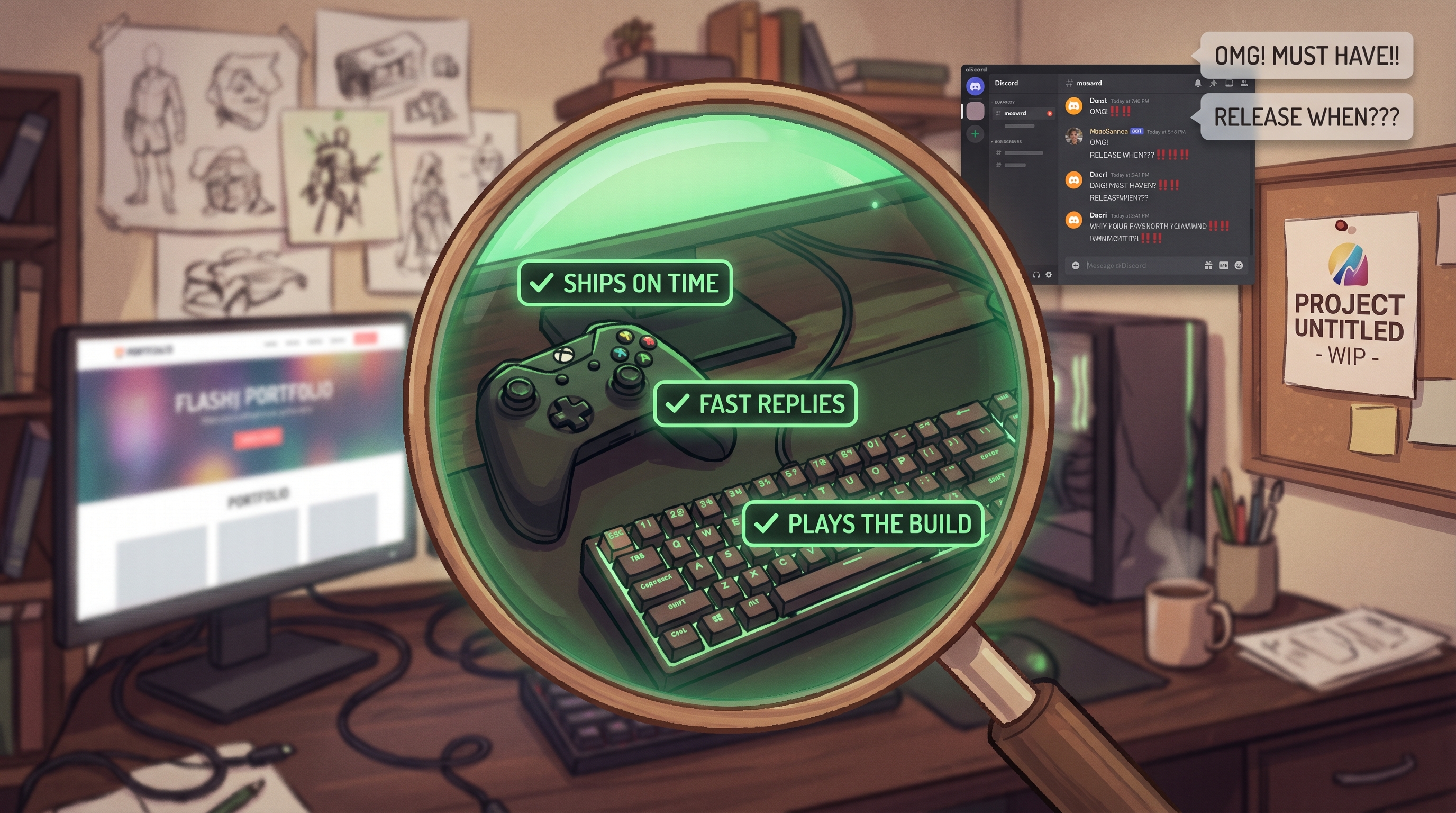
Trust shipping history over a polished portfolio. Has this person finished anything, even a tiny jam game? Trust response latency: a reliable teammate replies within a day, even if it's "I can't get to this until Thursday." Silence is the number one predictor of ghosting. And trust whole-project investment: a programmer who has never played the prototype is a contractor rather than a teammate.
Deprioritize what looks impressive but doesn't predict follow-through. A graveyard of unfinished fan projects says more about someone than their best render. Week-1 enthusiasm means nothing; week 6 is where the real data lives.
Game Developer's Alistair Doulin argues that personality compatibility matters more than raw technical skill on indie teams. The IGDA's 2023 Developer Satisfaction Survey backs this up: 28% of devs report regular crunch, 25% extended overtime. Workload that breaks people points at poorly formed teams, not at character flaws.
One indie dev put it in a sentence: "Teams are entities that win and lose as a unit. If a single person in the team can win while the rest of the teammates lose that's not really a team it's a committee."
How to try this in your project
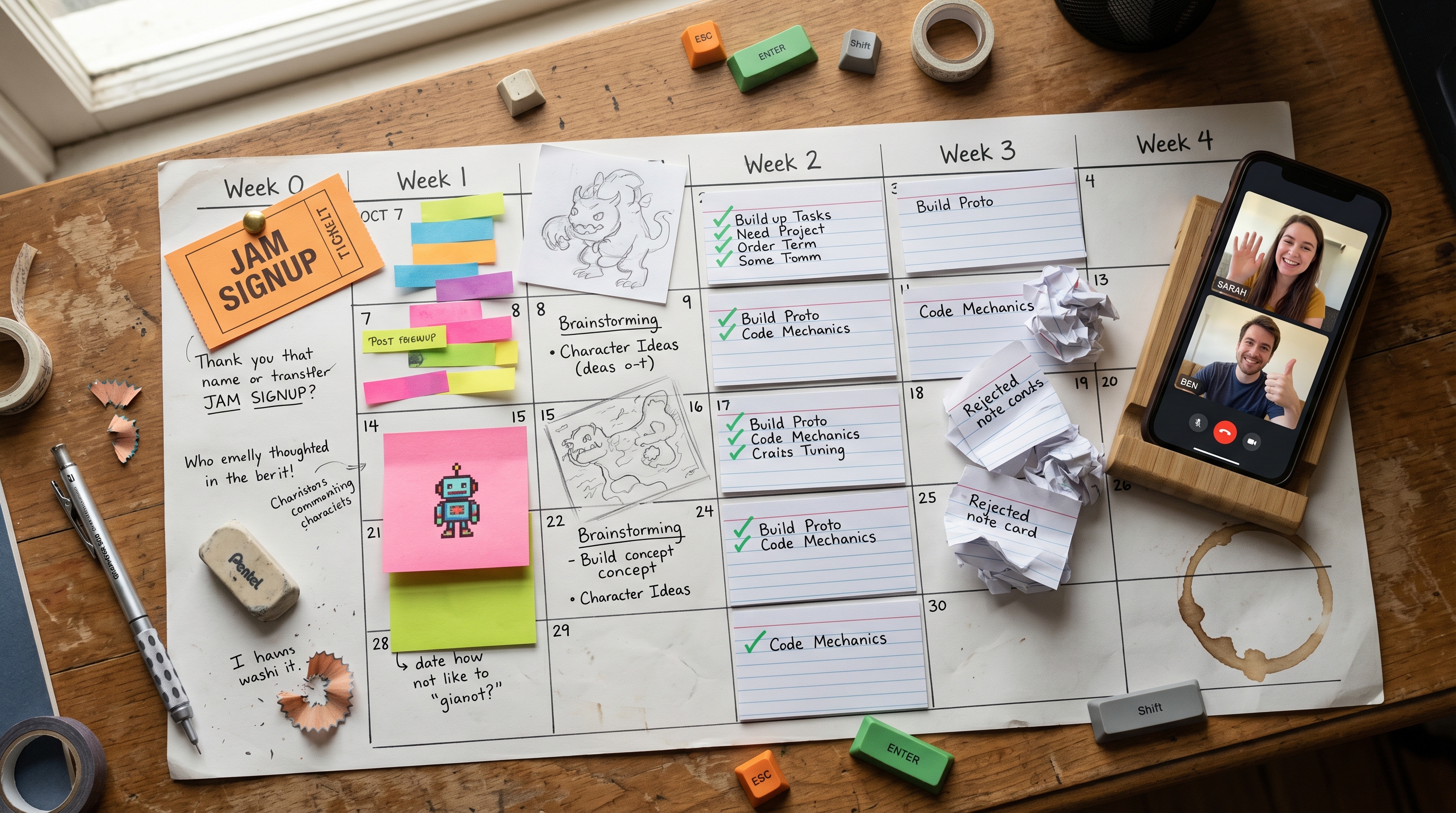
Four-week starter. Run it as-is.
Week 0 (this weekend). Find one game jam in the next 30 days. Ludum Dare, itch.io, a local Meetup jam. Sign up now, before you finish reading.
Week 1. Do the jam with one person. Finish and submit, even if it's ugly. Do a 30-minute retro after: What worked? What didn't? Would we do something tiny again?
Weeks 2-3. If the retro was good, propose a one-week trial sprint. Ship it by Sunday.
Week 4. If the sprint worked, install the weekly accountability call. Same day, same time, every week. The ritual only works if it's unconditional.
After two successful small things together, you've earned the right to commit to something multi-month. Not before.
If this sounds like a lot of work to do alone, it is. That's the point of what we're building at Clowdr. The jams are on a calendar, the trial sprints have scaffolding, the accountability call has a room waiting for you. Join the Clowdr waitlist and get matched with teammates who are counting on your work by Friday.
For the wider argument on why finishing is structural, read the complete guide to finishing your indie game.
Frequently asked questions
Where can you find teammates for an indie game?
Three places, in order of signal: game jams (48 to 72 hours of actually shipping with someone), Discord servers and forums you've been actively contributing to for 6+ months, and disciplined people already in your life. Skip "LF team" posts on r/INAT. They select for enthusiasm rather than follow-through.
Are game jams good for finding indie collaborators?
Yes. Game jams are the highest-signal channel for finding indie teammates. A weekend shows you how someone handles scope cuts, stress, and shipping. Research shows well-balanced jam teams complete more projects and report higher satisfaction. Physical jams beat online ones. Team up with one person, not three.
How do you vet a potential game dev collaborator before committing?
Run a one-week trial sprint with real scope, a real deliverable, and a Sunday deadline. After one week you know: do they respond to messages, do they ship what they said they'd ship, and would you do it again? If yes to all three, install a weekly 30-minute accountability call before committing to anything bigger.
Why do "LF team" posts on r/INAT and Discord rarely work?
Because they select for people scrolling team-finding subs at 2am with nothing better to do. That's the opposite of the finishers you want. Reliable devs are head-down on their own game, not refreshing r/INAT. You can't filter for reliability from a single post. You need time, not text.