
Discord Server vs. Game Dev Team: Why One Ships and One Doesn't
Game dev Discord vs team: a chat room isn't a dev team. Three things Discord can't enforce, and the migration path when you need to ship, not chat.
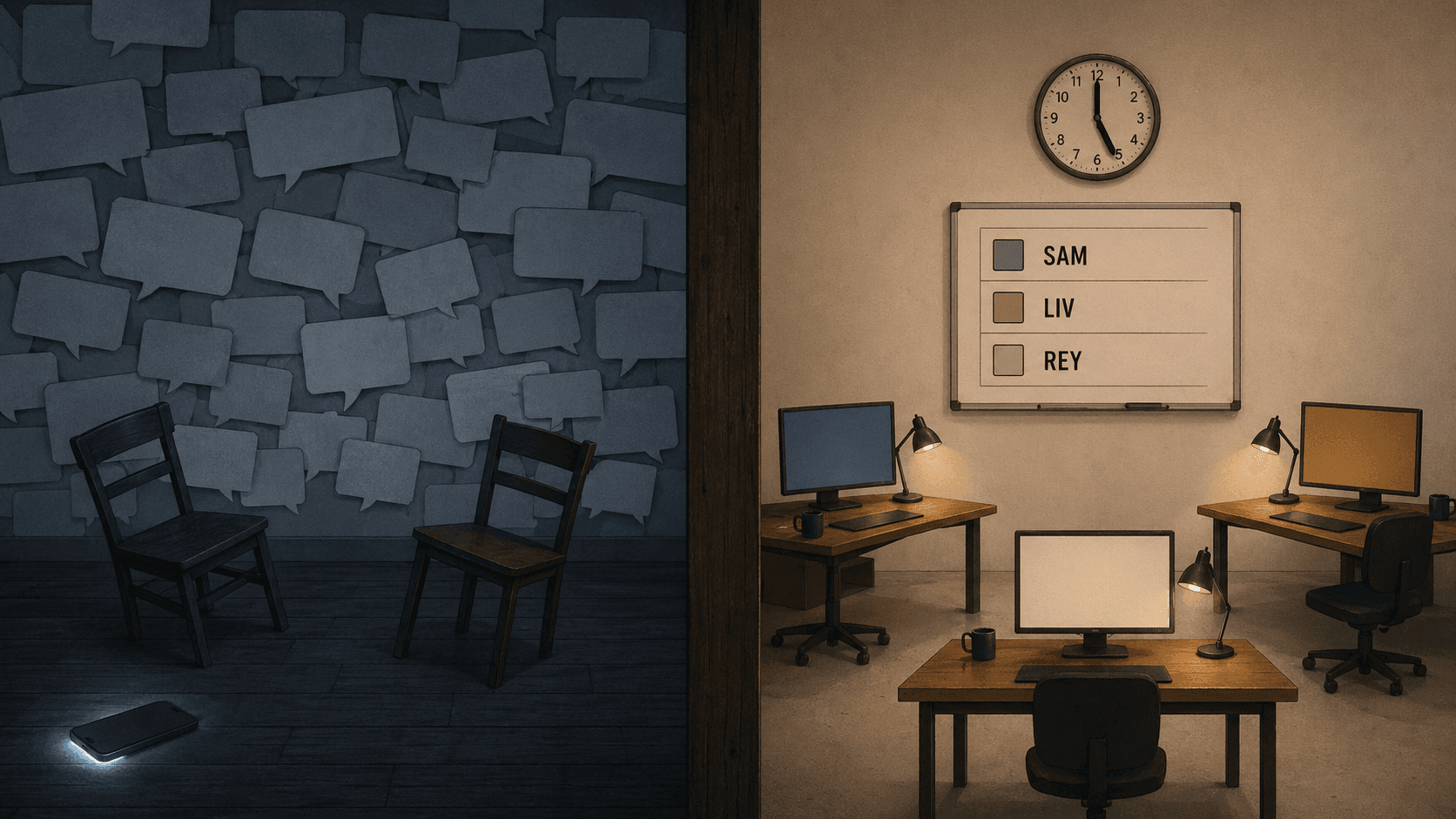
A Discord server is a chat room with notifications. A game dev team is a small group where someone is counting on your work by Friday. The two are not the same thing, and the gap between them is where most indie projects quietly die.
You can run a dev team inside Discord. People do it every day. But Discord itself can't make you a team any more than a WhatsApp thread can make you a marriage. It's a room. What happens inside the room is on you, and most Discord-organized indie projects never put anything load-bearing inside the room.
"We agreed to work together and then we never spoke to each other again." Escapist Magazine, on Reddit's pick-up indie scene
That is the whole Discord-server-vs-game-dev-team question in one sentence. So here is the comparison, straight:
The comparison at a glance
| What a team has | Discord server | Game dev team |
|---|---|---|
| Named owner per task | No (anyone can pick up anything, which means nobody does) | Yes (one person, by name, on one card) |
| A deadline someone else is watching | No (self-imposed at best) | Yes (weekly demo, two-week sprint, external eyes) |
| Cost to go silent | Zero (you close the tab) | Non-zero (you hand off, you say why) |
| Visible progress between meetings | Vibes and screenshots | Pushed builds, updated cards, stand-ups |
| Role clarity | "I'll help with code, I guess" | Programmer, artist, composer, lead, by name |
| Reply expectation | "Soon-ish" | Within a day on blockers |
| Exit cost | Ghost | Conversation |
| Who is in it for what | Unspoken | Written down |
If you scored your current project against that table and most rows landed in the left column, this article is for you. The problem isn't your teammates. Your Discord team isn't flaky. It's structureless.
What a Discord server actually is (and what it's good at)

A fair take on Discord first, no strawmen. A good server is useful. It's where you:
- Find people who like the kind of games you like.
- Playtest a build with fifty humans on a Saturday.
- Ask a stupid engine question at midnight and get an answer.
- Share screenshots and stay visible between your own projects.
- Meet the person who will eventually become your actual teammate.
Those are real jobs, and Discord does them well. The issue is what happens when people start treating that room like it's a team.
"Many people, but the reaction is low." prybulets, on Discord servers in gamedev (Medium)
Discord runs on weak ties. Weak ties are great for discovery and terrible for shipping. A weak tie is someone who will reply to your message if it's interesting and ignore it if it's not, with zero cost either way. Shipping a game requires the opposite: someone who replies even when it's boring, because they said they would.
A server full of weak ties looks like a team when everyone is excited in week one. By week six it looks like a graveyard of "still interested?" pings nobody answers.
What a game dev team actually is

Here are three things a real dev team has that a Discord server literally cannot enforce on its own. You can build all three on top of Discord. Most people don't.
1. Named ownership per task
On a team, every piece of work has one name on it. Not a role, a person.
"If two people are accountable for something then no one is accountable for it and it's much better to have a clear owner of that thing." IndieGameClinic, on Trello for small teams
When the inventory UI is "programming's problem," the inventory UI does not get made. When the inventory UI is Sara's card until it's done, Sara either finishes it or says out loud that she's blocked. Both outcomes move the project. The shared-credit version produces neither.
Discord servers default to the shared-credit version. A team defaults to named ownership.
2. A deadline someone else is watching
Willpower is the worst project manager ever hired. Deadlines work because someone else expects to see a thing on a date, and that expectation does the part of the work your own motivation can't.
"We all know from practice from school and work that we need deadlines in order to get work done on time. And one of the things that indie developers often struggle with is just applying this logic to their own projects." IndieGameClinic
The cheapest version is a weekly demo. Friday at 5pm, the team pushes a build, plays it, writes down what broke. On a Discord server, demos are optional and quietly stop happening by month two. On a team, demos are the week's spine and people feel it when one is skipped.
3. A non-zero cost to quit
On Discord, leaving a project costs nothing. You mute the channel. You don't reply. Four weeks later, somebody pings you and you don't see it. The project dies one silence at a time.
A team quit is more awkward, which is exactly the point. You tell people. You say why. You hand off your cards or you return your access. The awkwardness is load-bearing: it makes you either stay or leave cleanly, instead of lingering as a dead node for six months.
None of this is hypothetical. The Ghostbox postmortem on Game Developer names shared-without-owner design as one of the things that folded the studio, and recommends capping founders at two to four for exactly this reason. (Game Developer, Dom Drysdale) Alistair Doulin's piece on the same site names the same failure mode at the indie scale: "personality trumps ability" when you don't have the rituals to back it up. (Game Developer, Alistair Doulin)
When a Discord server is the right call
Pick the server when the job is a server job:
- You have a released or nearly-released game and you want a place for players to hang out, share clips, and report bugs.
- You need playtesters, not builders. Fifty people willing to break your demo for an hour is a Discord win.
- You're scouting teammates and you want to watch how someone talks for a month before asking them to commit.
- You're between projects and want a weak-tie network that keeps you warm without obligation.
- You're running a jam with a hard three-day window where the structure is the deadline itself.
None of those need named ownership, weekly demos, or handoff rituals. A channel and a pinned message are enough.
When a Discord server stops working

The server stops working the instant you need someone to do something specific by a specific date. Five symptoms you're already past that line:
- The "month-and-a-half" drop-off. Traffic halves. Then halves again. A gamedev.net forum thread captures this exactly: "Effort dwindled down after about a month and a half." That's not bad luck, it's the half-life of weak-tie motivation.
- "Real life got in the way." A specific unfalsifiable excuse that only shows up in structureless teams. On teams, "real life got in the way" becomes "I can't hit Friday, can we move the demo to Monday?" with a reason. On servers, it's a goodbye.
- The idea-guy crowding out the build-guy. When nobody is building, talk about what to build expands to fill the silence. You'll notice it because the #ideas channel is active and the #builds channel is a ghost town.
- The 3,000-to-5 ratio. Lost Relic Games has over three thousand members in his Discord. He has said on stream that a handful of trusted people actually "run the ship." Every server has this ratio. If you're not in the five, you're in the three thousand.
- Nobody owns the current blocker. Ask the room: "who is fixing the save-load bug?" If the answer is "someone should look at that," the room is not a team.
"Internet based indie projects with remote teams and young ambitious people almost all fail." Slayemin, Your Indie Game Dev Team Will Fail (Medium)
That is the top-ranking result for "indie game dev team will fail" and it has been for years. The reason it keeps ranking is that it keeps being true, because the structure people default to (Discord plus Trello plus vibes) doesn't close the gap to shipping.
How to tell which one you're actually in

Six-question diagnostic. Answer honestly. No points for what you plan to do next month.
- Who owns the next shippable milestone, by name? (Not a role. A person.)
- When is the next demo, and who will be watching it? (A date and at least one pair of eyes that isn't yours.)
- What happens if someone stops replying for a week? (Does the team notice within 48 hours, or not until someone randomly pings the channel in week three?)
- Can you point to what each person built last week? (Specifically. Commits. Files. Not "they were working on stuff.")
- Is there a written agreement, even a one-pager? (What each person commits to, what they get, what happens if they leave.)
- Would you bet 50€ that this ships in the next 12 months? (Not "might." Would.)
Score it:
- 0 to 2 yeses: You have a Discord server. Stop calling it a team. It's relieving yourself of a lot of guilt you're currently misrouting as "why am I so undisciplined."
- 3 to 5 yeses: You have a team-ish thing. Pick the missing pieces and install them in the next two weeks, or the structure won't hold past the next hard week.
- 6 yeses: You have a team. Keep doing what you're doing. Also, you're rare.
If this question hits harder than expected, read "You're Not Lazy. You're Unsupported.". The reframe is the whole thing.
How to turn a Discord server into a team (or leave cleanly)
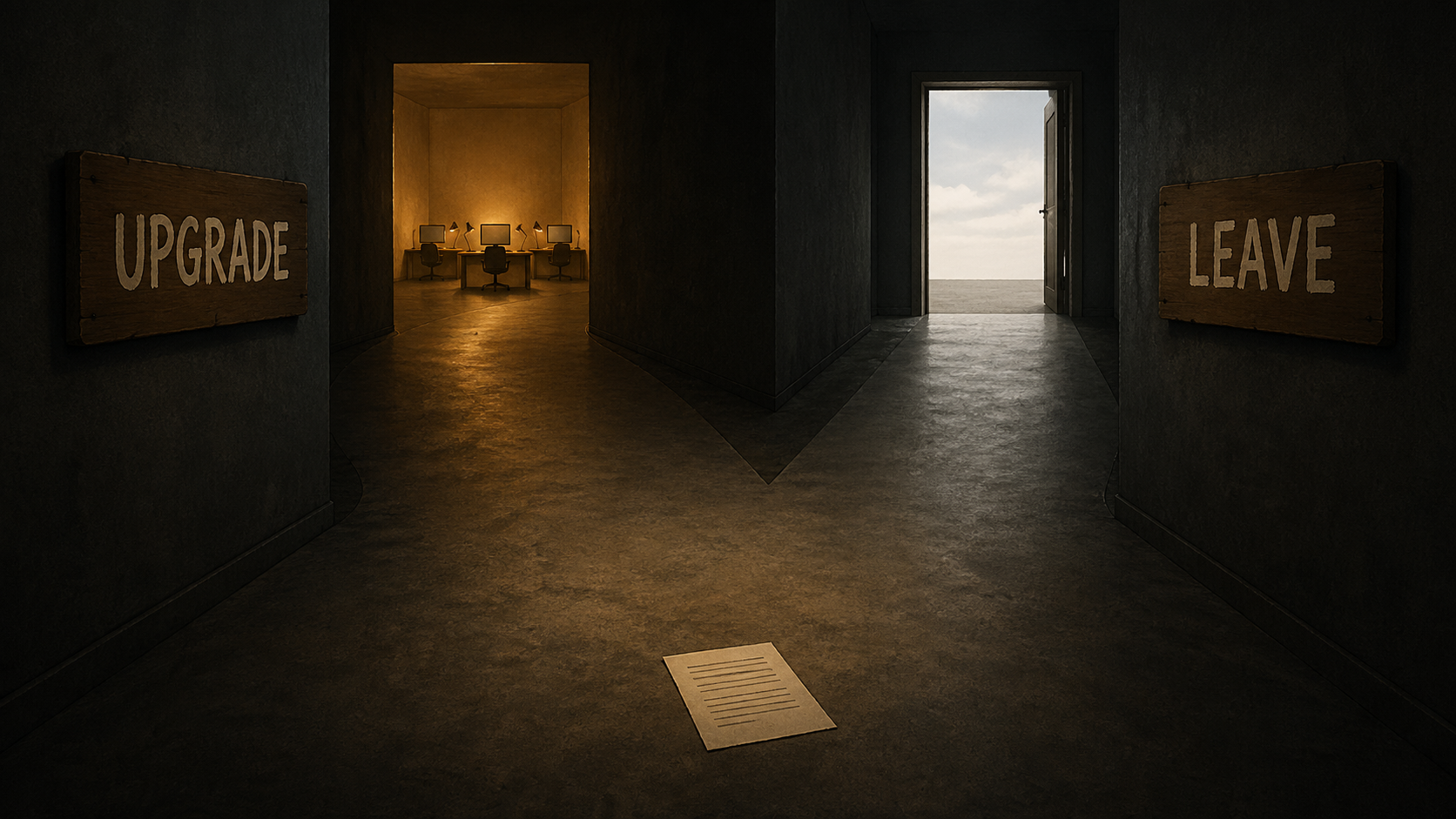
You have two honest paths. Pick one.
Path A: Upgrade the server in place
You like these people and want to ship with them. Do these five things in the next two weeks and don't skip any of them:
- Pick a vertical slice that fits in six to ten weeks, not the whole game. (See The Vertical Slice Protocol.)
- Name three owners, by name, for the three biggest pieces of the slice. One each. No shared cards.
- Set a weekly demo. Same day, same time, everyone pushes a build, everyone plays for twenty minutes, everyone writes down what broke. Friday at 5pm works for most time zones. (See The Ship-It Friday Ritual.)
- Write a one-pager. What each person commits to, what they get if the game makes money, what happens if they leave. It doesn't need a lawyer. It needs to exist.
- Agree on a reply expectation. Forty-eight hours on blockers, five days on non-blockers. Silence past that is a signal, not a mystery.
That's it. The Trello-and-one-card-in-Doing pattern from IndieGameClinic is the cheapest version of this and it works. Four columns, one card per person in Doing, visible to everybody.
Path B: Leave cleanly
You don't want to do Path A with these people, and that's fine. Some Discord projects are not going to become teams no matter what you install, and the longest-running lie in indie dev is telling yourself otherwise for six more months.
How to leave without burning the weak ties you will need later:
- Say it out loud in the channel. One paragraph. "I'm stepping back from this project. Thanks for the time, here is where I got to, here is the file you'll need." Short. No drama.
- Hand off what you built. Even if nobody picks it up. Leaving without handing off is the exact move that poisons the weak tie for next time.
- Don't wait to be asked. The longer you stay silent, the more you become part of the reason the project is dying.
Leaving is not a failure. Staying in a structureless project because you feel guilty is. If the project was sold to you on rev-share and the numbers don't add up, these red flags will tell you what you should have seen in week one. If you keep joining projects that ghost you, this guide to r/INAT has the filters to use next time.
The recommendation

Discord is where you find teammates. It is not where you ship games.
If your project is past week three and nobody is counting on your work by Friday, the problem isn't the people in the room. It's the room. Install the three non-negotiables, or move to a structure where they are already installed.
Clowdr is that second thing. It's built around named ownership, weekly demos, written agreements, and handoffs instead of ghosts. Contributors keep their rights. Nobody is in anyone's "family." Projects ship because somebody is counting on the work by Friday, every Friday.
If you want more of the structural fix before you commit, start with Accountability Circles for the small-team ritual, or How to Find Reliable Teammates for Your Indie Game for the vetting piece. Both of them take the same position as this post: your discipline is fine. Your structure isn't.
FAQ
Is Discord bad for game development? No. Discord is an excellent chat tool and a good community hub. It's a bad project management system because it has no concept of named ownership, deadlines, or handoffs. Use it for community, not for coordination.
Can small indie teams ship using only Discord? A two-person team with strong trust can often get away with Discord and willpower. Past three people, the math breaks and you need explicit structure (cards with owners, a weekly demo, a written agreement). The threshold is small.
What is the difference between a game dev community and a game dev team? A community is a group of people with a shared interest and no shared deliverable. A team is a small group with a shared deliverable and named ownership of the pieces. Most "teams" on Discord are actually communities.
How do I know if my Discord project will fail? Run the six-question diagnostic above. Zero to two yeses is a strong failure signal. Month-and-a-half effort drop-off, unfalsifiable "real life" exits, and no visible per-person output between meetings are the three loudest late-stage symptoms.