
The Tool Is Not the Architect
AI can help write code, but developers still own architecture, scope, maintainability, integration, and verification.

AI coding tools are the easiest part of this whole argument to sell to developers. That is exactly why this post has to be careful.
It would be simple to say: agents make code faster, indie devs are under-resourced, use the tools and ship. There is truth in that. There is also a trap in it.
The anti-AI developer concern is not only nostalgia for typing every character by hand. Some of it is craft defense. Some of it is the memory of cleaning up code nobody understood. Some of it is watching "vibe coding" turn into a permission structure for shipping systems that feel plausible until a player hits the one state nobody tested. Some of it is seeing agent-only pull requests where the author cannot explain the design, the tradeoff, or the failure mode.
That concern has a point.
Good developers are not only paid to produce lines of code. They are paid to reduce uncertainty. They turn unclear requirements into a bounded implementation. They choose the boring solution when boring is right. They notice when a feature request is really a design problem, when a bug report is really an architecture problem, and when a clever abstraction will make the next three weeks worse.
AI does not remove that work. It can hide it. That is the danger. A large diff can feel like momentum even when the real decisions are still undecided. A working prototype can feel like proof even when it only proves the happy path. A generated refactor can feel like cleanliness even when it erased the local knowledge that made the system debuggable.
Code that appears quickly can still be bad code. Code that compiles can still be the wrong architecture. Code that passes a narrow test can still break the build, leak performance, create state bugs, or make the next contributor afraid to touch the file.
Clowdr's answer is not "AI is the future, get over it." That is too cheap for the work. The answer is the same standard we use for art and audio: tools can help, but somebody owns the result.
Speed without judgment is not a feature.
Architecture is still your job
An agent can scaffold a feature. It can write a controller, draft a component, sketch a save system, wire up a menu, explain an engine API, generate a test case, or suggest a refactor.
That is useful.
It is not architecture.
Architecture is deciding where the feature belongs, what it should depend on, what it should not know about, how it fails, how it will be changed later, and what happens when the game grows around it. In game development, architecture also means respecting the engine, the asset pipeline, the build target, frame budget, input model, save format, and the messy reality that "it works once" is not the same as "it belongs."
The developer still owns architecture, scope, maintainability, and integration.
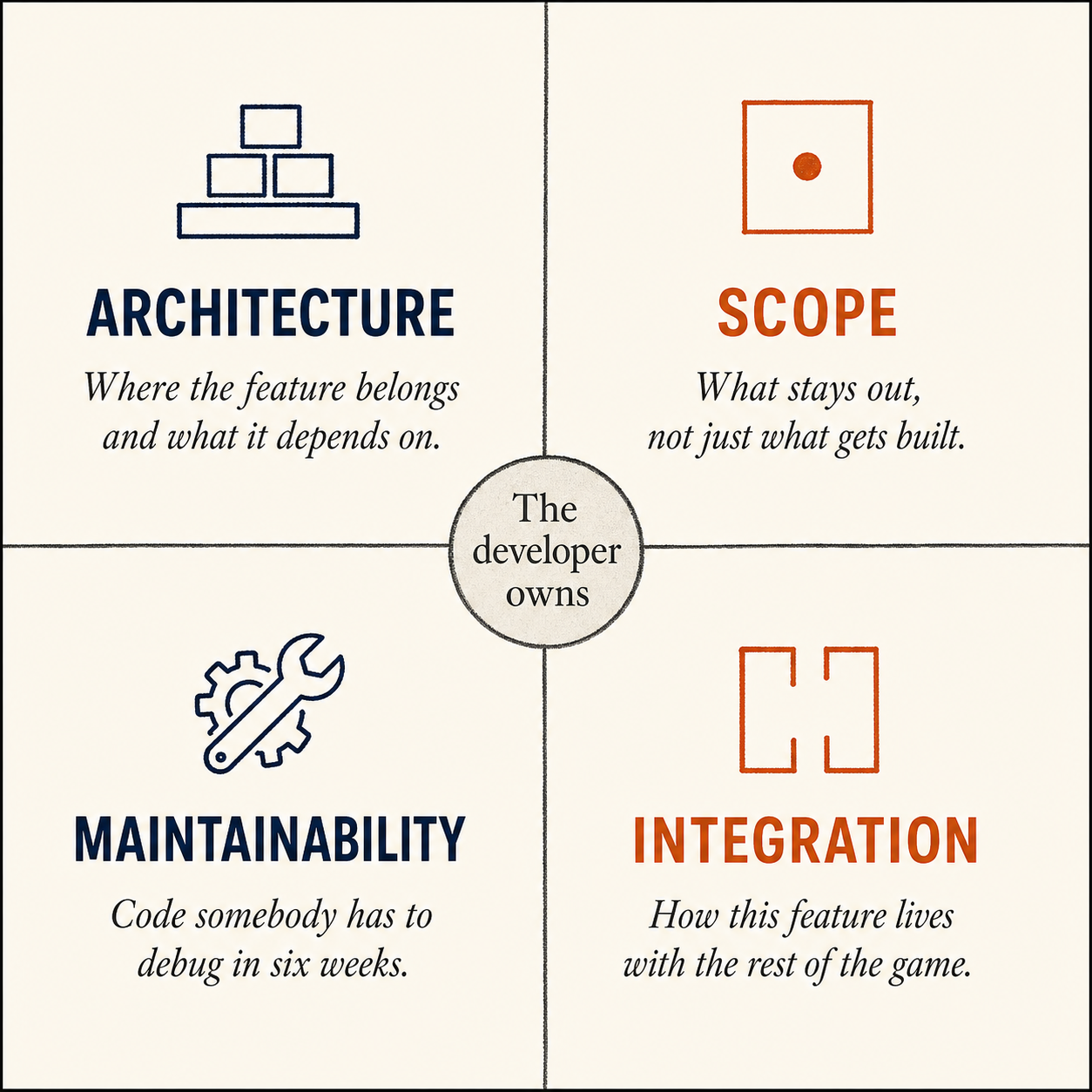
Scope matters because agents are good at adding surface area. Ask for a small inventory system and you may get categories, rarity colors, drag-and-drop, sorting, tooltips, persistence, analytics hooks, and three abstractions you never needed. That looks like progress until the feature has doubled the project.
The disciplined developer cuts the prompt down before the agent writes code. They decide what the feature must do, what it must not do, what existing systems it should reuse, and what would count as too much. They reject useful-looking additions when those additions expand the maintenance burden without improving the game.
Maintainability matters because somebody has to debug this code in six weeks. If the only person who "understood" the implementation was the model that generated it, nobody owns it.
Maintainability is not a vibe. It is whether another contributor can follow the control flow, whether a designer can tune the numbers without editing source code, whether a QA note points to a place a developer can actually inspect, and whether the next feature can be added without rewriting the first one. AI can help produce cleaner code, but it cannot decide what clarity means inside your project.
Integration matters because game code almost never lives alone. It touches scenes, prefabs, animation states, UI, physics, content data, audio triggers, save files, localization, platform quirks, and player behavior. A generated feature that ignores those edges is not done. It is a draft with confidence.
Verification is not just unit tests
The Clowdr standard is the same one from How We Ship:
No generated work ships without human ownership and an appropriate verification pass.
For code, human ownership means a developer can explain what changed, why it belongs there, what assumptions it makes, and how it was verified.
An appropriate verification pass depends on the change.
Sometimes that is a unit test. Sometimes it is a smoke test. Sometimes it is a clean build on the target platform. Sometimes it is a profiler run because the generated path allocates every frame. Sometimes it is a playtest because the bug is not "the function returns false" but "the player can soft-lock the level by opening the menu during a transition." Sometimes it is all of those.
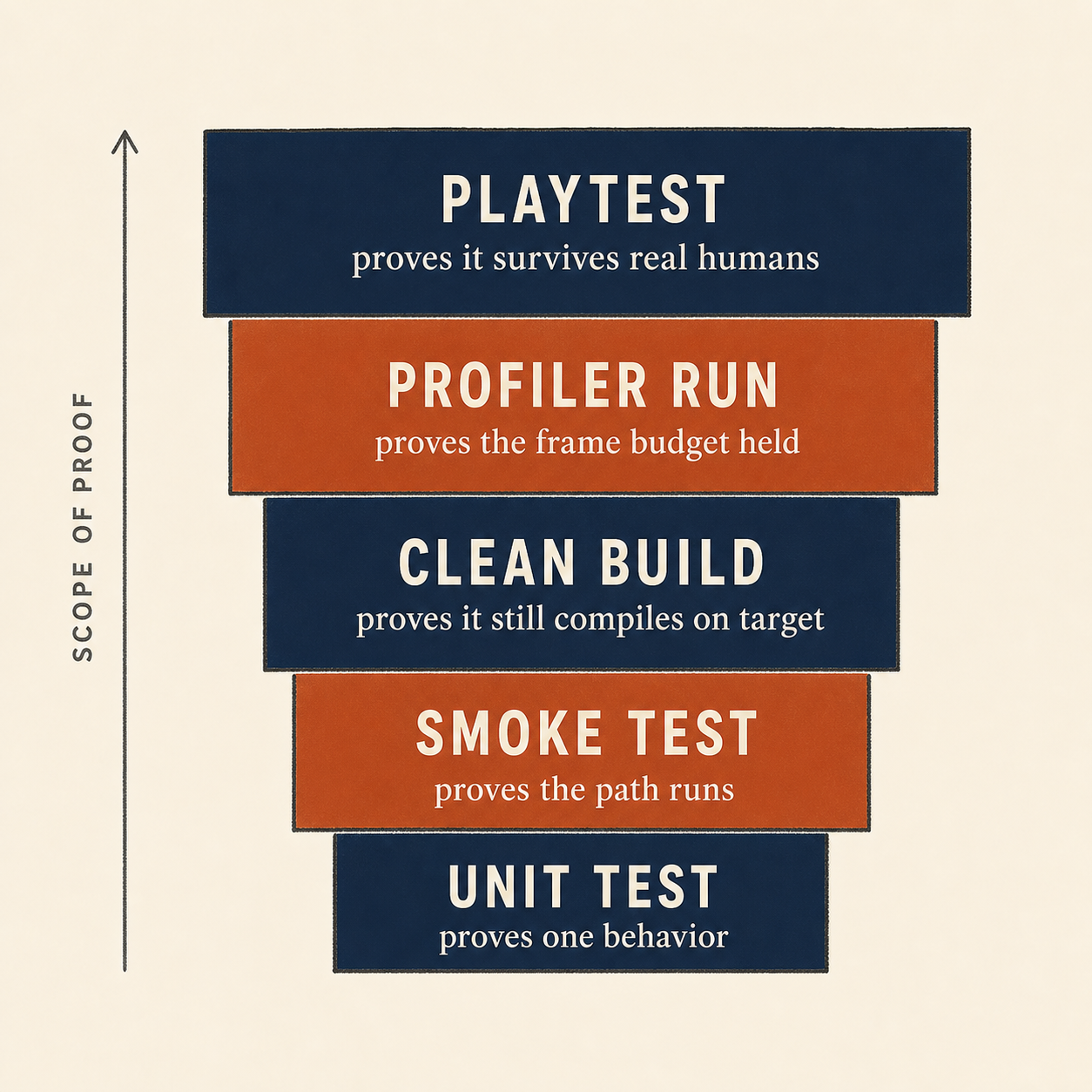
Games are not SaaS dashboards. Verification cannot collapse into "the test passed." A test can prove one behavior. A build can prove the project still compiles. A profiler can prove the shortcut did not burn the frame budget. A playtest can prove the state machine survives actual humans.
Verification also means checking the boring boundaries. Does the save still load after the data shape changed? Does the feature work after scene reload? Does it behave under pause, death, restart, disconnect, rebinding, localization, low frame rate, and controller input? Does the editor workflow still make sense for the teammate who has to place the content? Did the generated code introduce a hidden dependency on file order, object names, update timing, or one specific resolution?
Those checks are not bureaucracy. They are the difference between a demo and a product.
The developer chooses the verification pass. Then the developer owns the result.
What does not clear the bar
An agent-generated feature merged because it "looked right" fails.
A pull request where the author cannot explain the architecture fails.
A refactor that removes duplication but breaks editor workflows, asset references, or debugging clarity fails.
A save system generated from a prompt that has no migration plan fails.
A UI implementation that works on one resolution and collapses on Steam Deck fails.
An AI-written gameplay system that never touches a playtest build fails.
A performance-sensitive loop accepted without profiling fails.
Scope drift hidden under "the agent can handle it" fails.
This is the dev version of slop: plausible output with no owner. The code may be syntactically fine. The damage is in the unreviewed decisions, untested states, hidden coupling, and future maintenance nobody budgeted for.
The same rule applies to hand-written code. A handcrafted system that nobody can maintain still fails. Craft matters. So does product judgment.
The same standard applies across roles
The developer post does not get a separate moral universe.
The artist standard in Taste Is Still the Job says generated images are drafts until an artist owns coherence, polish, rights, and final direction. The composer standard in Sound Is More Than Generation says generated audio is draft material until a composer owns emotional intent, timing, mix, implementation, and rights.
Code is no different.
Generated code is draft material until a developer owns architecture, scope, maintainability, integration, and verification.
That cross-role standard matters because games fail at the seams. A code shortcut can create art debt. A bad asset pipeline can create engineering debt. A music cue that cannot be implemented can create design debt. Nobody gets to throw output over the wall and call it shipped.
Clowdr is built for contributors who want the work to survive contact with the product.
What kind of developer belongs here
Clowdr is for developers who want to ship games with other contributors who also own their work.
Not for people who want agents to replace judgment. Not for people who want to dump unreviewed code into a shared project and make the next person sort it out. Not for people who think hand-written code is automatically higher quality.
If you use AI to move faster and still take responsibility for architecture, scope, maintainability, integration, and verification, you fit the standard.
If you do not use AI and still meet the same bar, you fit the standard too.
The tool is not the architect. The developer is.
The standard answers to How We Ship. The operational version is The Clowdr AI Standard, which defines the per-domain checks in more detail.
If that sounds like the kind of standard you want to work under, sign up.