
Taste Is Still the Job
AI game art does not remove the artist's job. Taste, coherence, polish, rights, and final direction still decide what ships.
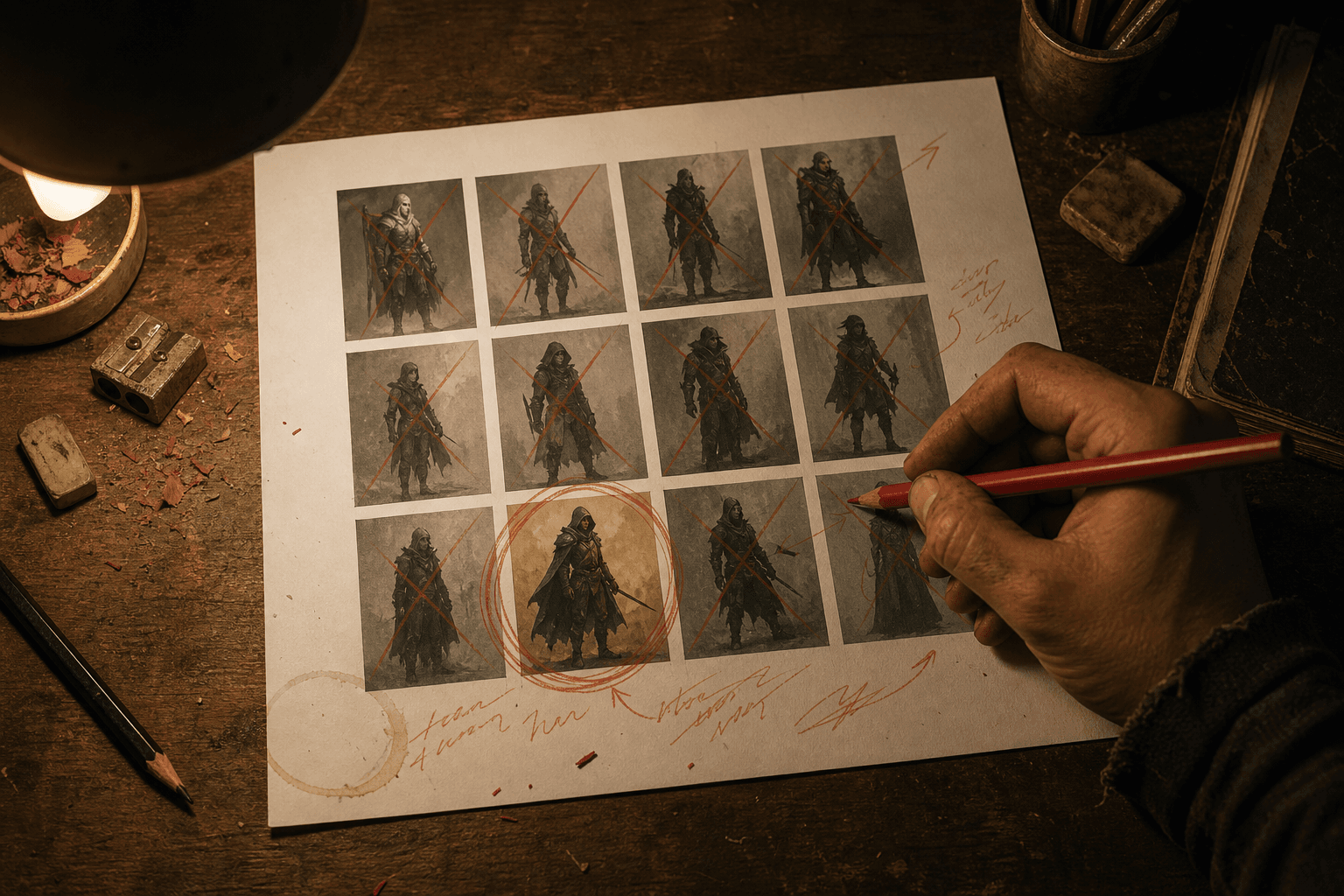
If you are a game artist, the AI conversation probably does not feel abstract.
It feels like watching your portfolio get scraped, your style get imitated, and your job get described as a prompt away by people who never had to make a sprite read at gameplay size. It feels like another version of the same old deal: the budget is tight, the timeline is worse, the artist is brought in late, and somehow the specialized visual work is the first thing everyone thinks can be replaced, compressed, or paid in vibes.
The anger makes sense.
Training data is not a footnote when the work being trained on looks like yours. Slop is not a joke when it floods every feed where clients used to find you. "Just generate it" is not harmless advice when it becomes the new version of unpaid exposure work. The pitch is familiar: the project will be great later, the credit will matter later, the real budget will appear later, and for now could you please turn this pile of half-formed output into something usable by Friday?
That is not progress. That is the old artist-service-desk problem wearing a new toolchain.
It also devalues the part of the job that outsiders barely see. The iteration. The ugly first pass. The style rules nobody writes down because the artist is carrying them in their head. The decision to simplify a shape so the player can read it in motion. The refusal to use a flashy render because it breaks the project's material language. The quiet cleanup that makes an asset feel like it was always meant to be there.
When people call that work "prompting with extra steps," artists hear the same insult they have heard for years: your craft is decoration, your time is optional, and your name can be replaced by a cheaper process.
That is the wound this piece has to start from.
So no, Clowdr's answer is not "make peace with it." That line is lazy. It skips the real problem. It treats artists as people standing in the way of production instead of people who make production worth finishing.
The more serious answer is this: generation is not direction.
Generation is not direction
An image generator can produce options. Sometimes many options. Sometimes useful options. It can give you a wall of silhouettes, a color mood, a prop variant, a texture direction, a UI motif, a rough enemy concept, or a quick placeholder that helps the rest of the project move.
That is not the same thing as knowing what belongs in the game.
Art direction is not "make a cool image." It is a sequence of judgment calls under constraints. What should the player notice first? Does the enemy silhouette read in half a second? Does this palette fight the biome? Does the weapon shape communicate range, weight, and danger? Does the UI sit inside the world or on top of it? Does the character belong to the same project as the environment? Does the asset still work after compression, animation, lighting, camera distance, and actual gameplay?
That is taste in production. It is not mystical. It is not a prompt. It is trained judgment applied to a specific game.
A generated concept can be impressive and still be wrong. It can have polish in the JPEG and fail inside the build. It can look expensive and carry no usable style decision. It can be the kind of image that gets likes and still be useless for a contributor trying to ship a coherent game.
The artist's job is not to produce isolated images. The job is to make visual decisions that survive contact with the product.
The job is coherence
Coherence is where most generated game art fails.
One generated character looks painterly. The next looks like plastic. The third has a different costume language. The fourth has hands nobody wants to talk about. The environment has a great mood, except the props belong to another genre, the material language changes every five meters, and nothing tells the player where to look.
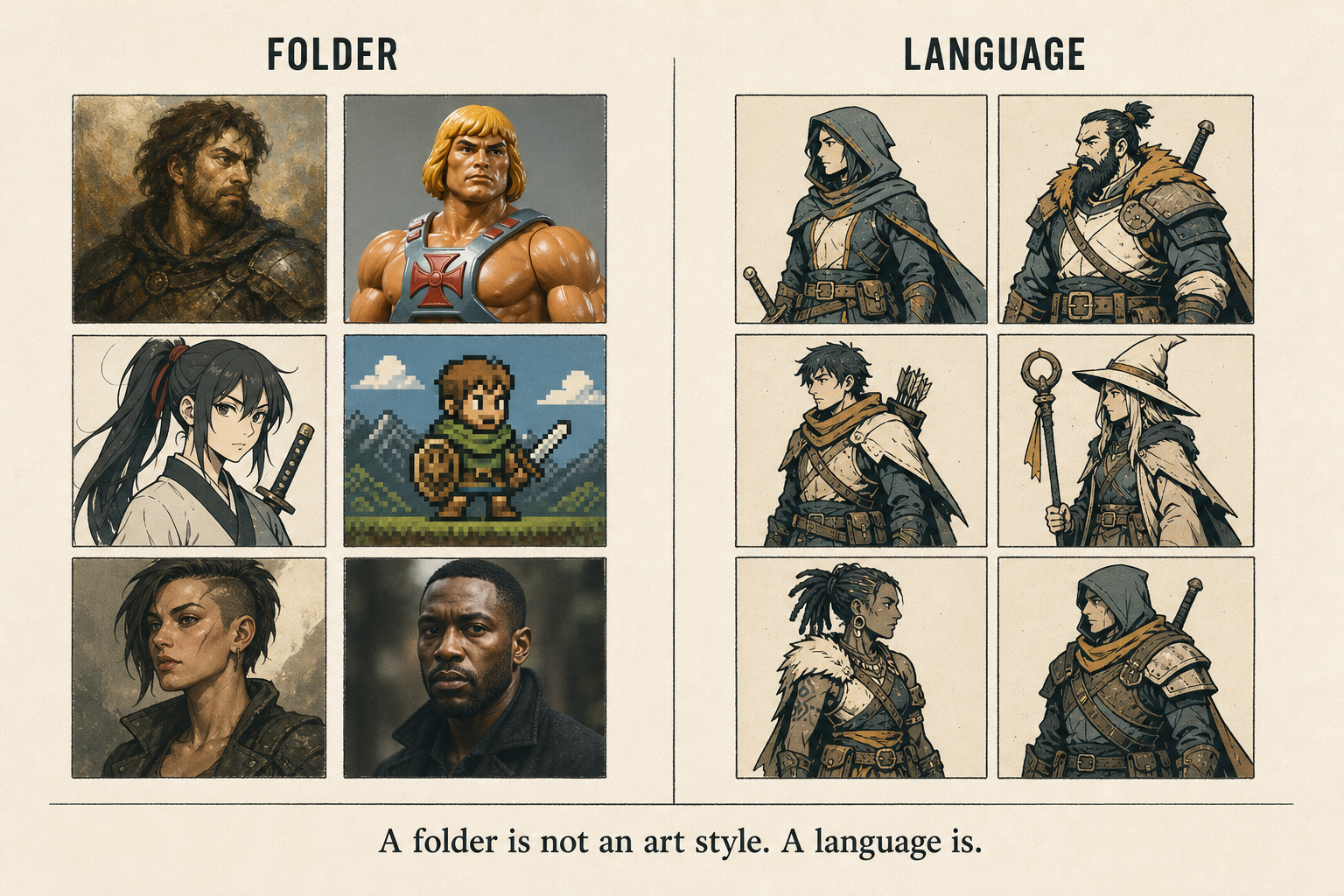
That is not an art style. That is a folder.
An artist turns a folder into a language. They decide what shapes repeat, what colors carry meaning, what level of detail belongs on gameplay objects, what gets simplified, what gets exaggerated, what must stay consistent, and what can vary. They decide which references are useful and which are just noise. They decide when an asset is good enough for a placeholder and when it is dangerous because the team is starting to design around a false promise.
That is especially important in indie games, where the visual standard has to do more with less. A small team cannot brute-force art with volume. The work has to be selective. A few readable shapes beat a hundred mismatched assets. A strong constraint beats a mood board with no decisions in it.
This is why artists need to be brought in early. Not at the polish pass. Not after the mechanics are locked. Early, when visual readability can still affect design and design can still affect visual scope.
Clowdr already treats artists as creative partners for that reason. If an artist is only invited after the project has accumulated nine months of style debt, they are not directing the work. They are cleaning up a mess.
What AI can be useful for
AI can still be useful.
That sentence will annoy some people. It is still true.
Used honestly, AI can help explore references faster. It can generate mood directions for a conversation. It can produce placeholder assets for a prototype that would otherwise stall. It can create variation when the artist already knows the constraint. It can rough out prop ideas, palette tests, background textures, or composition options.
None of that makes the output shippable.
The useful version has a human owner. An artist decides why a generated direction is useful, what gets thrown away, what gets redrawn, what gets simplified, what gets integrated, and what gets rejected. The artist also decides when AI should not be used because the rights are unclear, the style is too close to a living artist, the output pollutes the visual language, or the shortcut creates more cleanup than it saves.
The tool does not get a vote. The project does.
There is a clean difference between "we used AI to explore" and "we used AI to avoid hiring an artist." The first can be professional. The second usually produces exactly what artists are warning everyone about: generic output, unclear rights, weak taste, no accountability, and a final game that looks like nobody loved it enough to make decisions.
The Clowdr bar
The Clowdr standard is the same one from How We Ship:
No generated work ships without human ownership and an appropriate verification pass.
For visual art, human ownership means an artist owns the final direction. Not the prompt. Not the model. Not the person who dumped thirty images into a channel and asked the team to pick one. A human contributor takes responsibility for the asset's fit, rights, polish, optimization, readability, and relationship to the rest of the game.
An appropriate verification pass means the asset is tested in context.
Not in a gallery. In the game.
Does it read at the target camera distance? Does it animate cleanly? Does it survive compression? Does it match the existing style bible? Does it confuse interactable and non-interactable objects? Does it fight the UI? Does the source and license situation hold up? Can another contributor build from it without guessing?
If the answer is no, it is not shippable yet.
That does not mean the asset is worthless. It may be a useful draft. It may be good reference. It may be a strong placeholder. It may be the spark that gets the actual direction moving.
Draft is not delivery.
What does not clear the bar
Here is what fails inside this standard.
A beautiful generated character concept with no matching turnaround, no animation plan, no material consistency, and no rights clarity fails.
A batch of UI icons where each icon looks good alone and terrible together fails.
A tileset that looks impressive in a preview and becomes unreadable at gameplay scale fails.
An enemy design that copies the silhouette language of a recognizable game because the prompt leaned too hard on references fails.
A placeholder background promoted to final because "players probably will not notice" fails.
A style board made entirely of generated images with no artist deciding the actual constraints fails.
A model that needs three days of cleanup for every hour it supposedly saved fails.
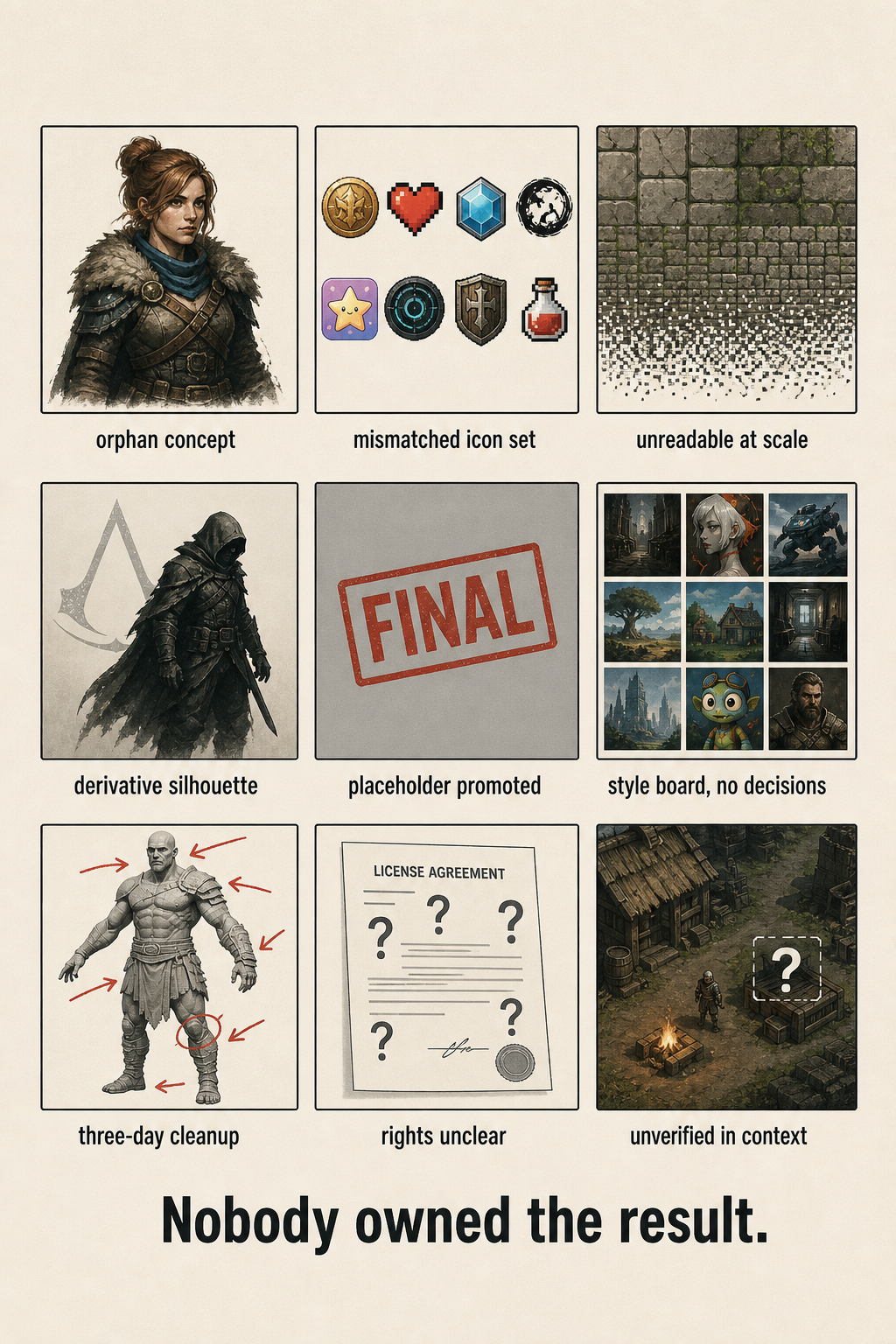
The through-line is not "AI touched it." The through-line is that nobody owned the result.
The same rule applies to handmade work. A hand-painted asset with no fit, no readability, no rights clarity, and no integration still fails. Craft matters. So does product judgment.
The artist's leverage is judgment
This is the part that gets lost when the AI argument turns into slogans.
The artist's leverage is not only hand skill. Hand skill matters. It always will. But in a production environment, the deeper leverage is judgment: knowing what to keep, what to cut, what to standardize, what to simplify, and what the game cannot afford to become.
That is why the "AI replaces artists" story is both frightening and incomplete.
Bad teams will try to replace artists with output. They already tried to replace artists with exposure, vague credit, last-minute cleanup, and "just make it look good." AI gives them a faster excuse.
Good teams will need artists more, not less, because the volume of possible output creates a harder taste problem. More options do not create direction. They create noise until somebody with taste turns them into decisions.
That is the job.
What kind of artist belongs here
Clowdr is for artists who want their work inside games that ship.
Not buried in dead folders. Not locked forever behind cancelled-project NDAs. Not treated as decoration after the real work is done. Inside the product, shaping the product, credited as part of the product.
That does not require agreeing with every AI use. It does require working from a standard that judges the final work, not the purity story around it.
If you want a place where generated material is treated as final art because it looks impressive at first glance, this is not it.
If you want a place where artists are expected to rubber-stamp whatever a developer generated overnight, this is not it.
If you want a place where tools are banned from the conversation before the work is even evaluated, this is not it either.
Clowdr's line is narrower and more useful: use tools when they help, reject them when they do not, own the work, verify it in context, keep rights clear, and ship something coherent.
That standard answers to the manifesto at How We Ship. The composer sibling is Sound Is More Than Generation, and the developer spoke is The Tool Is Not the Architect. The operational version is The Clowdr AI Standard, which defines the per-domain checks in more detail.
If that sounds like the kind of standard you want to work under, sign up.