
Solo Dev vs. Team: Which Path Is Right for Your Game?
Solo game dev vs team: the honest comparison. Why Celeste and Undertale aren't really solo, and the third option that actually ships indie games.
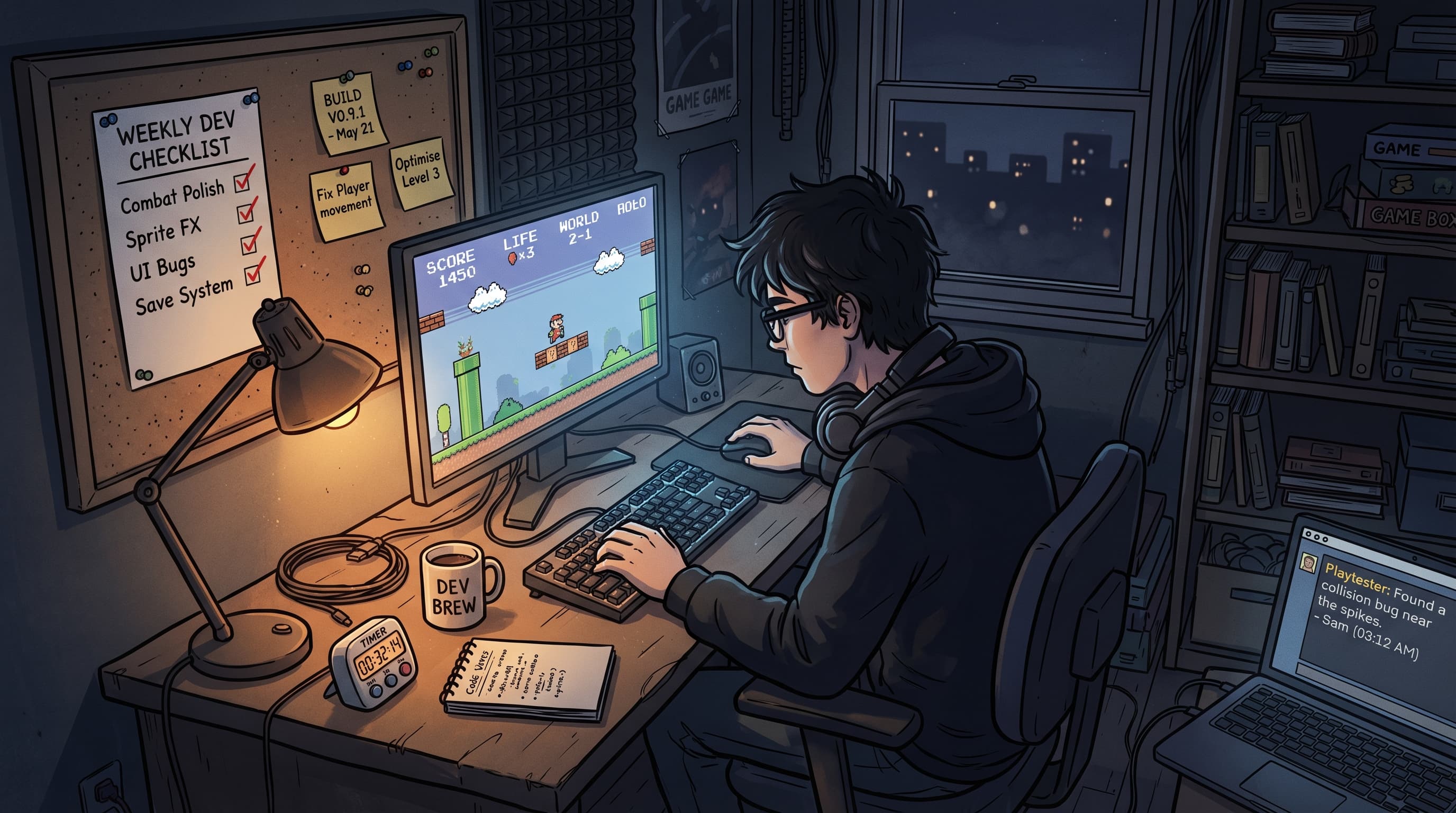
There's a question that never dies in indie dev circles: should I make my game alone or with a team?
You'll find strong opinions on both sides. Solo devs point to Stardew Valley and Undertale. Team advocates point to the graveyard of unfinished solo projects, the ones nobody ever hears about because they never shipped.
Both sides are defending a false binary.
Most indie devs frame this as "solo vs. team." The honest answer is neither: solo-with-structure ships more games than either pure path. Solo gives creative control but kills projects through isolation. Teams ship faster but collapse from ghosting and compromise. The shipping path is solo hands with accountability built in, not headcount.
Here's the honest comparison, including the option most posts skip.
The comparison at a glance
| Solo (alone) | Full team | Solo (with structure) | |
|---|---|---|---|
| Creative control | Total | Shared | Total |
| Accountability | None | High | Medium-high |
| Pace | Yours | Team cadence | Yours, with checkpoints |
| Shipping odds | Low | Medium-high (if the team survives) | Medium-high |
| Burnout risk | High | Medium | Low-medium |
| IP / rights | Yours | Negotiated | Yours |
| Setup cost | Zero | High (cofounder-grade commitment) | Low |
Most "solo vs. team" posts cover columns one and two. Column three is where shipped games actually live.
The case for solo (and what it quietly costs you)
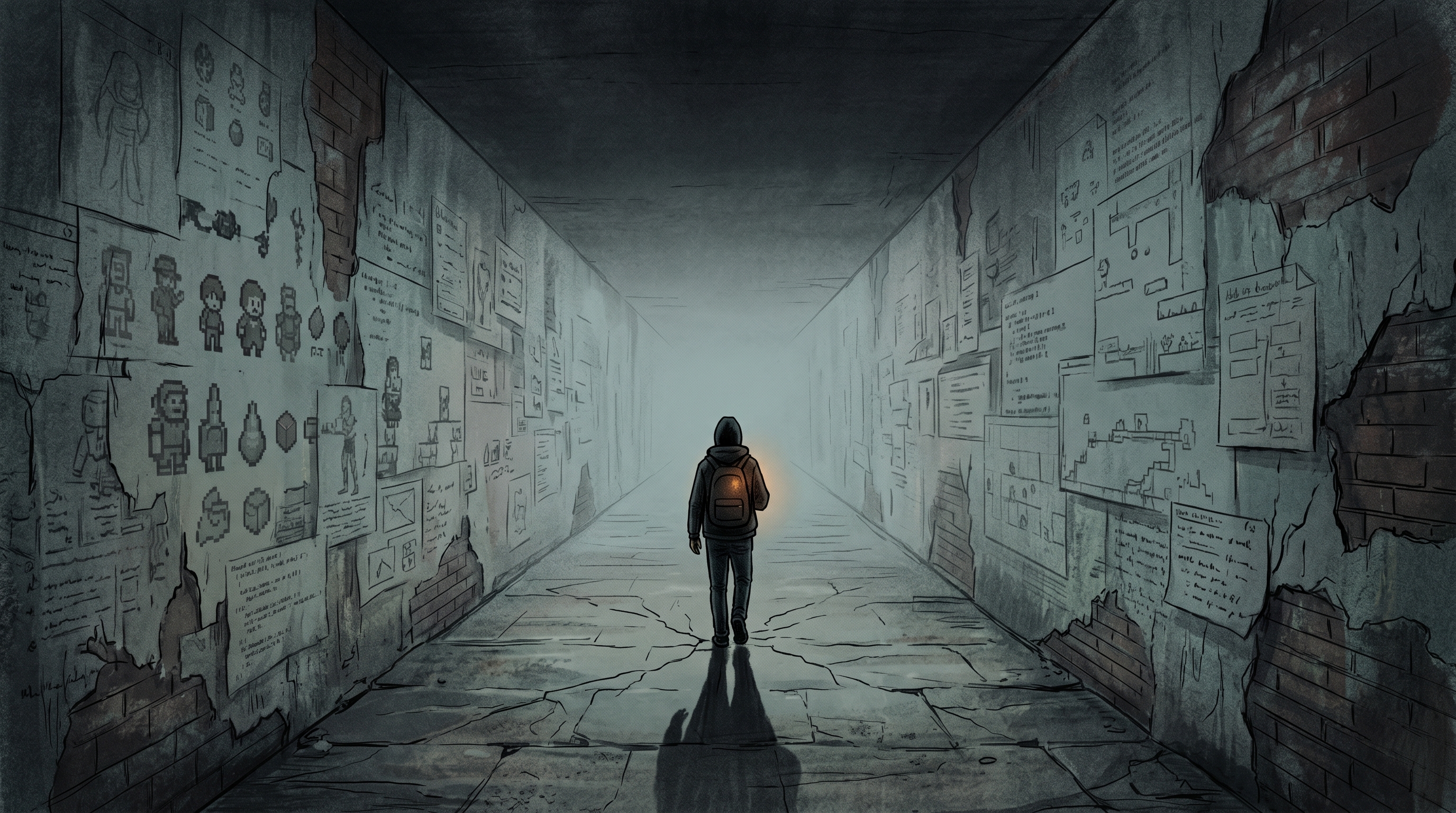
The upside of going solo is real.
When you're the only person on the project, you set the pace. You can take breaks without letting anyone down. You can pivot the whole design on a weird 2 AM instinct without running it past a committee. And the game you ship is unmistakably yours: every line of dialogue, every pixel, every mechanic.
A solo developer talking about working alone put it this way:
"There's no pressure to show up, you can take breaks, you don't have to worry about letting people down, you can kind of take it at your own pace and chill."
That's a genuine upside. For a certain kind of developer, it's the whole point.
And for some people, this is the right mode. One Hacker News comment from a working solo dev captures it honestly:
"A lot of flexibility but very lonely and isolating. You have to be the right kind of person and have more in your life than just your work."
If you're the right kind of person (high self-direction, rich life outside of dev, naturally structured), solo works fine. You probably already know who you are. And if you're reading this post, you're here because it hasn't been working.
Now the cost.
Solo dev is how indie games die. Not because solo devs are lazy or untalented, but because nothing in a one-person setup pushes back when things slide. One developer described the drift mechanic perfectly:
"There's no accountability... you get another idea, that shiny object syndrome kicks in, and you're like hey I could just jump on this idea nobody would even know, nobody would ever know, they're not gonna find out."
This is the part no productivity hack fixes. Nobody notices when you shelf the project on a Tuesday. Nobody asks about it on Friday. The abandonment is silent, then permanent.
And then there's the personal cost. From the same dev, looking back on years of solo work on a single game:
"There were years of development on Photophobia that I made alone in a room on my computer, and it is the most lonely draining horribly mentally negative possible thing that I could possibly have done."
He's not describing a bad week. He's describing years. And the data backs it up. A 2024 GDC burnout survey found 30% of game developers currently experience burnout, with mid-career devs (4 to 6 years of experience) reporting the highest rates.
Put it together: no accountability + total isolation + cyclic burnout. That's the solo-alone recipe, and the reason most solo projects never ship isn't a character flaw. It's a structural one.
You're not lazy. You're unsupported.
The case for a team (and the thing nobody warns you about)
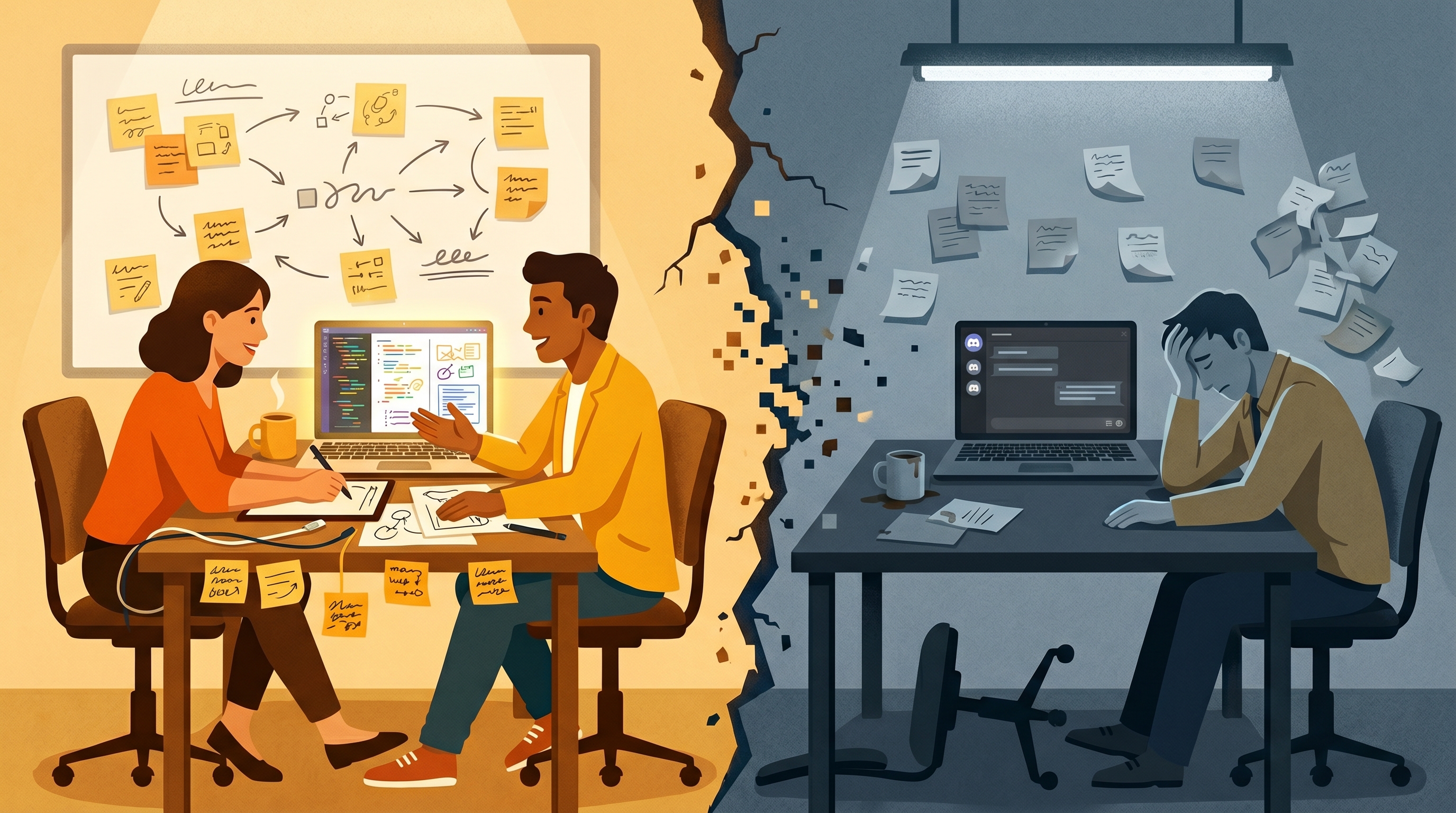
Now the other side.
Teams ship games. The math of working with other people is better than it looks from the outside.
One experienced indie dev interviewed about his team-up described it like this:
"It's almost like when you put two people together, it's an exponential return... it's like they're worth three to five people."
That's not motivational-speaker math. When you pair two people with complementary skills, the output isn't additive. Someone catches a UI problem you were blind to. Someone suggests a mechanic that reshapes your whole design. Someone sees the player experience from an angle you can't reach. And both of you are on the hook for Friday.
Another dev from the same conversation was blunter:
"No one succeeds alone, because whatever you're doing, whatever skill set you have, whatever you're building, there are always a series of things that you yourself don't have."
So teams ship games. Done deal, right?
Not so fast.
Here's the thing nobody writes about in the standard "solo vs. team" post: most indie "teams" aren't teams. They're a Discord server where someone posted "looking for collaborators for a JRPG," four people raised their hands, two vanished in the first week, one worked for three weeks, and the person who posted it is now doing it alone again, but angrier.
This is so normalized in the indie world that it has its own vocabulary. A reporter embedded in r/INAT summed up the pattern:
"People would flake out and eventually stop responding to messages altogether."
Ghosting. That's the word devs use, and they use it constantly. The place you're most likely to look for teammates is the place most likely to waste six months of your life.
And the other warning label: "teammates" who quietly expect free labor from artists and composers in exchange for a slice of a game that will never ship. A Medium post that gets re-shared in indie circles put it in four words:
"Twenty percent of zero is still zero."
That's the math on most hopeful cap-table splits. A team that can't ship a game is worth exactly nothing, which makes any percentage of it a waste of the only currency you actually have: your time.
Teams also come with a tax even when they work. One dev talking about his best collaboration still said this:
"There's no teams without compromise, no great teams without compromise, so doing that can kind of frustrate you sometimes — you're like, I really don't want that feature there."
If your game is a deeply personal artistic statement, that tax is sometimes too high to pay. And that's before we get to the broken data most "solo vs. team" posts are built on.
The "famous solo dev" myth that's poisoning this comparison
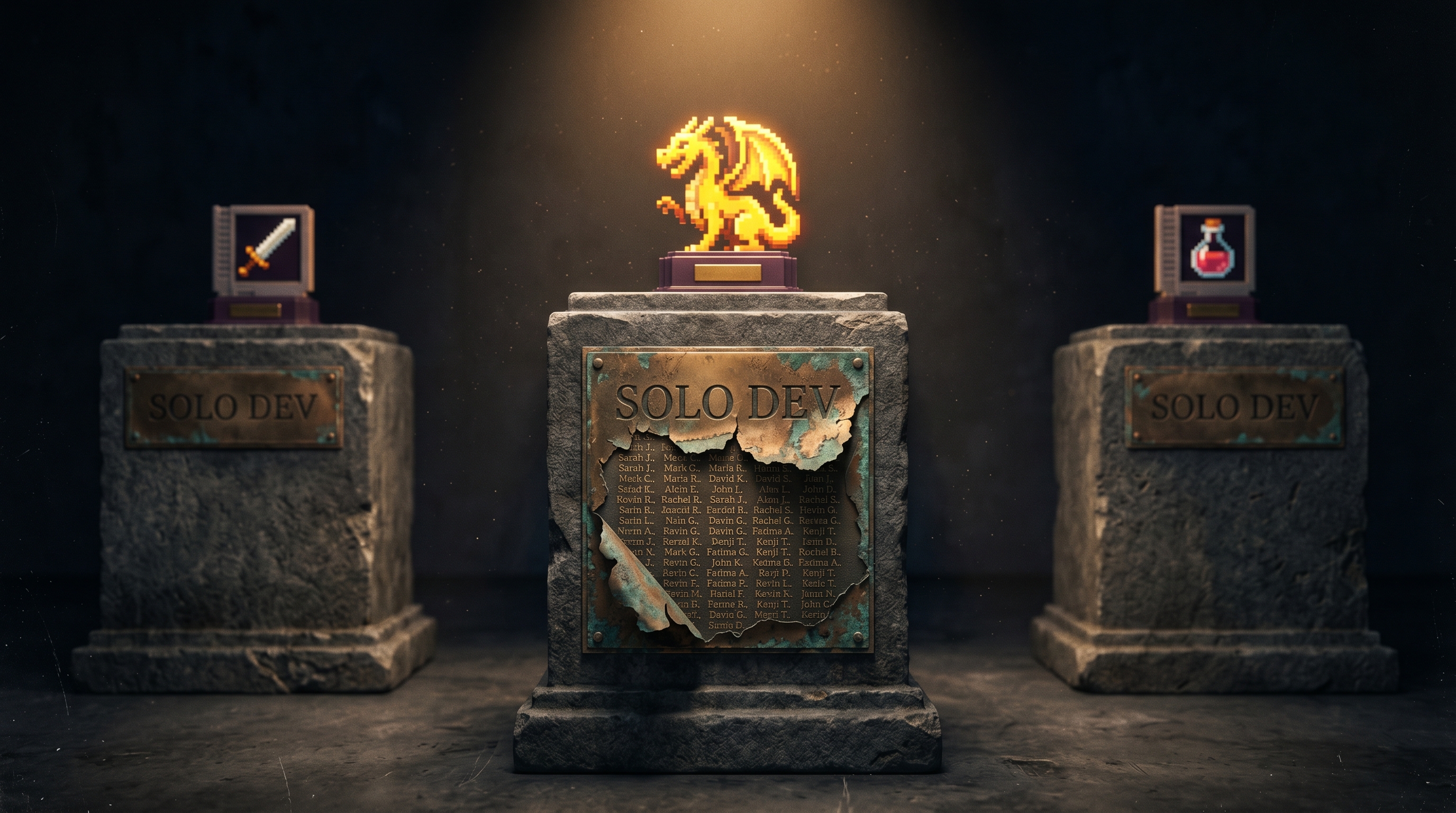
Most posts on this topic open with the same three games: Stardew Valley, Undertale, Celeste. And almost everything they imply is wrong.
Celeste was not a solo project. It credits at least seven contributors, including director Maddy Thorson, lead programmer Noel Berry, composer Lena Raine, and sound designer Kevin Regamey (Wikipedia, retrieved 2026-04-10). The "small team" framing is technically true; the "indie solo genius" framing is fiction. Celeste is a team game that gets misremembered as a solo one.
Undertale's solo reputation hides significant collaboration. Temmie Chang is credited as logo designer, cutscene artist, overworld artist, animator, shop artist, tile artist, and co-conceived the character Papyrus with Toby Fox (Toby Fox Wiki, retrieved 2026-04-10). There is literally an in-game character named after her. Calling Undertale a "one-person game" is a marketing story, not a development one.
Stardew Valley's Eric Barone built the game solo over four years, working approximately 70 hours per week in cyclical phases of insane productivity followed by near-total shutdown (Game Developer, retrieved 2026-04-10). Barone actually did it. His own retrospective describes the process as self-imposed crunch. That's not a success story you can copy. It's a survivorship bias you can hurt yourself with.
Every famous "solo dev" success either hid a team or paid for it with years of isolation. Both are data points. Neither is a business plan.
The option most posts skip: solo but not alone
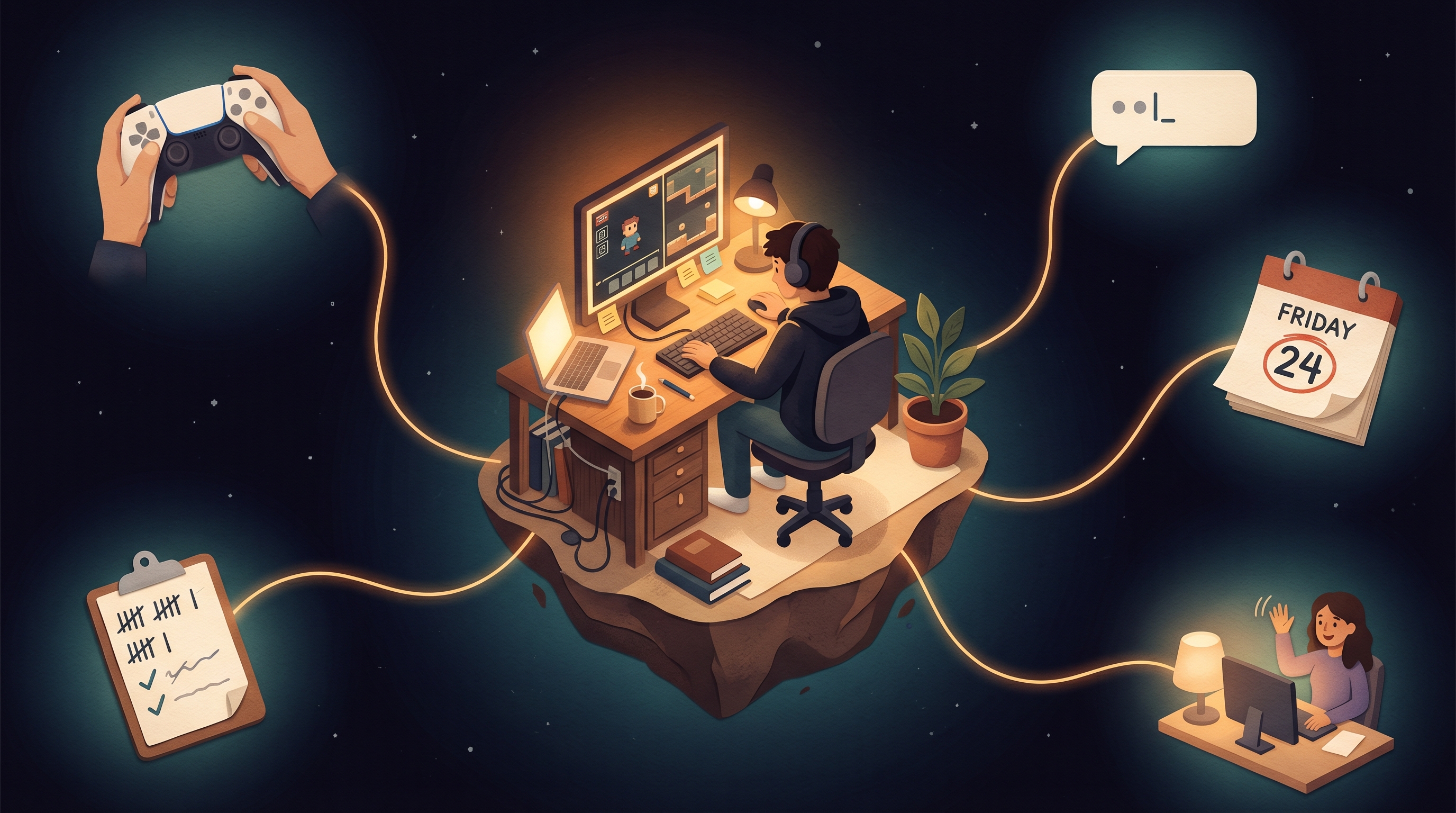
The most useful thing any indie dev has ever said about this question came from one describing what finally changed for him:
"You can make a game solo but not alone, and I never noticed that distinction, and because I didn't notice a distinction I realized that I was super lonely all the time."
Read that twice. The distinction between "solo" and "alone" is the entire post.
You can be the sole creator of a game without being in isolation. You can own every design decision while still having people who playtest your builds on a schedule, call you out when you've been procrastinating for three weeks, and notice when you ghost your own project. That's not a team. That's a structure around a solo developer.
The same dev, after years of pure solo work, didn't fix his isolation problem by finding a cofounder. He fixed it by streaming his dev sessions and running a Discord where he had to show up. Different hands, same project. But suddenly not alone in the room.
Here's what structured solo actually looks like:
- A weekly accountability call with one other dev. Not a five-person server, not a Slack channel with 40 muted notifications. One person who expects to see your progress on Friday.
- A playtester group that expects a build on a cadence. The build shipping becomes the deadline. You can't silently stop when someone is waiting for Thursday's build.
- A shared pool of assets and code you can pull from instead of making every texture, every shader, every save system from scratch.
- Someone who will notice, out loud, when you quietly shelf the project for a shinier one.
None of this requires starting a studio. None of it requires cap-table negotiations, IP splits, or a cofounder conversation. It's the accountability and momentum of a team, without the ghosting tax.
If your graveyard of abandoned projects is real, if you're reading this with three dead prototypes in the back of your mind, this is the path most likely to actually get a game shipped. You don't suddenly develop discipline you've never had. Someone just starts counting on your work by Friday.
How to decide which path fits you
Comparison posts love grids and quadrants. You don't need one. You need answers to five questions.
Should I make my first game solo or with a team?
If you've never shipped a game, start small and solo. You need to feel what "done" actually looks like before adding coordination overhead. But solo does not mean alone. See the structured-solo section above. Start small, stay solo, but put one other dev on the hook for noticing.
My project has stalled for weeks. Do I need a team?
Probably not. Three-week stalls almost always signal missing structure, not missing teammates. Adding headcount on top of zero accountability just makes more ghosts. Fix the structure first.
Does my game's design need one unified vision?
If yes, solo-with-structure beats a team every time. Compromise is the tax of teams. Some games, especially deeply personal ones, can't afford it. Keep the vision solo, add accountability, not co-directors.
There's a skill I don't have and can't learn in time. Should I team up?
Yes. Specific skill gaps (audio, 3D, shader work) are the clearest single reason to bring someone on. But bring them in as a creative partner with retained rights, not a service desk. Artists and composers have opinions; ignoring those opinions is how you end up with the kind of team-ups that die in a month.
I have a graveyard of abandoned projects. Should I try a team this time?
The graveyard is an isolation pattern, not a laziness pattern. Add structure before you add teammates. A weekly accountability call with one other dev will do more than a five-person Discord every time. The reason 90% of indie games die in the idea phase isn't headcount. It's the absence of anyone who will notice when you quietly stop.
The bottom line

The honest answer to "solo or team?" isn't a recommendation. It's a reframe.
Solo is fine. Alone is the problem.
Make your game solo if the vision demands it. Work with a team if the skill gaps demand it. But whichever one you pick, the thing that determines whether you ship isn't in that decision at all. It's the answer to one question:
Who is counting on your work this Friday?
If the answer is "nobody," you already know how this ends. You've seen it end that way before. The fix isn't more willpower. The fix is structure: someone on the hook for noticing, a build on a cadence, a small system of people who have skin in your shipping.
That's what Clowdr is for. Not a Discord. Not a place to post "looking for collaborators" into the void. Not a studio. It's a structured place to be solo without being alone, where you keep your rights, you keep your vision, and someone is counting on your work by Friday. You get a system built for actually finishing instead of another year of good intentions.
Join the Clowdr waitlist. You don't have to do it alone.
Frequently asked questions
Is Stardew Valley really a solo game?
Yes. Eric Barone built Stardew Valley solo over roughly four years. But his own description of the process included ~70-hour weeks and "phases of insane productivity followed by phases where I hardly worked at all" (Game Developer). It's a solo game and a warning label.
Was Celeste made by one person?
No. Celeste was made by a small team of at least seven credited contributors, including director Maddy Thorson, lead programmer Noel Berry, composer Lena Raine, and sound designer Kevin Regamey (Wikipedia). It's frequently miscategorized as a solo project in "solo vs. team" debates.
Was Undertale made by one person?
Not quite. Toby Fox led the project, but Temmie Chang contributed extensively as logo designer, cutscene artist, overworld artist, animator, shop artist, and tile artist, and co-conceived the character Papyrus (Toby Fox Wiki). There is literally an in-game character named after her.
Can one person really make a successful indie game?
Yes, but the survivorship bias is brutal. The visible successes ignore thousands of unfinished projects and multi-year burnout stories. The 2024 GDC burnout survey found 30% of game developers currently experience burnout (Game Developer), with mid-career devs hit hardest. One person can do it. Most who try can't. The isolation wears them down before the talent question even comes up.
How long does it take to make a game solo?
Longer than you think. Stardew Valley's four years at ~70 hours a week is a realistic benchmark for a full-scope commercial game by one person. Smaller projects can ship in months, but anything you'd put on Steam with serious ambitions will typically take multiple years solo.
Is it better to make a game alone or with a team?
Neither. The real question is whether you have accountability. Solo ships games when there's structure around the solo developer: playtest cadence, accountability partner, external deadlines. Teams ship games when the team is small and actually committed. The worst of all worlds is solo-in-isolation with no external pressure, which is the default most indie devs fall into by accident.