
How to Write a Contributor Handoff for Game Artists, Composers, and Designers
Contributor handoff guide for indie devs: brief artists, composers, and designers with context, constraints, rights, and feedback rules.
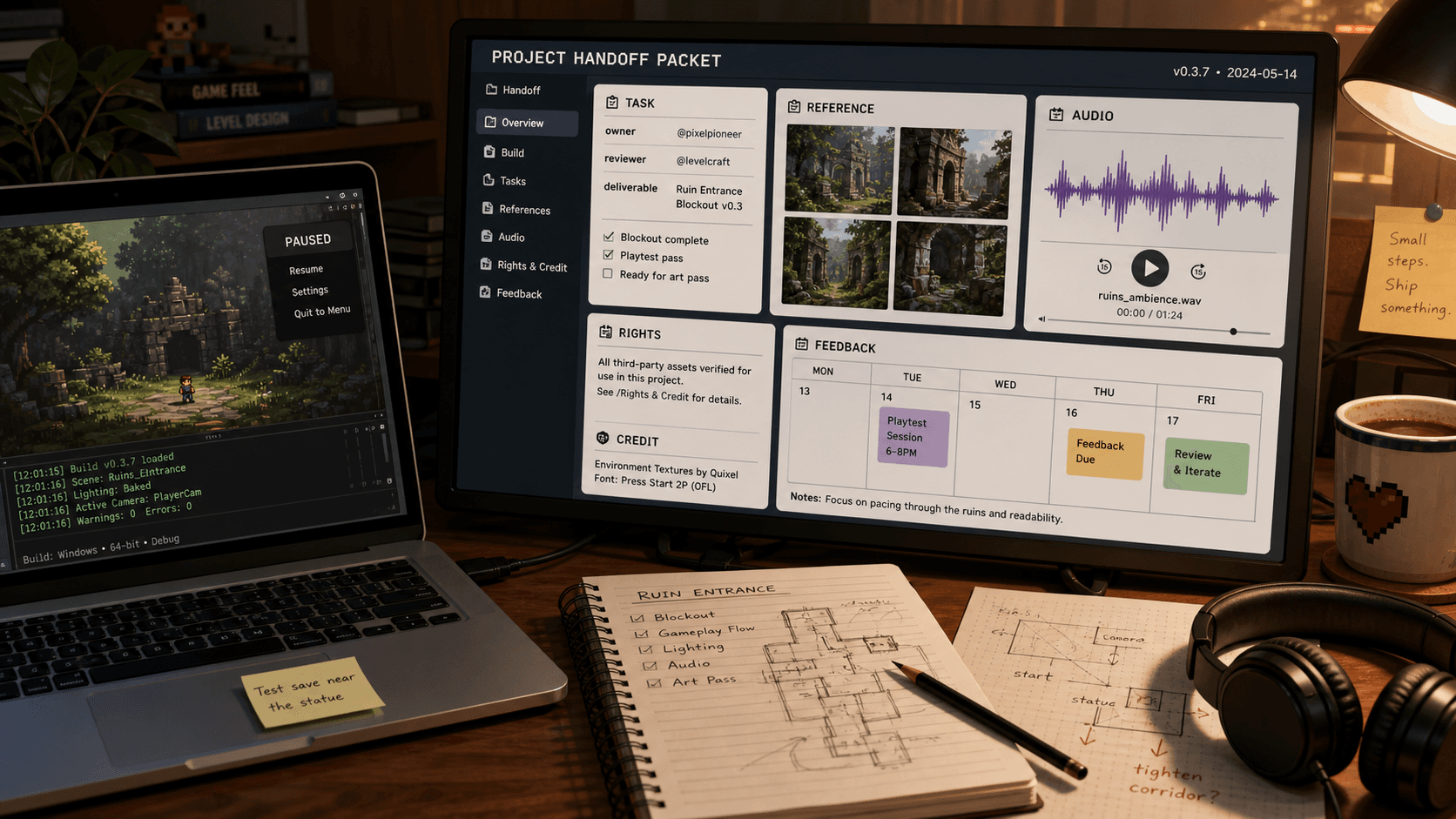
A contributor handoff is the packet of context someone needs before they can do useful work on your game. For artists, composers, audio designers, and game designers, it is the difference between creative partnership and a ticket queue.
By the end of this guide, you will have a one-page handoff format you can use before asking someone for sprites, music, UI, level feedback, mechanics tuning, or sound implementation. The goal is simple: give them enough context to make good decisions, enough constraints to avoid waste, and enough written structure to protect both sides.
Before you start
You do not need a forty-page game design document before you bring in a contributor. You do need enough project reality that the person is not guessing.
Have these ready before you write the handoff:
- A playable build, video capture, prototype, or mockup.
- One sentence that explains the game without lore.
- The current project stage: prototype, vertical slice, production, polish, launch.
- The decision-maker for this handoff.
- A rough budget or contribution model.
- A place where decisions live, such as Notion, Trello, Linear, GitHub Issues, or a shared doc.
If all you have is "I need an artist" or "I need music," stop. You do not have a contributor handoff yet. You have a wish.
1. Name the contributor job precisely
The first job of a handoff is to separate the work. "Art" is not a task. Neither is "audio," "design," or "make it feel better."
A useful handoff starts with the role and the job:
- 2D character artist for one enemy animation set.
- Composer for a thirty-second combat loop and a menu loop.
- Sound designer for player movement, hit confirmation, and UI feedback.
- Level designer for a first-pass blockout of the tutorial room.
- Systems designer for economy tuning on the first ten minutes.
- UI artist for HUD readability and icon treatment.
That sounds basic. It is where most indie project requests fall apart.
Tim Ruswick has a good blunt line in a transcript about hiring artists: "most people don't know what they want." His practical advice is to do a rough version yourself first, even if it is ugly. If you need a jump animation, block in a stick-figure version. If you need combat audio, record a terrible mouth-sound pass against a screen capture. If you need UI, sketch boxes on top of a screenshot.
You are not doing this because your version is good. You are doing it so the contributor can see the shape of the problem.
What to watch for: if your handoff says "make this better," rewrite it. Better how? Faster read? Clearer silhouette? Stronger emotional tone? Less muddy mix? Shorter loop? Lower memory use? The answer changes who you need and what they should deliver.
2. Give project context before the asset list
Creative contributors cannot make good choices from an asset list alone. They need to know what the game is trying to make the player feel and what already exists around the work.
For an artist, context includes genre, camera, platform, resolution, visual references, animation needs, target audience, and the gameplay function of the asset. MLC Studio's guide to a game art brief makes the same point: mechanics and camera matter because the art has to work inside the game, not just look good in isolation.
For audio, context is even easier to skip because the asset names sound obvious. "Jump sound" feels like enough until the composer or sound designer asks: heavy character or light character? Cartoon or grounded? Does it play every jump, only charged jumps, or only landings? Does it need to cut through music? Does it trigger from animation, physics, or state change?
Akash Thakkar uses the Joshua Bell subway experiment to make a career point about demo reels, but the lesson transfers cleanly to handoffs: context changes how people value and interpret creative work. Drop audio into the wrong context and even good work reads wrong.
Your handoff should include:
- The game in one sentence. No lore dump. No genre soup.
- Player fantasy. What should the player feel while interacting with this feature?
- Current build state. Prototype, vertical slice, production, or polish.
- Existing references. Screenshots, clips, mood boards, music references, mechanics examples.
- Non-goals. What this should not become.
- Where this appears. Level, menu, combat state, cutscene, boss, onboarding, trailer, Steam page.
The non-goals line matters. "Not cute," "not orchestral," "not high contrast," "not another currency," and "not a full rework" save more time than another ten reference images.
3. Define constraints before taste
Taste conversations get expensive when constraints are missing.
"Can you make it punchier?" is a bad first feedback note if the composer did not know the loop had to sit under constant weapon SFX. "Can you make it more readable?" is late feedback if the artist did not know the sprite would render at 64 pixels tall on Switch. "Can you make this economy less grindy?" is vague if the designer does not have retention goals, session length, or reward timing.
Put the constraints in the handoff before subjective feedback begins.
For artists:
- Canvas size or model budget.
- File format and layer expectations.
- Animation count and frame count.
- Palette, lighting, camera, and readability constraints.
- Engine import rules.
- What existing assets it must match.
For composers and audio designers:
- Length, loop behavior, stems, loudness targets, and export format.
- Middleware or engine implementation needs.
- Trigger conditions and game states.
- Mix priorities: what must cut through, what can sit back.
- Whether the contributor owns implementation or only asset creation.
For designers:
- Player goals, metrics, tuning range, current build behavior.
- Systems touched and systems off-limits.
- Data format, spreadsheet structure, or engine access.
- What counts as accepted: paper spec, playable prototype, balancing pass, or shipped values.
A Sound Effect's game audio task planning guide has a useful standard here: tasks should be readable, trackable, purposeful, and accountable. That is the bar for every contributor handoff, not just audio.
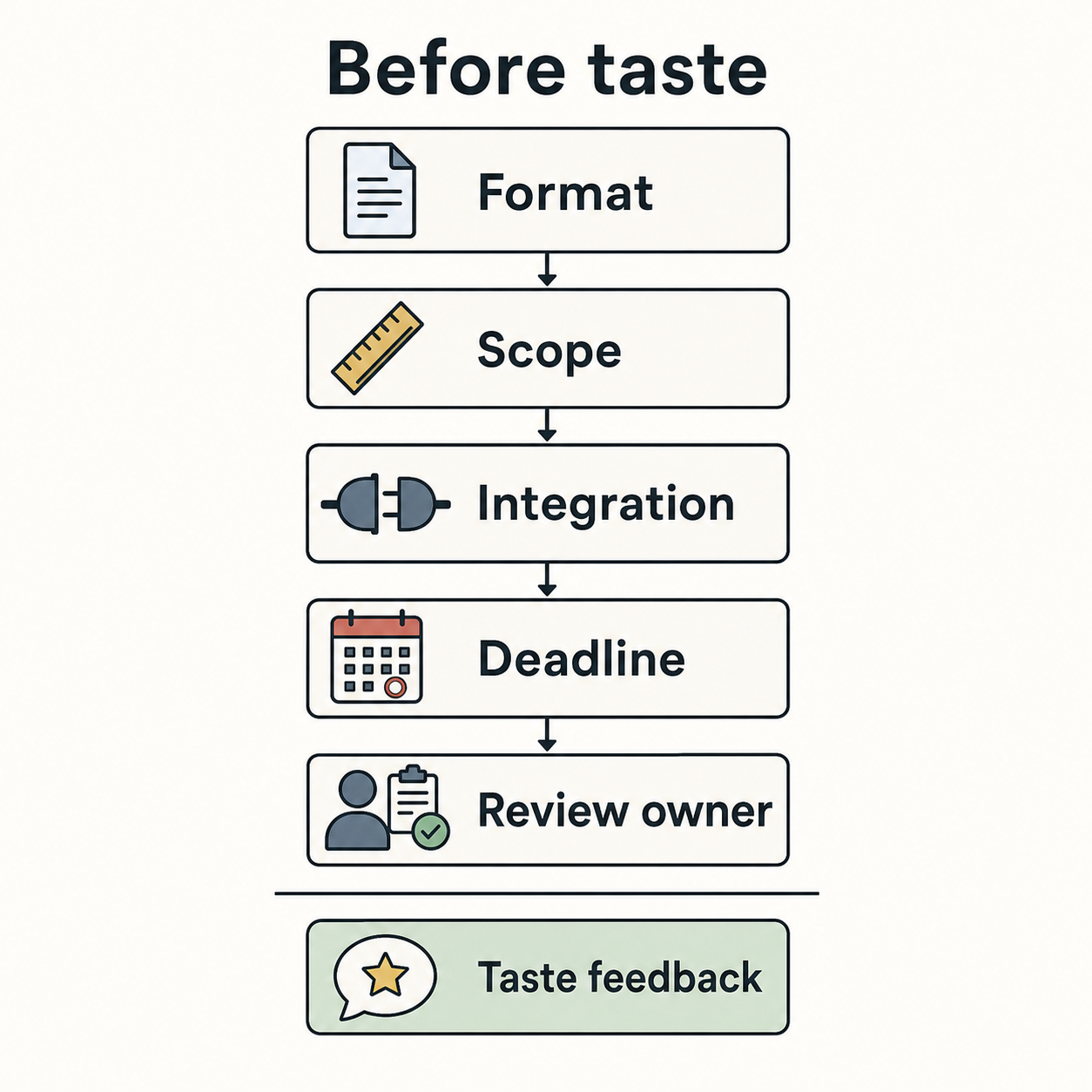
What to watch for: if the first meaningful constraint appears after the first delivery, you are not revising. You are correcting a bad handoff.
4. Turn the handoff into one owned task, not a vague role
Small indie projects love shared responsibility until something slips.
"Alex and Mina own art direction" sounds collaborative. It usually means nobody knows who signs off the sprite. A project-management transcript in the repo puts it cleanly: "if two people are accountable for something then no one is accountable for it."
Use one handoff per owned task. The card can mention everyone involved, but it needs one owner and one reviewer.
A good task card has:
| Field | Example |
|---|---|
| Owner | Mina |
| Reviewer | Alex |
| Dependency | Combat prototype video, enemy state chart |
| Deliverable | One enemy attack animation, 12 frames, layered source + exported PNG sheet |
| Acceptance criteria | Reads at 64px, wind-up frame visible for 200ms, export imports into Unity without slicing fixes |
| Due date | Friday, May 29 |
| Review state | In review before done |
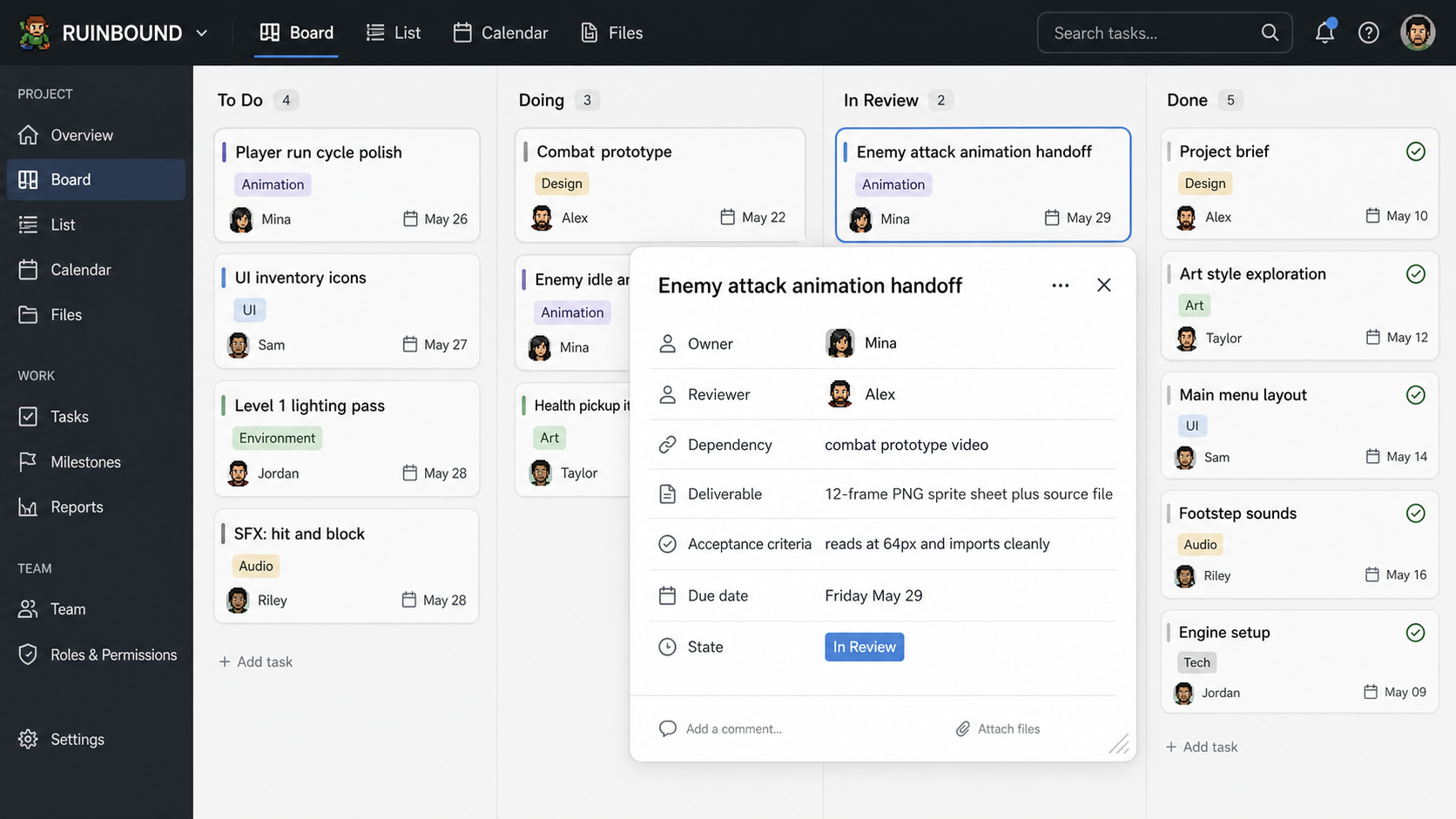
That "in review" state matters. Done by the contributor and accepted by the project are different moments. If your board only has "to do, doing, done," the contributor has to guess whether done means uploaded, tested, integrated, approved, or shippable.
For audio, acceptance criteria might include a video showing what sound should trigger when, repro steps, state names, and a build check. The A Sound Effect guide recommends that kind of third-party check because it lets someone confirm the result without relying on the original audio person to explain everything live.
For design, acceptance criteria might be a playtest script, a before-and-after tuning table, or a short Loom showing the new behavior in context.
What to watch for: never put "final art pass" or "audio polish" on a card unless the card says which assets, which scenes, which owner, which acceptance criteria, and which reviewer.
5. Put rights, credit, and portfolio use in writing early
The handoff is not only about creative context. It also has to answer the uncomfortable questions before anyone does valuable work.
Artists and composers have been burned by dead projects, vague upside, and portfolio restrictions. The customer research in this repo has the line that matters: "Artists can typically only showcase their work on personal portfolios for shipped games, not cancelled ones." If your game dies and the contributor cannot show the work, you did not only waste their time. You trapped the proof that they did the work.
Your contributor terms do not need to be a legal cathedral. They do need to be written.
Cover:
- What the contributor is making.
- Payment, upside, or other consideration.
- Who owns the work, or what license the project receives.
- Whether the contributor can show the work in a portfolio.
- Credit language.
- Revision limits.
- What happens if the project stalls or the contributor leaves.
- What happens if the project ships, ports, expands, or gets a sequel.
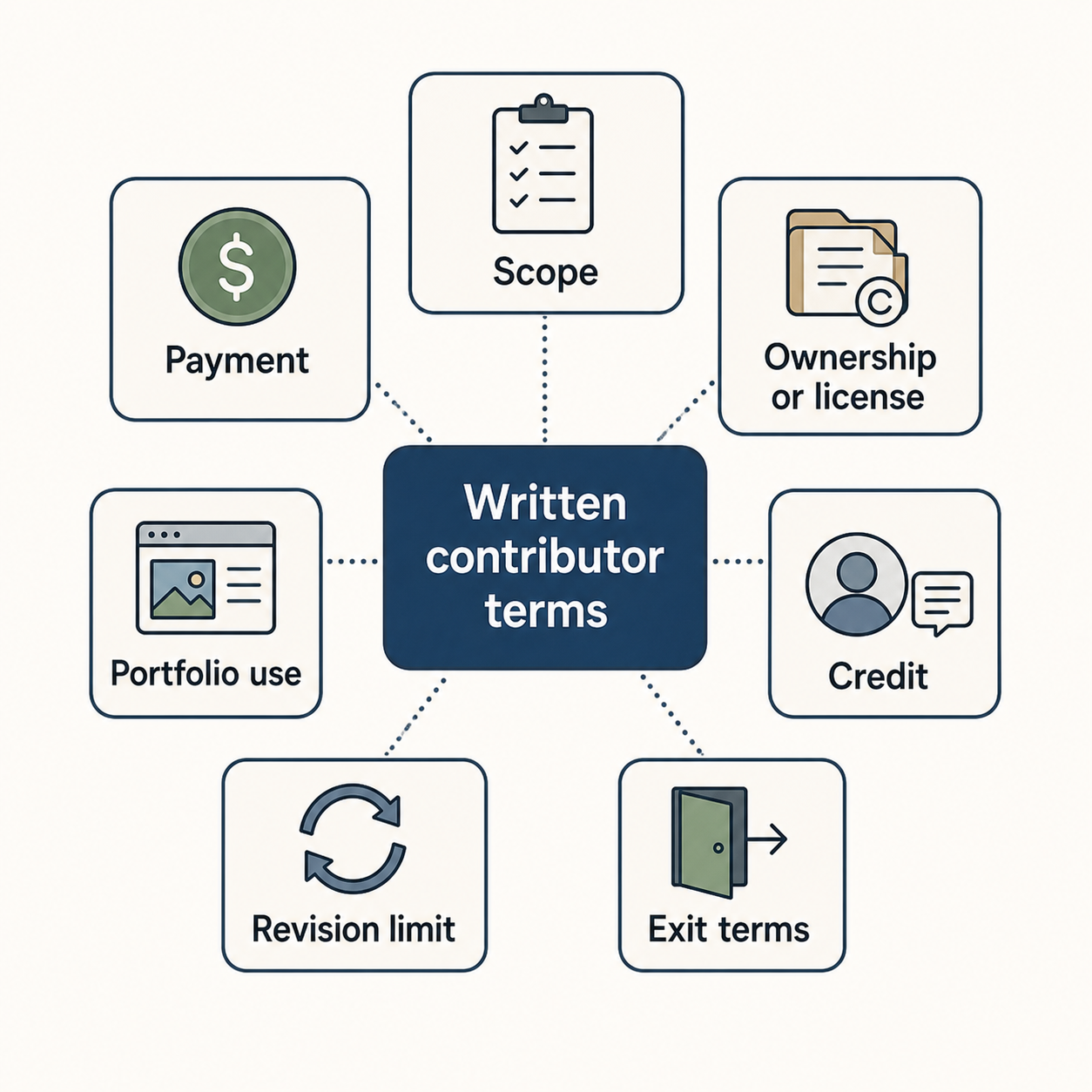
Legal GPS's 2026 audio engineer and sound design agreement summary lists the same practical buckets: scope, technical specifications, ownership rights, revision limits, payment structure, credit, portfolio usage, milestones, and written amendments. You still need real legal review for real contracts, but the checklist is the point.
Do this before the first meaningful deliverable. "We will sort out paperwork later" moves the risk onto the contributor with the least bargaining power.
If this is the part you are avoiding, read How to Spot Rev-Share Red Flags Before You Join an Indie Game Project and Working as a Game Composer for Free. Both posts exist because these problems repeat.
6. Set the feedback loop before first delivery
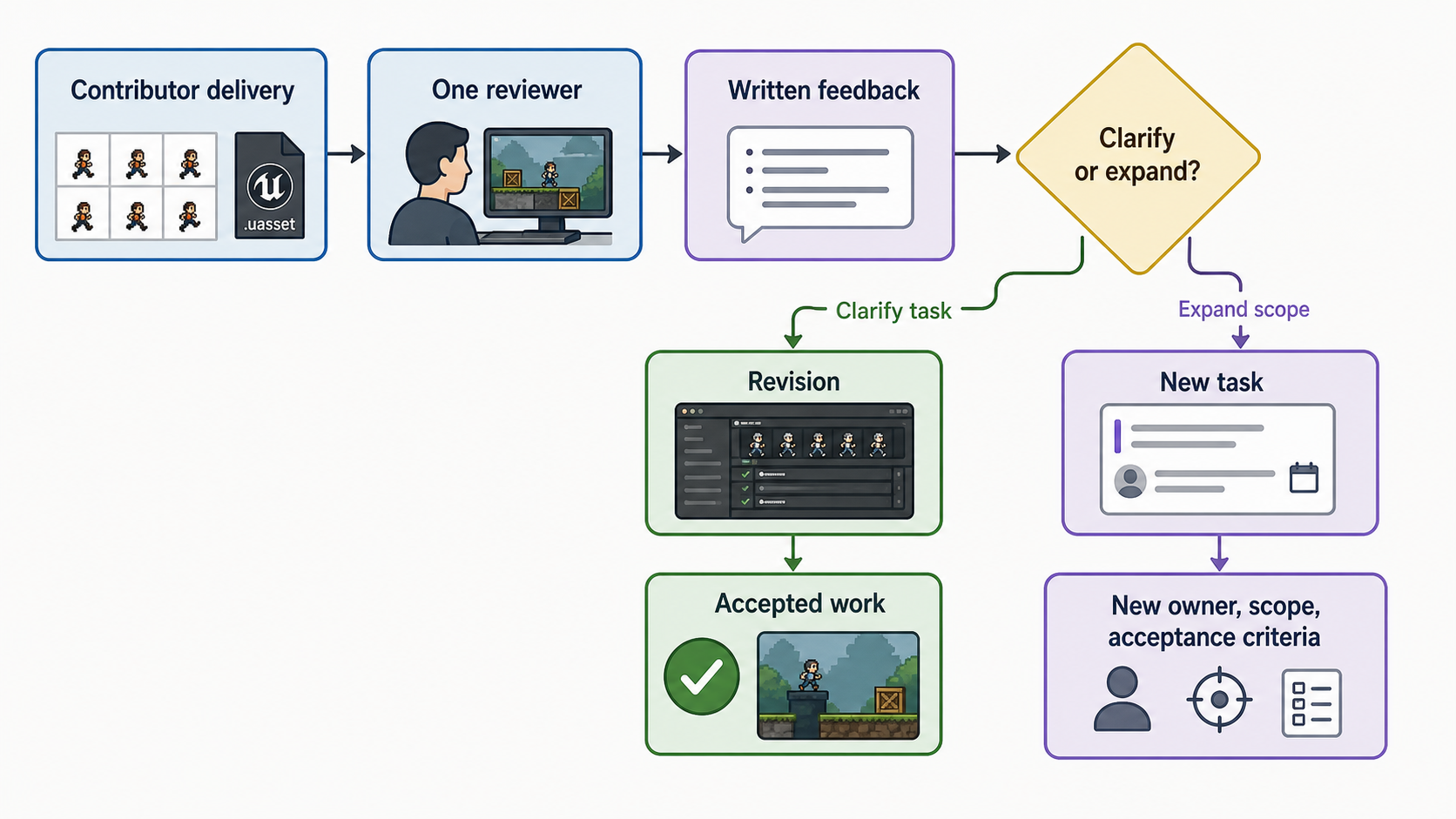
Feedback is where a handoff either becomes trust or turns into scope creep.
Decide the feedback loop before the first delivery:
- Who gives final feedback?
- Where does feedback live?
- How often does review happen?
- How many revision rounds are included?
- What kind of feedback creates a new task instead of changing this one?
- What happens when feedback conflicts?
One reviewer beats five drive-by comments. A weekly review beats rolling Slack pings. Written feedback beats a voice call everyone half-remembers differently.
A Sound Effect warns that formal feedback should prevent actions from becoming additions on top of the original task. That is the exact failure small projects hit. Someone asks for "one small tweak," then another, then another, and the contributor realizes the task no longer matches the agreement.
Use this rule: feedback can clarify the task, but it cannot silently expand the task.
If you want the composer to add a stinger, the artist to create an extra hit frame, or the designer to rebalance a second system, make a new card. Attach it to the original task if needed. Give it its own owner, scope, and acceptance criteria.
What to watch for: "while you are in there" is usually unpaid scope expansion wearing a friendly hat.
7. Keep the handoff alive as the project changes
Game projects move. Mechanics change. Characters get cut. A scene changes from forest to factory. The audio trigger moves from animation event to state machine. The UI gains a new constraint because Steam Deck text is unreadable.
That does not mean the handoff failed. It means the handoff needs maintenance.
Update it when:
- A dependency changes.
- A reference is accepted or rejected.
- A deliverable is split into smaller tasks.
- The reviewer changes.
- A technical requirement changes.
- A decision affects rights, credit, scope, timeline, or budget.
- A piece of work is accepted.
The game design document is often described as a living document because game development changes as production reveals the actual project. Your contributor handoff is the small version of that. It should be stable enough to prevent chaos and alive enough to stay true.
This is where structured rituals help. A weekly accountability call, an in-review column, and a short decision log do more for contributors than another Discord channel. If your current setup is a chat room with pinned messages, read Discord Server vs. Game Dev Team next.
8. Use this contributor handoff template
Copy this into a doc, issue, or project card. Keep it short. One page is the target.
## Contributor handoff

### Project context
- Game:
- Current stage:
- One-sentence pitch:
- Player fantasy:
- Platform/camera/engine:
- Relevant build, video, or screenshot:
- Non-goals:

### Contributor job
- Role:
- Task:
- Owner:
- Reviewer:
- Due date:

### Constraints
- Format:
- Dimensions, length, budget, or data shape:
- Engine, middleware, or import requirements:
- Existing assets or systems this must match:
- Dependencies:
- Off-limits changes:

### References
- Reference 1:
- What to copy from it:
- What not to copy:
- Reference 2:
- What to copy from it:
- What not to copy:

### Deliverables
- Files or spec:
- Source files:
- Exported files:
- Implementation responsibility:
- Acceptance criteria:

### Terms
- Payment or contribution model:
- Ownership or license:
- Portfolio use:
- Credit:
- Revision limit:
- Kill, pause, or exit terms:

### Feedback
- Review cadence:
- Feedback location:
- Final decision-maker:
- What counts as a new task:

### Open questions
- Question 1:
- Question 2:
The template is boring on purpose. Boring protects the work.
What to do next
If the next contributor is an artist, read How to Work With a Game Artist on Your Indie Project. If the next contributor is a composer, read Working as a Game Composer for Free before you write anything that smells like exposure. If the problem is cadence, Accountability Circles gives you the weekly ritual.
The larger point is structural. Artists, audio people, and designers do not become service desks because they lack opinions. They become service desks when the project gives them no context, no rights clarity, no feedback boundary, and no way to shape the work before it is too late.
Clowdr is built for the opposite pattern: contributors pick up scoped tasks, keep their rights, work from written agreements, and ship inside a structure where someone is counting on the work by Friday.
Sign up for Clowdr if you want contributors to enter your project with context instead of guesswork.