
The Ship-It Friday Ritual: How to Run a Weekly Demo That Forces Your Indie Game Forward
Ship-It Friday is a weekly demo habit for indie game dev that turns vague weeks into shipped ones. Seven steps — pick the unit, set the slot, run the demo.
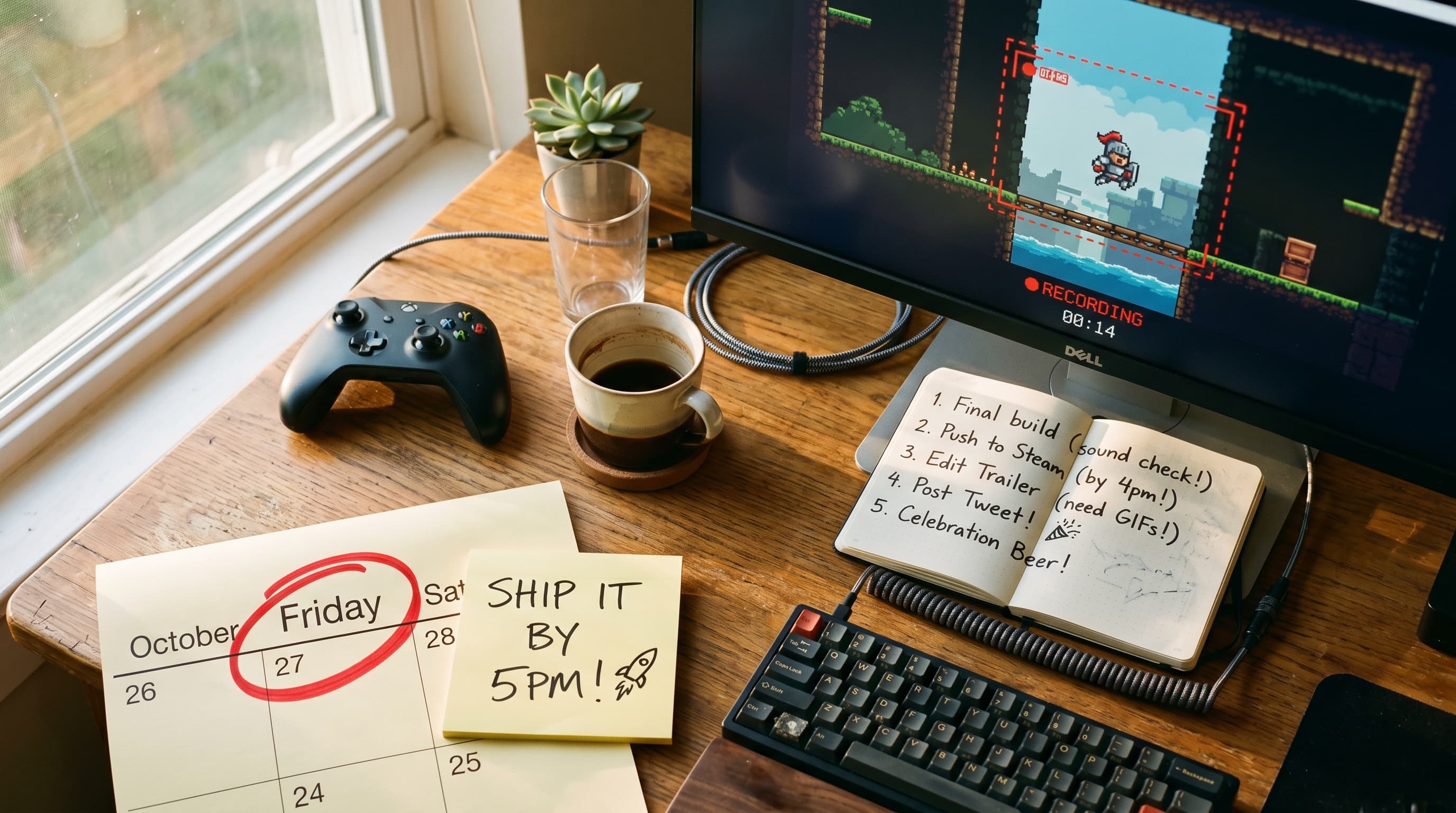
Every week without a witness is a week the game can disappear. A Ship-It Friday ritual forces a weekly shippable — five minutes of playable, or a single captured GIF, or a visible change to one system — against a deadline someone else can see. By the end of this guide you'll know how to pick the unit, set the slot, choose the audience, and run the demo on the weeks when real life wins.
What you need before you start: a current build in any state, one recurring 60-minute calendar block, and at least one person who'll notice if you skip.
1. Diagnose the real failure mode: you don't lack willpower, you lack a witness
The week starts with a vague plan — "polish the dash system" — and ends somewhere between a half-refactored input layer and a tab full of Reddit. This isn't a discipline problem. It's a witness problem.
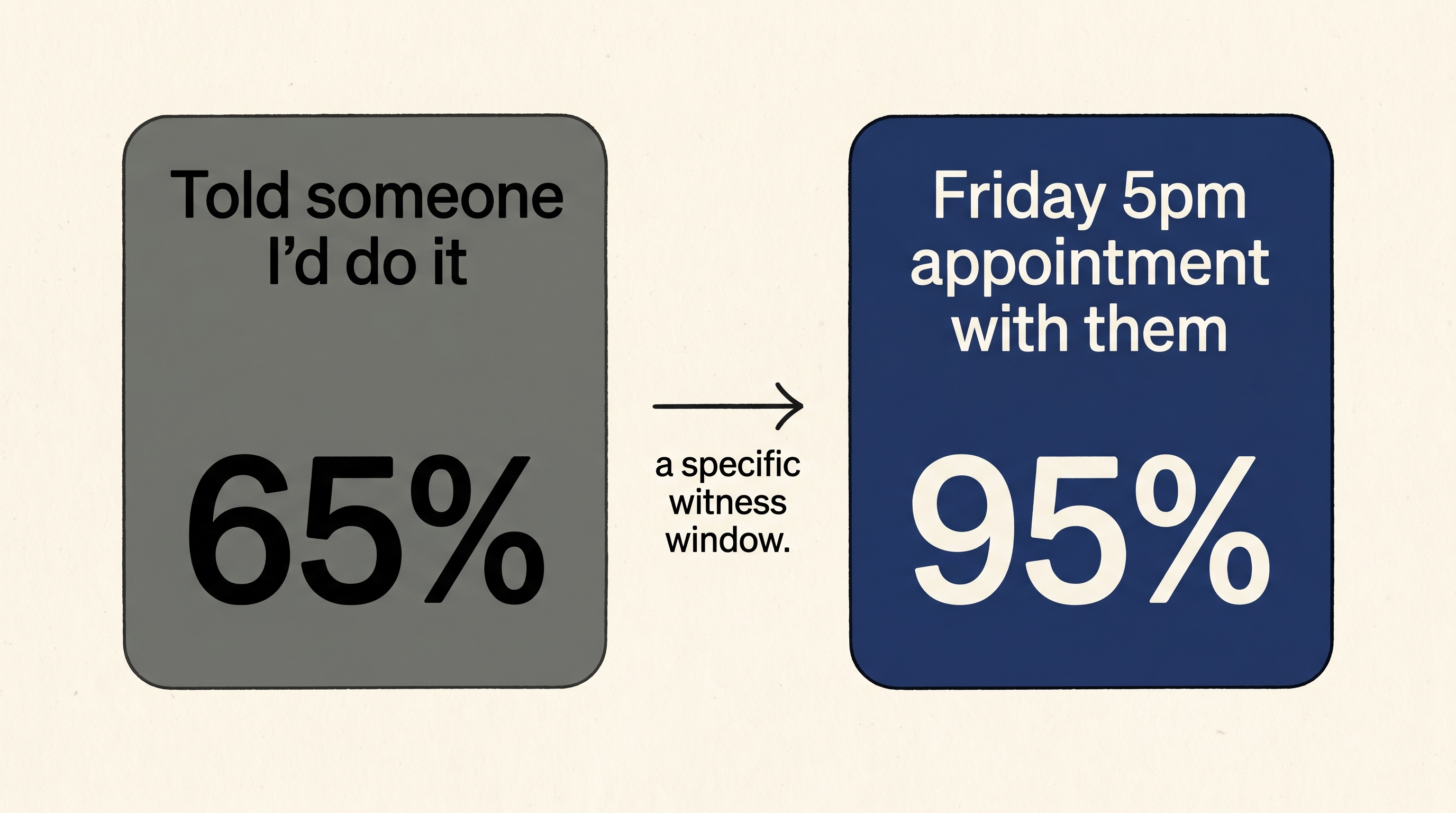
The numbers are blunt. A meta-analysis by Peter Gollwitzer and Paschal Sheeran covering 94 studies found that implementation intentions — goals specified as when, where, and how — produce a medium-to-large effect (d = 0.65) on whether the goal actually gets done. ASTD-attributed accountability research sharpens that: the probability of finishing a goal rises from 65% (you told someone you'd do it) to 95% (you set a specific accountability appointment with that person). "I'll work on the dash system this week" is 65%. "Friday 5pm, I'll post a GIF of the new dash in #demos" is 95%.
You're not lazy. You're unsupported. A Ship-It Friday ritual is the cheapest way to manufacture the witness condition, even when you're solo.
2. Pick what "shippable" means this week (the five-minute version)
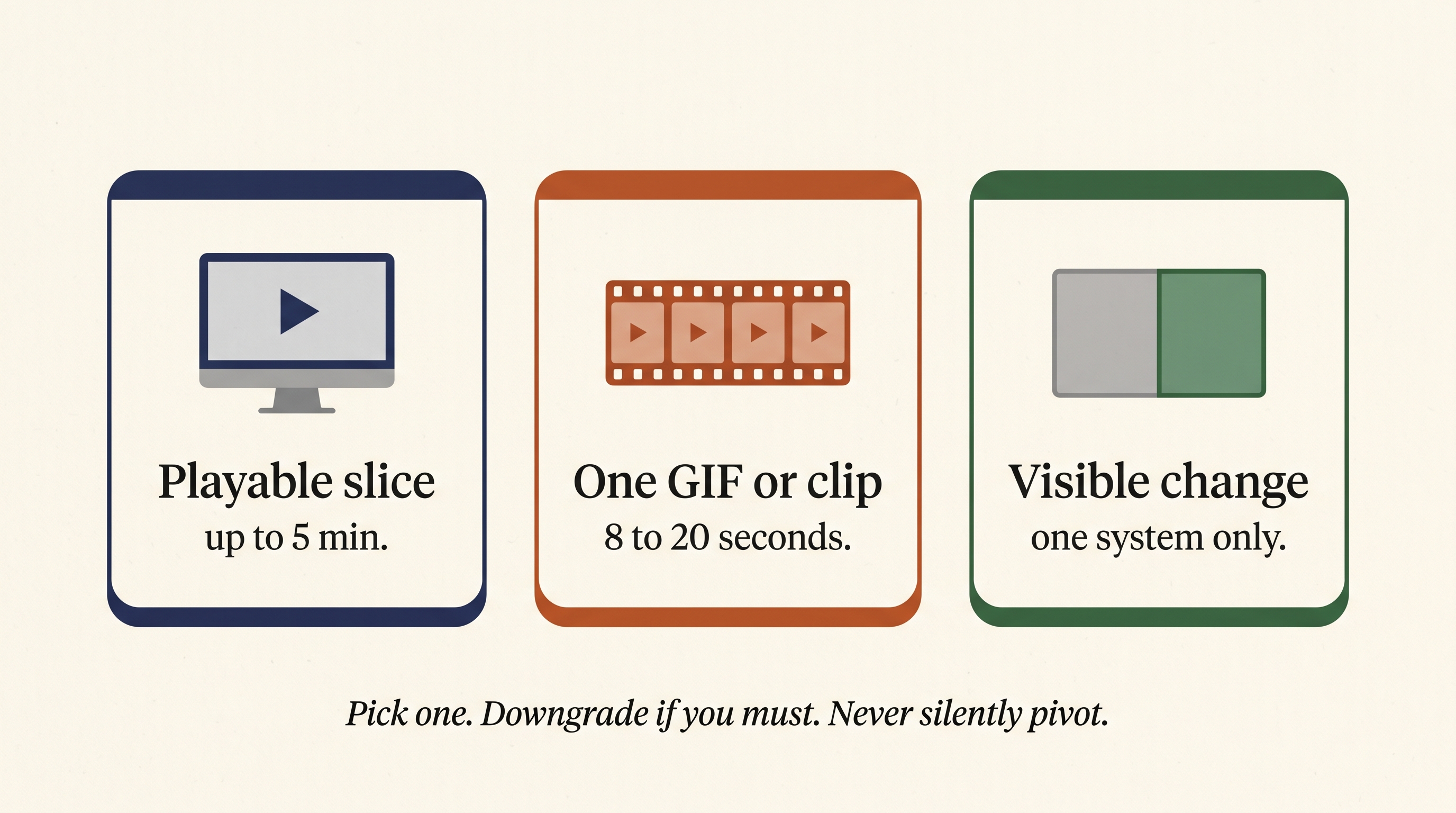
Before you set the slot, decide the unit. A weekly shippable is not a milestone. It's the smallest artifact that proves you moved. Three valid shapes:
- A playable slice — up to five minutes of gameplay someone can run. Prototype-quality is fine; jank is fine.
- A single captured GIF or clip — one new behaviour, rendered in-engine, 8–20 seconds long.
- A visible change to one system — a UI pass, an enemy behaviour swap, a camera rework. Shown as a before/after.
Chris DeLeon, who has run the Home Team Game Dev club since 2004, is blunt about why this works: "All I'm gonna focus on is just a final deadline." His club has shipped hundreds of games on that principle because every pitch comes with a concrete release date attached, not a vague "when it's done." The weekly version is the same idea at a shorter interval — every Friday is a mini-release.
The unit is not negotiable once the week starts. If you pick "playable slice" on Monday and by Wednesday you realise the level isn't going to be ready, you don't upgrade the promise. You downgrade it: a GIF of the part that is working. Shipping down is shipping. Silent pivoting is not.
3. Set the Friday time and the ugly-commit rule
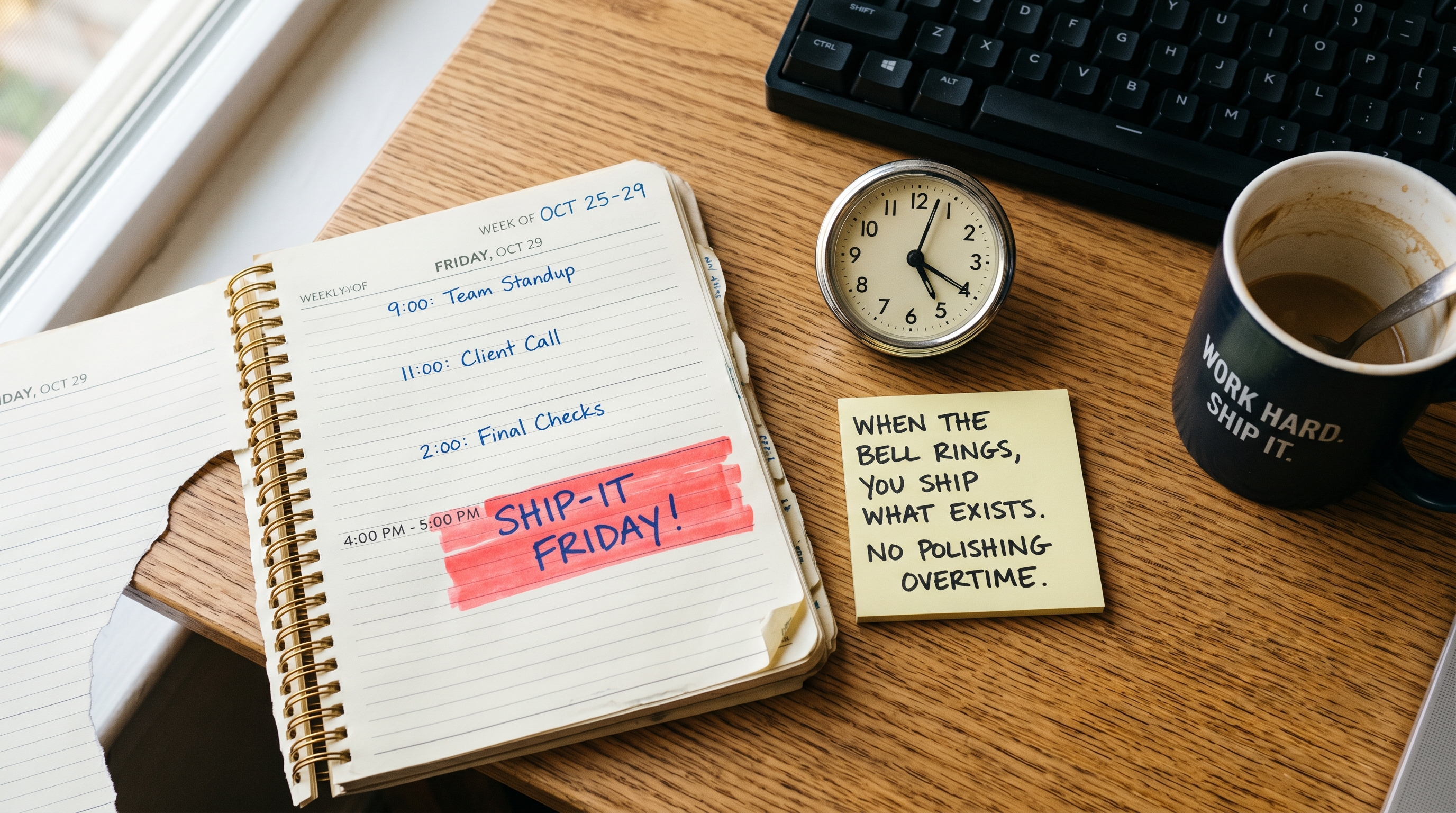
Pick a recurring 60-minute block. Friday afternoon is conventional because it caps the work-week and gives the weekend clear. Write it as an implementation intention: "Every Friday, 4–5pm local, I post the week's build to [channel]." Put it on the calendar now, not at the end of this article.
Then adopt the ugly-commit rule. When the bell rings, you ship what exists — broken, ugly, partial. No polishing overtime. No "let me just fix one thing."
The first few Fridays will be hard because the impulse is to hide. Host Tim Ruswick describes ghosting his own YouTube channel for months before breaking the spiral with a rule he calls "post the crappiest video I can." The point isn't to produce crappy work. The point is that the shame spiral only breaks when you ship once despite the shame. After three Fridays of ugly commits, the Friday slot stops being a performance and starts being a valve.
What to watch for: scope creeping back into the week because "I can fix it before Friday." If the fix doesn't fit in the week you have left, it doesn't fit in this Friday. Cut it and note it for next week.
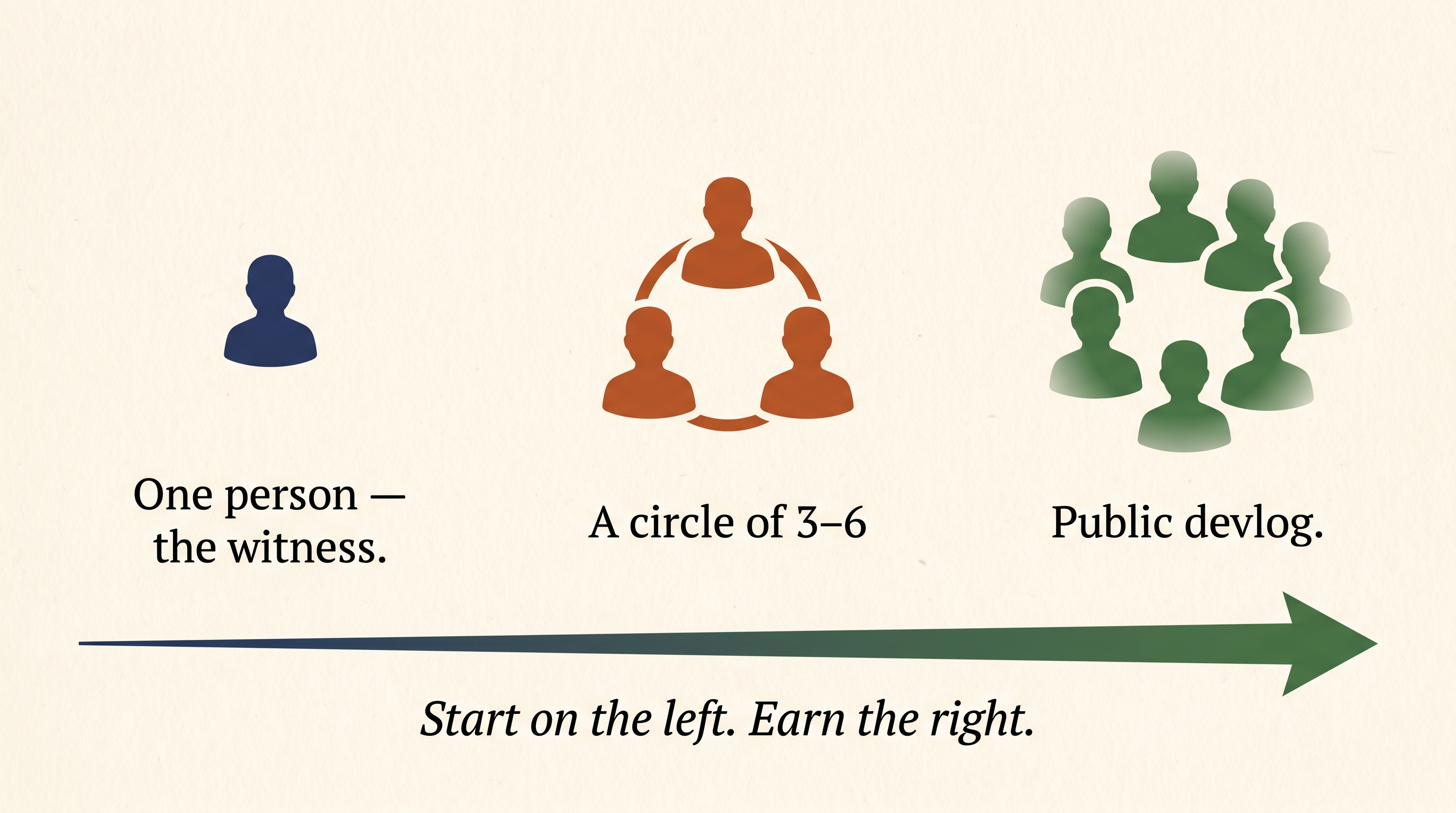
4. Choose your audience: one person, a three-person circle, or a public devlog
A lot of advice on weekly demos assumes you already have an audience. You don't need one. You need a witness. These are different.
The spectrum, from week-one to late-game:
- One person. A single dev, artist, or composer who replies by Monday. Lowest overhead, highest accountability density. The bar to start.
- A three- to five-person circle. A small channel where everyone ships on Friday and everyone reads. Each person's demo is low-stakes; skipping is high-stakes because four people will notice. This is the structure described in our accountability circles playbook.
- A public devlog. Twitter, Bluesky, Mastodon, a Discord server, an itch.io page, Screenshot Saturday. This is the late-game version. Vlambeer ran Nuclear Throne "performatively" via bi-weekly livestreams and weekly playable Early Access builds — making the game itself their marketing. By 2015 that cadence drew over 12,000 paid Twitch subscriptions. Butterscotch Shenanigans has sustained a weekly public podcast, Coffee with Butterscotch, since 2015. These devs earned the audience with months of private cadence first.
Start with one person. Upgrade only when the Friday slot has been non-negotiable for six straight weeks. A public audience that never replies is worse than one teammate who does — silence at scale is the fastest way to stop posting.
5. Structure the demo: the three-beat format
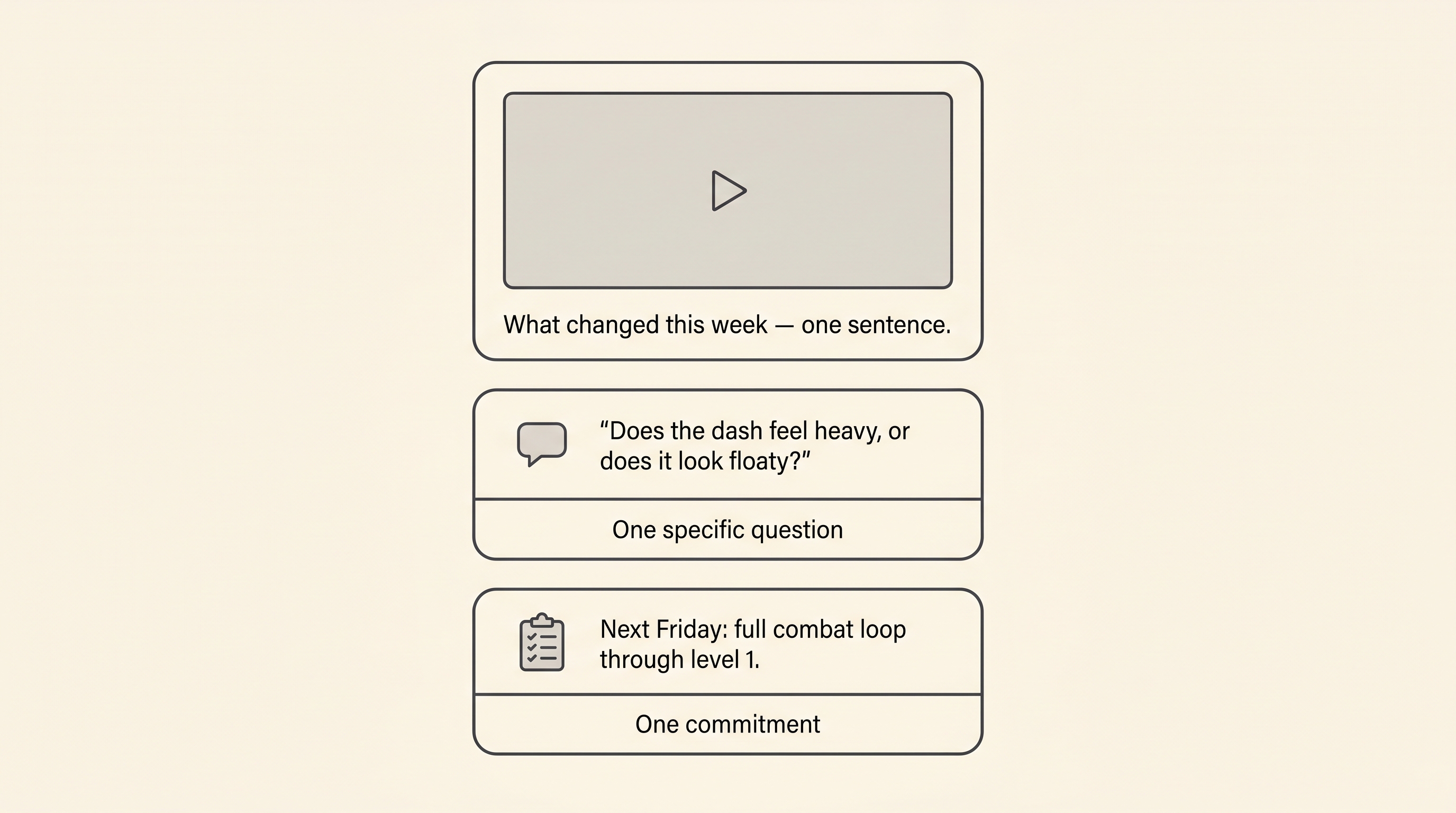
The demo post or recording should always have three beats, in order. This keeps you from rambling and makes replies actionable.
- What changed this week. One sentence plus the artifact (clip, GIF, screenshot, playable link). Resist the urge to explain design context. The artifact speaks.
- One specific question. Not "thoughts?" Not "feedback welcome." A single targeted question: "Does the dash feel like it has weight, or does it look floaty?" This is the difference between getting likes and getting usable feedback.
- The single thing you're shipping next Friday. One line, one artifact type committed. This becomes Monday's first task.
Three beats, every Friday. Over a quarter, you build a searchable log of change, question, and commitment — the clearest picture of the project's actual velocity you'll ever have. At milestone review time, this log is more honest than any status doc you could write.
6. Handle the week that collapsed: the fallback protocol
Real life wins some weeks. A sprint at your day job, a sick kid, a crisis in the other project. The failure mode isn't missing the shippable — it's going silent, then quietly not posting the next week either. Ghosting your own ritual.
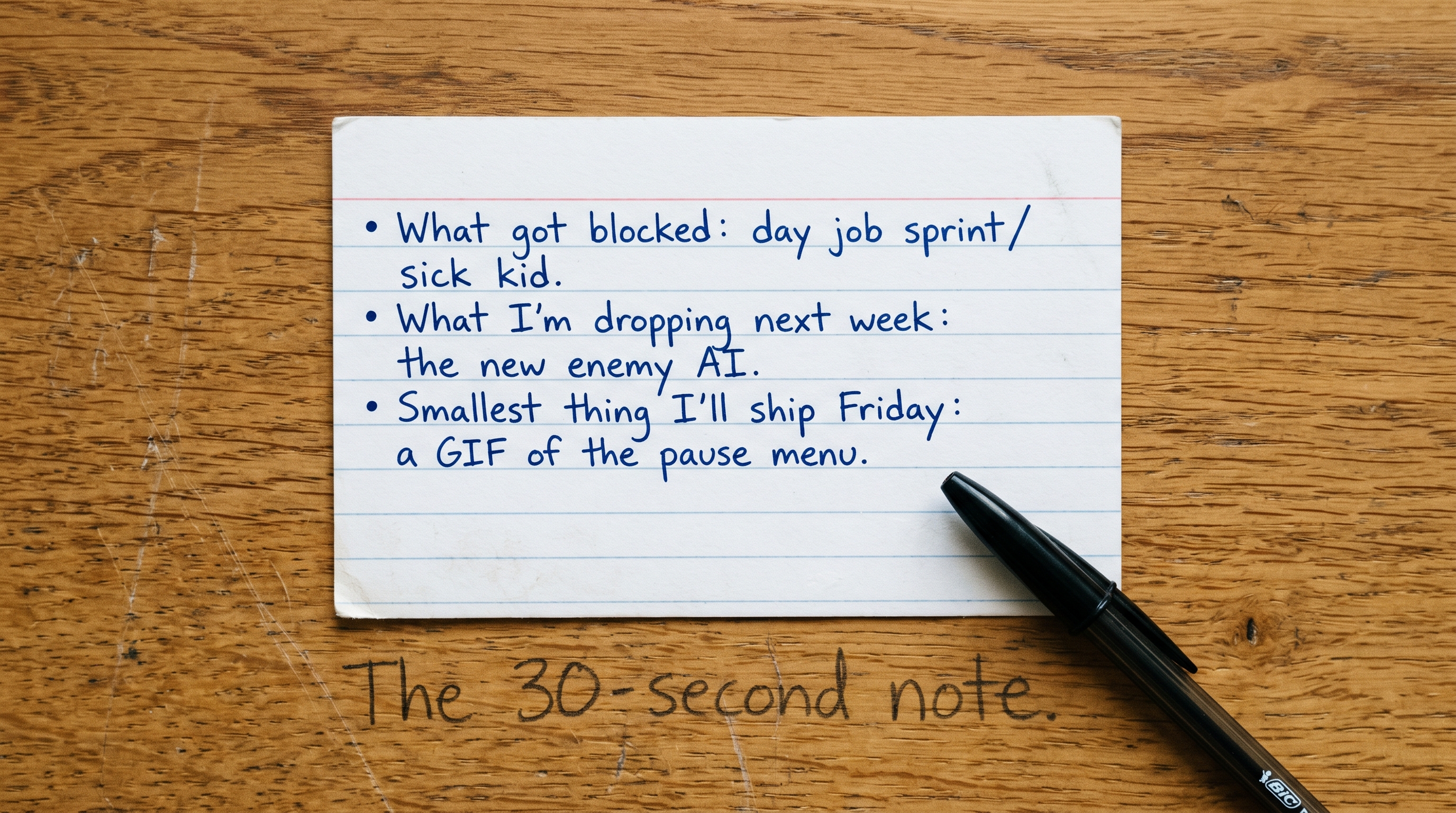
The fallback is a 30-second note, posted at the normal Friday slot:
- What got blocked (one sentence).
- What you're dropping from next week's plan to make room.
- The smallest thing you can commit to shipping next Friday — even a GIF of a menu tweak counts.
This looks trivial and it is. That's the point. The ritual isn't "ship every week" — the ritual is "show up every week." The commitment contract stays intact, the witnesses stay engaged, and the shame spiral never starts.
What to watch for: two fallback weeks in a row. That's a signal something structural has shifted — scope, time, or health — and the weekly unit needs to be renegotiated, not muscled through.
7. Close the loop: one piece of feedback in, one change out, before Monday
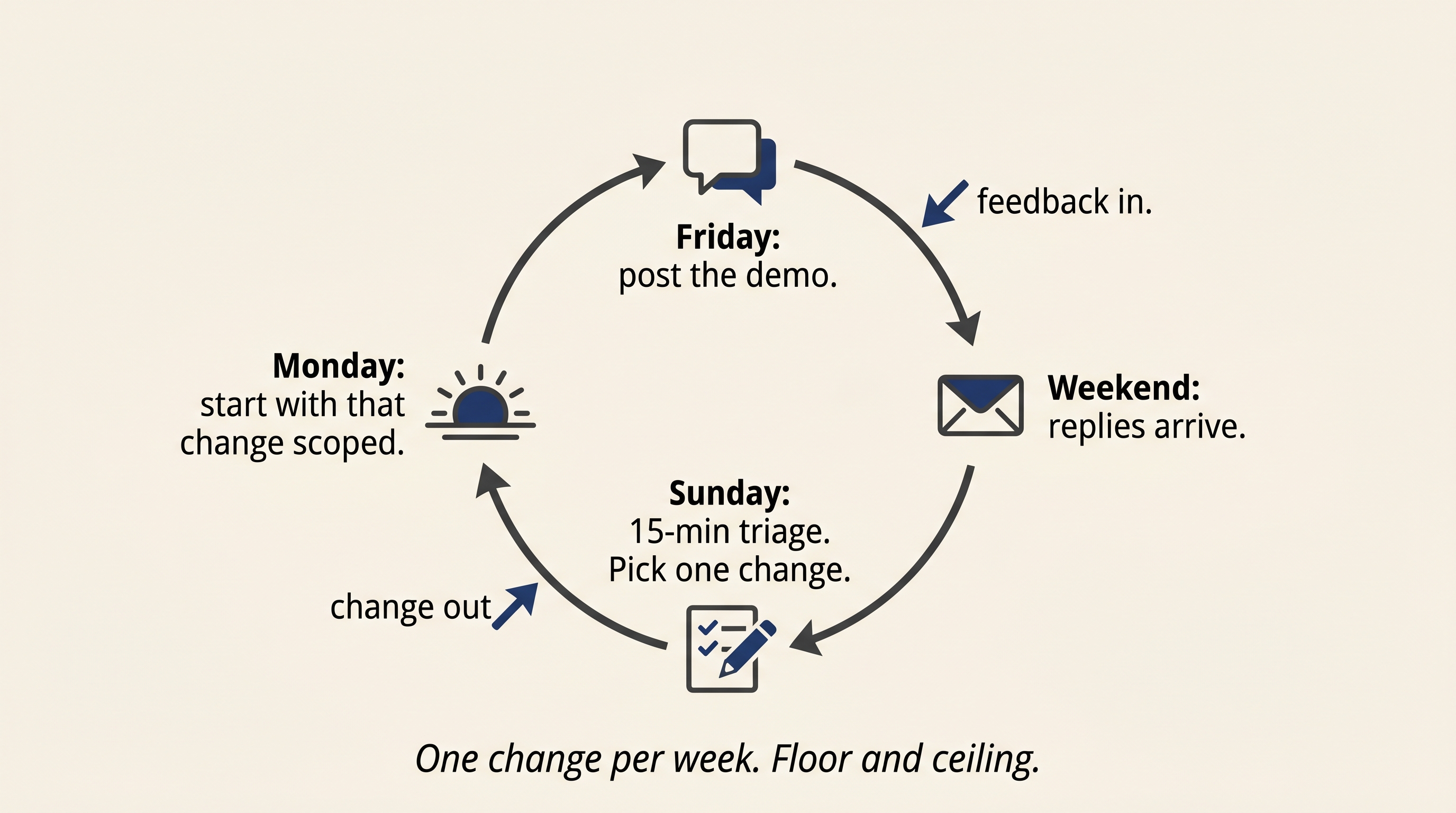
A weekly cadence fails when the demo is send-only. The fix is a Sunday-night triage, 15 minutes:
- Read every reply to Friday's demo.
- Pick exactly one change to make based on the feedback.
- Write it as Monday's first task.
One change per week is the floor and the ceiling. Pick the change that a witness would notice next Friday. Ignore the rest — not forever, but for this week. If five people ask for five different things and you try to address all of them, Friday's demo becomes a justification document instead of a piece of forward motion.
This loop is what makes a Ship-It Friday compound. Vlambeer's public cadence worked not because they posted more, but because they visibly shipped the change someone had asked for the week before. Feedback in, change out, new artifact, new question. That's the real flywheel.
Common pitfalls
- The status meeting drift. A weekly demo is not a Monday standup rolled to Friday. If the post becomes "here's what I worked on," it dies. Keep it artifact-first, always.
- The scope slip. "I can fix it before Friday" is the sound of next week's demo getting smaller, not this week's getting bigger.
- The silence spiral. Two skipped Fridays become four. Use the fallback protocol before you've missed anything.
- The wrong audience. A thousand followers who never reply is not a witness. One teammate who does is.
What to do next
A Ship-It Friday is one ritual inside a larger system. Stack it with three others:
- Hold the Friday slot with a small team. The ritual has more torque when other people's demos anchor yours. See Accountability Circles: How to Run the Small-Team Ritual That Replaces the Indie 'Family' for the 3–6 person structure that pairs directly with this playbook.
- Know what weekly demos look like at milestone scale. A Ship-It Friday is a one-week unit. A vertical slice is a one-quarter unit. The Vertical Slice Protocol shows how the weekly cadence telescopes up.
- Use the cadence to push through the last 10%. Where this ritual really earns its keep is the endgame. The Ninety-Ninety Rule breaks down why the final stretch stalls and how a weekly witness drags it over the line.
If you don't have the one person yet — the teammate who'll notice if you skip Friday — that's the problem Clowdr is built to solve. Sign up for Clowdr and get a teammate who's counting on your build by Friday. It's structural accountability, not another Discord server.