
Scope Creep Is Killing Your Game: A Practical Guide to Cutting Features
Scope creep in game development kills indie projects. A five-question framework, backlog system, and ship-date plan to cut features and ship your game.
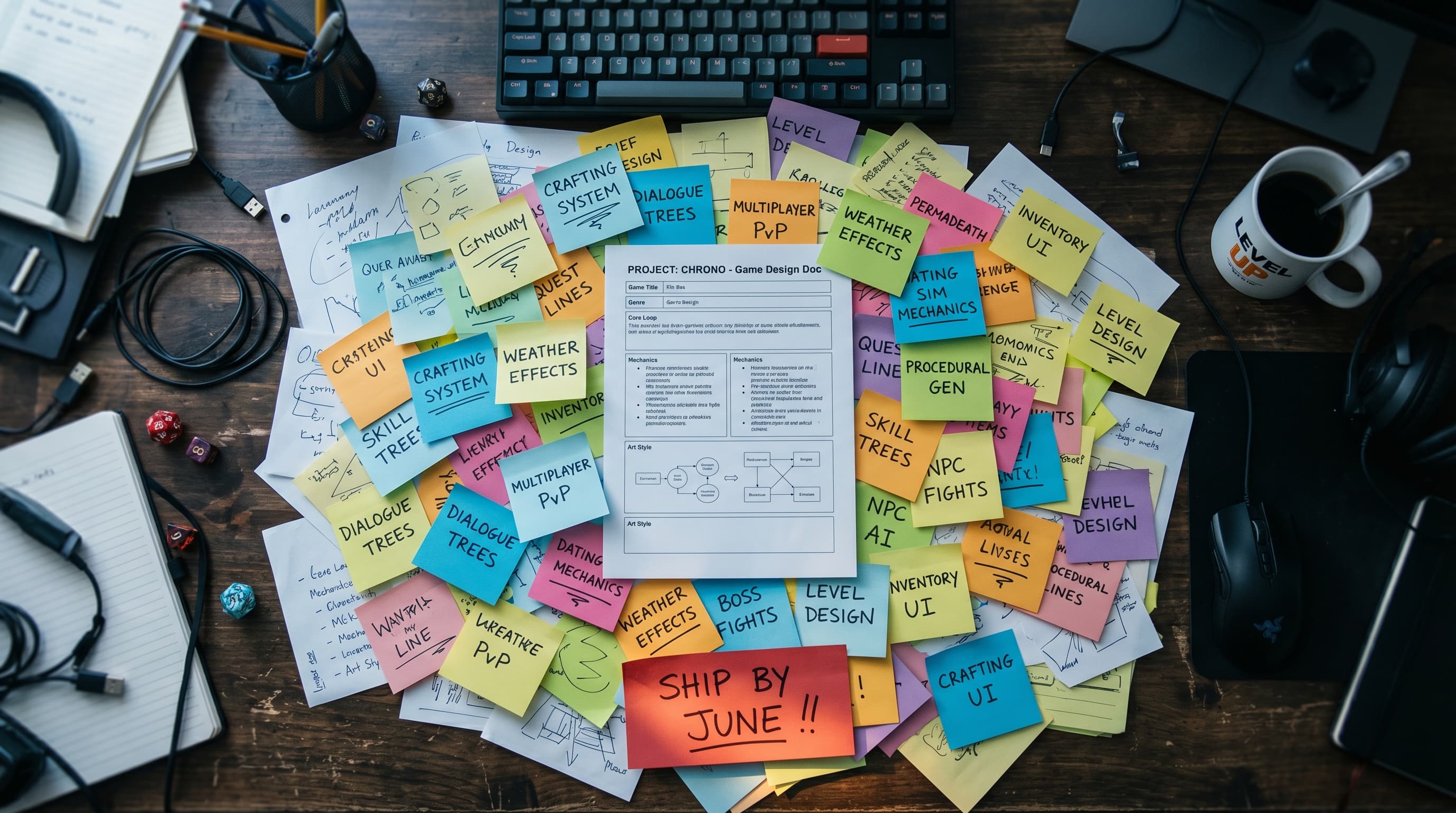
Scope creep in game development looks like one extra feature, then another, then six months of work on systems nobody asked for. This guide gives you a five-question framework for deciding what to cut, a backlog system that captures ideas without killing them, and a diagnostic for telling scope creep apart from the iteration that actually makes games better.
What you need before you start: your honest in-progress feature list, a spreadsheet or board you'll actually use, and the willingness to be wrong about something you've already built.
1. Diagnose the real failure mode: you're not undisciplined, you're unchecked

Most scope-creep advice starts with a pep talk about willpower. That's the wrong diagnosis.
You didn't add the crafting system, the dialogue tree, and the faction reputation mechanic because you lack discipline. You added them because nobody was standing between you and "wouldn't it be cool if." Tim Ruswick, in a talk on over-scoping, put it bluntly: "Why do people over scope the game? They want to believe that's the right choice… they want to believe that if they spend more time on something it gets better."
That's the trick your brain plays. You want the game to succeed. Wanting it to succeed feels, in the moment, exactly like adding another feature will make it succeed. So you add one. Then another. Then you wake up three months later staring at an impossible mountain.
You're not lazy. You're unsupported. Scope creep isn't bad planning — it's what happens when nobody's checking your work. A solo dev has no one to say "we talked about this, that's not in the plan." Weeks 3 to 6 of every solo project look the same: the original idea is working, the prototype is playable, and then the "what ifs" start arriving faster than you can build them.
This is the same failure pattern we diagnosed in why 90% of indie games die in the idea phase. Scope creep is how it kills you if you made it past week one.
The fix isn't more willpower. The fix is structure: a decision rule you run on every feature, a backlog so no idea gets lost, and, ideally, someone counting on your work by Friday.
2. Separate scope creep from healthy iteration before you cut anything

Before we get to cutting, we need to name a thing the internet keeps getting wrong.
Not all scope growth is scope creep. Games are iterative. A feature that sounded exciting on paper can fall flat once prototyped. A "just one more thing" side experiment can turn out to be the diamond that makes your game sell.
One dev I've heard of added a full combat system to what was originally a simple axe-throwing game. Textbook feature creep, right? Except playtesting revealed the original design was horribly boring, and the combat system became the game's biggest selling point. Cutting it would have killed the game.
The CD Projekt Red team learned a version of this publicly. Senior level designer Miles Tost has said that cutting features and scope is "a very normal part of development": dual-wielding, subway systems, wall-running, all dropped from Cyberpunk 2077. But not every cut is damage control, and not every addition is creep.
The difference is whether you're doing it on purpose.
Is scope creep always bad? No. Scope creep is uncontrolled iteration: features added because they sound cool, without checking them against the core of your game. Healthy iteration is the opposite. You add, playtest, measure against your design pillars, and keep or cut based on what the playtest showed you. Same action, totally different process.
Feature creep in indie game development kills projects when it slips in unchecked. The test isn't whether you added a feature. The test is whether you could explain, out loud, which of your design pillars the feature serves and what it displaces. If you can't, you have scope creep. If you can, you have iteration.
The rest of this guide assumes you've hit the point where the honest answer is "I don't know anymore." Here's what to do about it.
3. Run every feature through a five-question decision framework
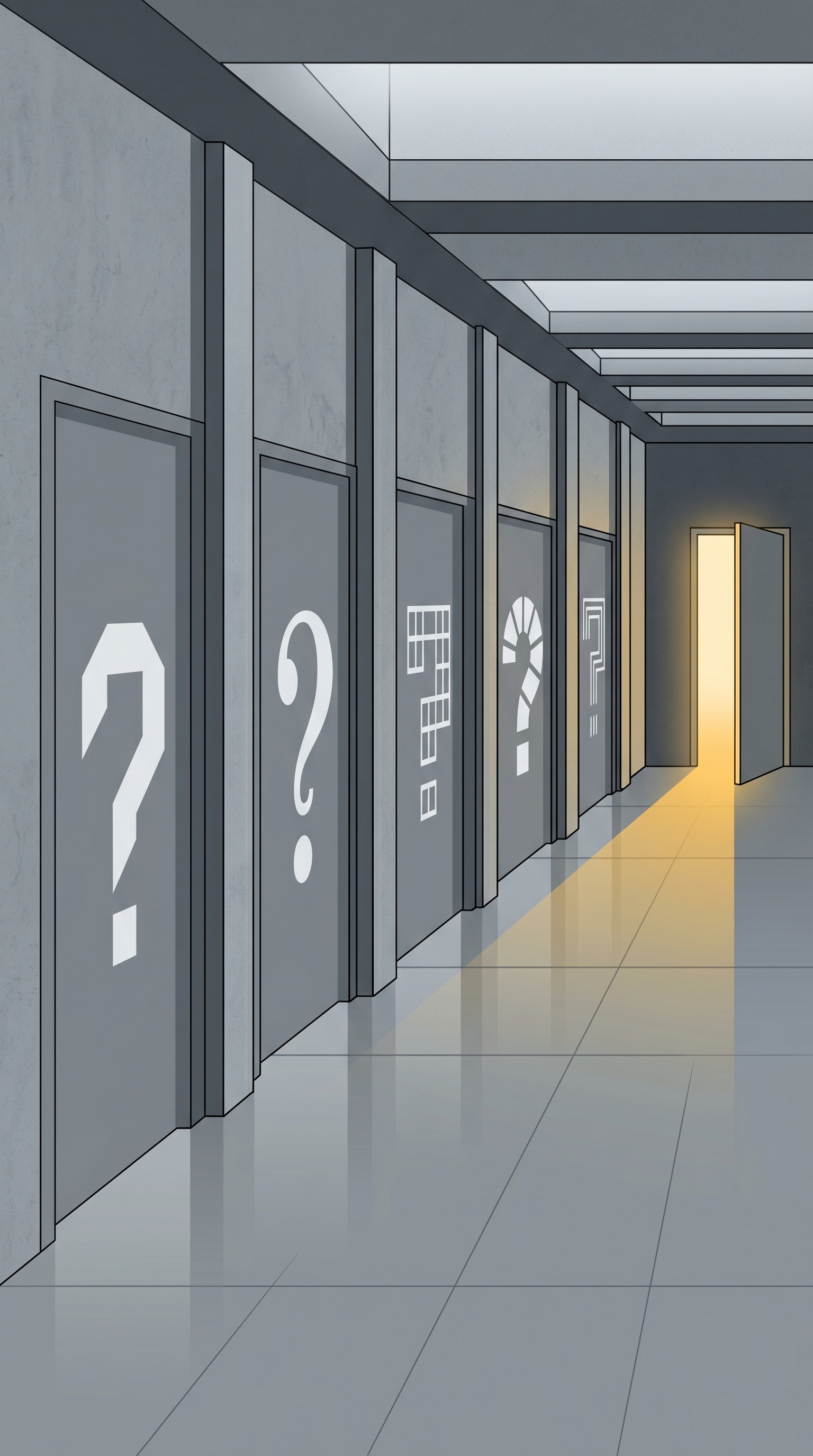
Most scope-cutting advice stops at "cut ruthlessly." Here's the how.
Pull up your feature list. For every item on it, including the ones you've already half-built, run these five questions.
1. Does it improve the player's experience, or just yours?
Not "would other devs be impressed?" Not "is it cool to build?" Does the player actually benefit?
Tim Ruswick tells the story of building an elaborate crafting system for one of his games. Recipes, ingredients, power combinations, all technically impressive. Other developers loved it. For players, it was unnecessary complexity. He cut it, and the overall experience went up.
2. Is adding this taking something else away?
Jarrel Seah, working on a tactics game, put it well: "Not just are you adding something cool, but is the thing you're adding taking something else away."
He gave a regular unit the same mortar ability as the boss. The unit was cool on its own. But it made the boss, who was supposed to be the dramatic highlight of the encounter, feel less special. The unit had to go because it was stealing impact from something more important.
Every feature lives in a system. Adding one changes the balance of the others. If the thing you're about to build makes something else in your game less interesting, you're trading, not adding.
3. Does it encourage the behavior you actually want?
Another lesson from the same tactics game: the dev put loot inside destructible boxes. Sounded great on paper. In practice, the optimal strategy became kiting enemies around while methodically destroying every box. Players were playing the game in the most boring possible way because the system was quietly telling them to.
Ask what the feature incentivizes, not what you hope it incentivizes. If the answer is "the opposite of the game I'm trying to make," cut it.
4. Would you build it again knowing what you know now?
Sunk cost is a liar. If you were starting today, with everything you've learned from playtesting and the current state of the game, would this feature be on the list?
If the answer is no, you're keeping it because you built it, not because it belongs.
5. Which bucket does it belong in: showstopper, game-changer, or filler?
Sort every feature into one of three categories:
- Showstopper. The game wouldn't be a game without it. A platformer needs something that jumps. A tactics game needs a turn system. Cut this and you don't have the product anymore.
- Game-changer. The novel element that makes your game different from every other game in its genre. Worth real investment.
- Filler. Nice polish, adds some flavor, but not load-bearing. Always the first to go.
Be honest about which bucket things actually belong in, not which bucket you want them to belong in. Most devs discover half their "game-changers" are really just filler they're attached to.
Anything that fails question 1, 2, or 3, or lands in the filler bucket, goes on the cut list. As Jarrel put it: "It's weird that cutting something can actually make the game better, but it does."
4. Cut the feature you worked hardest on (yes, that one)

Now for the hard part.
The feature you spent three weeks building, the one you're secretly most proud of, is probably the first thing you need to cut.
Tim Ruswick spent years building an enormous sci-fi universe when he was a teenager: lore, factions, planets, the works. Years later, when he was making a completely different game, he couldn't let the universe go. He kept forcing the universe into a project that had nothing to do with it. It took him a while to realize the universe wasn't serving the game. He was serving the universe.
"Sometimes the stuff we work the hardest on is the last thing that should be in the game, and I learned that the hard way." — Tim Ruswick
Working hard on something doesn't mean it belongs. Your brain has a built-in bias toward protecting things you sank effort into. That's exactly why sunk cost is the worst possible reason to keep a feature. The question isn't how much did this take to build. The question is does it belong in the finished game, yes or no.
There's an even sneakier version of this: using "it's not done yet" as a hiding place. Perpetual development is a way to avoid the scary parts. Marketing. Launch. Reviews. Real players telling you what they think. If the game never ships, none of that can happen.
Be honest: are you keeping the feature because the game needs it, or because you need it?
5. Apply subtractive design: cut by category, not by count

Here's the mistake most devs make when they hear "make smaller games." They make the same game with fewer levels.
That's not smaller. That's shorter. Different problems.
A smaller game is a game with fewer categories of work. The indie games that ship and sell use something called subtractive design: deliberately cutting entire categories of features so you can polish the rest to a higher standard. As one creator put it: "A good idea is one which allows you to do more with less. One which allows you to take stuff away from the game without taking anything away from the game."
Here are three concrete moves.
Fewer characters, or none at all.
Characters are expensive. They need animation, dialogue, behaviors, interaction systems. AAA studios have entire teams dedicated to the relationship between character, controls, and camera: the "three C's." You are not AAA.
Clever indies find ways around this. Gone Home tells a rich story about a family through documents and artifacts. No characters on screen. Portal puts you in a desolate facility where the absence of people is the mood. Dredge makes a boat your main character. Pacific Drive gives you a sentient car. Cars and boats are easier to animate than people. Build your game around what you can actually build.
Smaller worlds, or no level geometry at all.
Cyberpunk 2077 shipped with 10 level designers. Elden Ring had 16. Assassin's Creed Valhalla had over 40. If you're solo or a two-person team trying to build an open world, you're competing against that with a fraction of the resources. You will lose.
Instead, consider formats that don't need sprawling environments. Coffee Talk and VA-11 Hall-A create rich game worlds you never physically explore. Characters come to you. Papers, Please turns document checking into compelling gameplay without a single explorable level. Exit 8 loops the player through the same corridor and makes the loop itself the mechanic.
Fewer mechanics, or "genre descoping."
Take one enjoyable element from a larger genre and make it the entire game:
- Tower defense came from stripping real-time strategy down to just base-building
- Backpack Hero takes inventory management from dungeon crawlers and makes it the whole game
- Vampire Survivors reduces the action RPG to its most primal loop
You still get the thematic appeal of the bigger genre, but you've cut out entire feature sets by focusing on one thing. As the subtractive-design school puts it: "You take an enjoyable element of a larger game and blow it up until it's the entire game."
A good subtractive decision takes something away from your workload while adding something to the player experience. That's the target. If the cut makes the game worse, it wasn't subtractive design. It was just a cut.
6. Build a backlog so cut features wait their turn
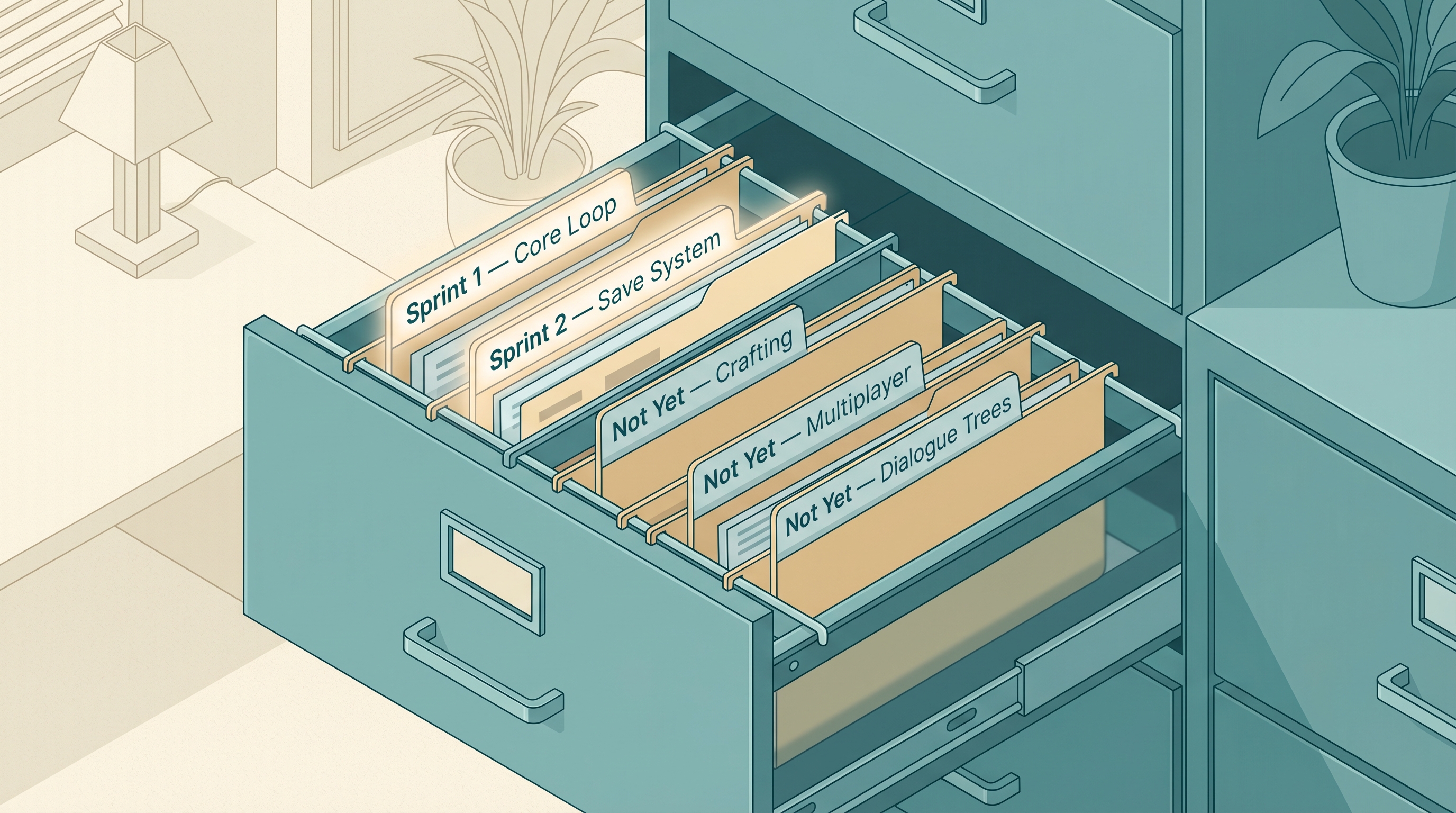
Cutting features sounds brutal. It doesn't have to be. The problem with most "just cut it" advice is that it doesn't tell you where the cut idea goes, and if the answer is "the trash," you'll find reasons not to cut.
Build a backlog. Here's the version that actually works:
- One spreadsheet or board. Every idea goes on it. No idea gets rejected in the moment. No idea gets committed to in the moment either. Every feature, every suggestion, every "wouldn't it be cool if." All on the list.
- Tag each entry with the design pillar it serves. Core gameplay? Polish? Narrative? Immersion? If it doesn't map to a pillar, that's a red flag right there.
- Work in time blocks. Call them sprints, cycles, months, whatever. Each block has a clear theme and a fixed amount of time.
- At the start of each block, pick from the backlog. Based on the theme and your remaining dev time. Everything you don't pick stays on the list as "not yet." Not "no."
This works for three reasons.
First, ideas don't get lost. That "crazy" suggestion from three months ago might look brilliant in hindsight, and the backlog remembers it.
Second, if you're working with teammates, rejecting ideas in the moment kills morale. One dev explained: "If you block every idea then people kind of lock up and they stop coming up with ideas." A backlog replaces "no" with "not yet, and we'll evaluate it at the start of the next block." That's not a rejection. That's a process.
Third, it protects you from yourself. When a new feature idea shows up at 1am and feels like the most important thing in the world, the backlog catches it. Tomorrow-you, with a clearer head, decides whether it belongs in the next block.
This is also where a second pair of eyes actually matters. A backlog is a thousand times more powerful when someone who isn't emotionally attached to your 1am ideas is looking at it with you. If you're weighing whether the solo grind is still working, solo dev vs team walks through the tradeoffs.
7. Pick a ship date and cut backward from it
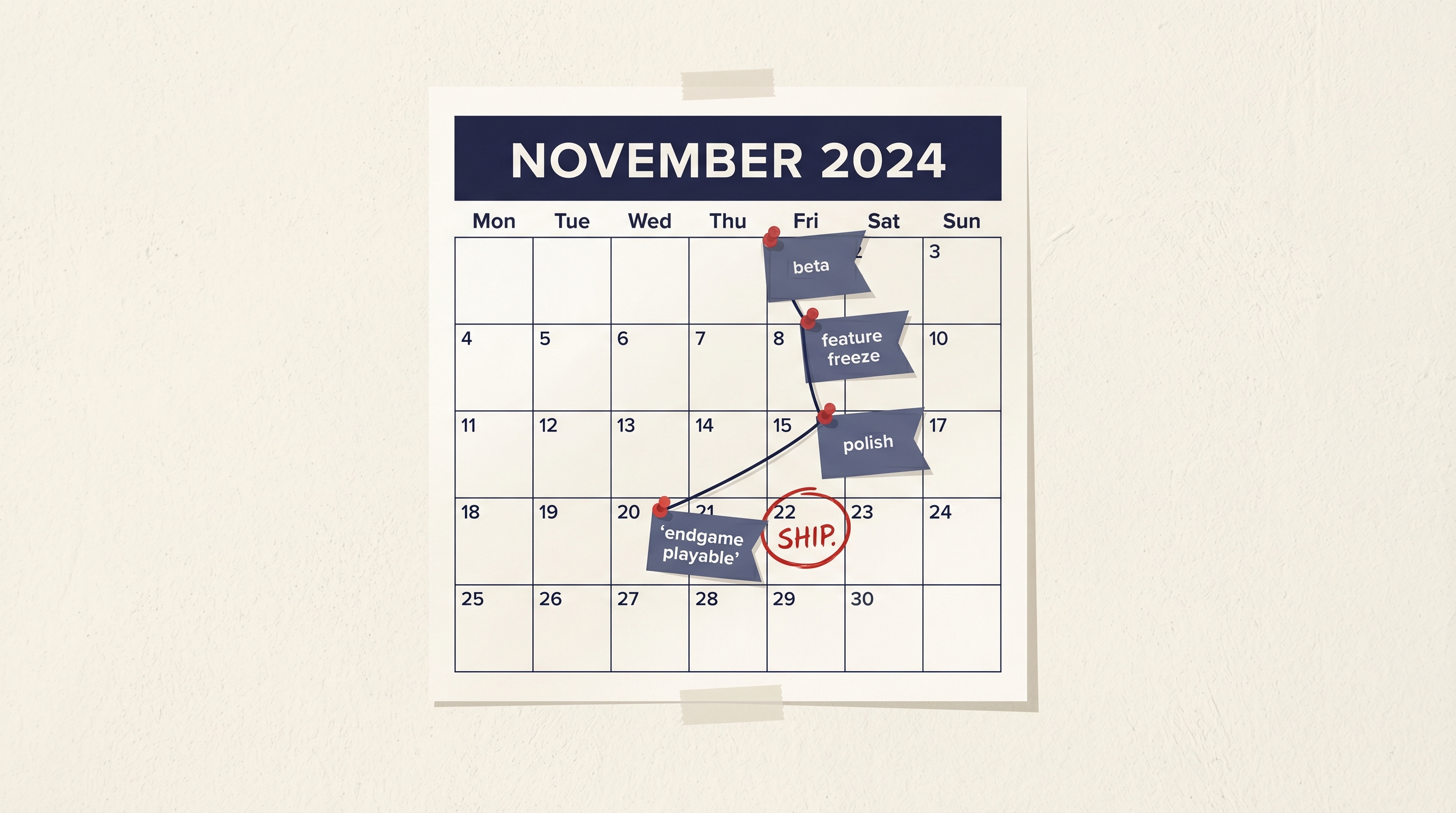
This is where indie game scope management either holds or falls apart. And it's the inversion of how most devs plan.
The default planning method is feature-first: "Here are the features I want. How long will they take? That's my ship date." The problem is that the ship date is a variable, which means it's a lie. There will always be one more feature, one more polish pass, one more bug. The date moves. And moves. And eventually the game dies.
The fix is to flip it. Pick a ship date first. Work backward. Whatever fits in that window is the game.
Derek Yu, the creator of Spelunky, has argued that the best metric for scoping a project isn't how skilled you are. It's the scope of the previous games you've actually finished. If the biggest game you've shipped so far took three months, scope your next one for four, not eighteen.
The Dead State postmortem tells the other half of the story. DoubleBear refused to cut major features and paid for it with a full year of delay. Protecting scope has a cost. Cutting it has a cost. The question is which cost you'd rather pay, and when.
And for the extreme version of scope paralysis: Jason Schreier's reporting on Anthem showed that BioWare spent nearly seven years on the game but entered real production only in the final 18 months. Seven years of indecision, then 18 months of panic. That's what happens when nobody has the authority, or the nerve, to say "this is the game, this is the date, this is what fits."
One more practical trick: build the ending first. Rosstin Murphy's rule, from a "Finish Your Game" piece for Game Developer, is blunt: "If a person can get from the beginning of your game to the end without the game actually crashing, your game is done." Get to the end state of the game as fast as you can. Now you have a full game, even if it's ugly. Every feature after that is an upgrade to a working product, not a bet on an imaginary one.
Pick the date. Build the ending. Cut backward. The game ships.
Common pitfalls
A few traps that eat devs who've technically read all the advice above and still end up with a too-big game.
Cutting features but keeping content. Trimming from 40 enemies to 10 isn't subtractive design. It's the same game with thinner content. You didn't cut the feature; you cut the polish. Cut the category.
Keeping the hardest systems and cutting the shipping-critical ones. Dev brains love hard problems. The result: the procedural generation stays, the save system becomes "we'll do it later." Then the game can't ship because it literally can't save.
Treating the backlog as a graveyard. If nothing ever graduates from the backlog into the game, it's a trash can with a prettier name. Review it at the start of every cycle. Things move in and out.
Confusing "smaller" with "shorter." Shorter games are still big games if they have the same number of systems. Smaller means fewer parts, not less content.
What to do next
Three things from here.
- Open your feature list and run the five questions on every item. Don't skip the ones you love. Those are the ones the framework is for.
- Start a backlog today. Spreadsheet, Trello, Notion, Linear, whatever you'll actually open tomorrow. The first entry is every idea you've been carrying in your head.
- Pick a ship date. Write it down somewhere you'll see it every morning. Work backward from it.
And if the real problem isn't your scope instincts, if the real problem is that nobody's checking your work, that's a different kind of fix.
You're not lazy. You're unsupported. Scope creep dies when someone's counting on your work by Friday. Clowdr is a team: a structured group of indie devs, artists, and composers shipping games together. You keep full rights to your work. Someone is waiting on your Friday build. Scope decisions stop being a private fight with your own brain.
Join the Clowdr waitlist and ship a smaller game with a team that follows through.
More on what it takes to finish the last 10%: the complete guide to finishing your indie game.