
How to Run a Playtest Feedback Meeting Without Letting Notes Become Scope Creep
A playtest feedback meeting format that turns messy notes into decisions, cuts, and scoped tasks before every suggestion becomes scope creep.
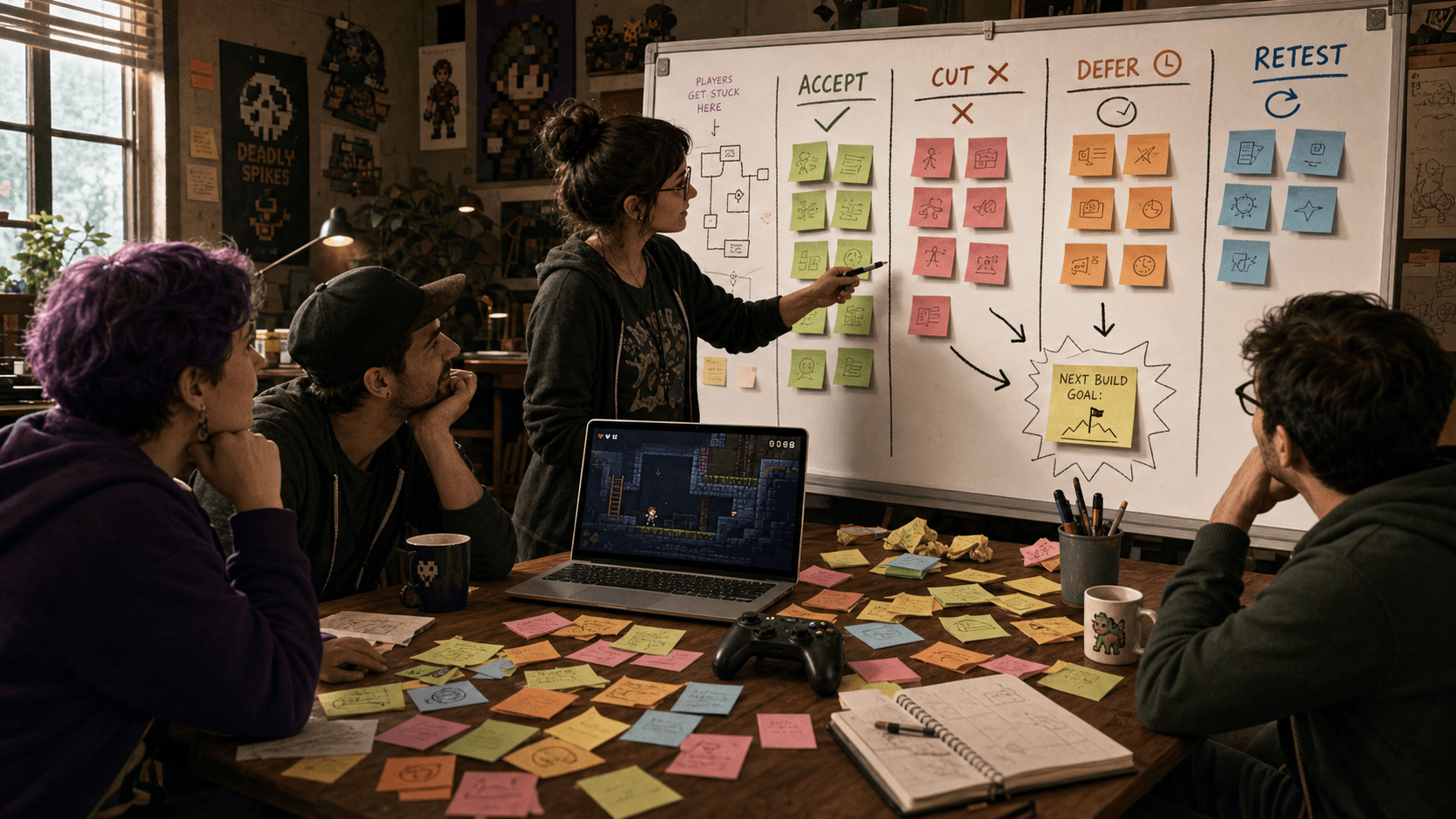
Playtest feedback is supposed to make your game clearer. Somehow it often turns into a bigger backlog, three new systems, and a quiet feeling that your current build is now wrong in every possible direction.
That is the trap. A playtest gives you evidence. It does not give every note a vote.
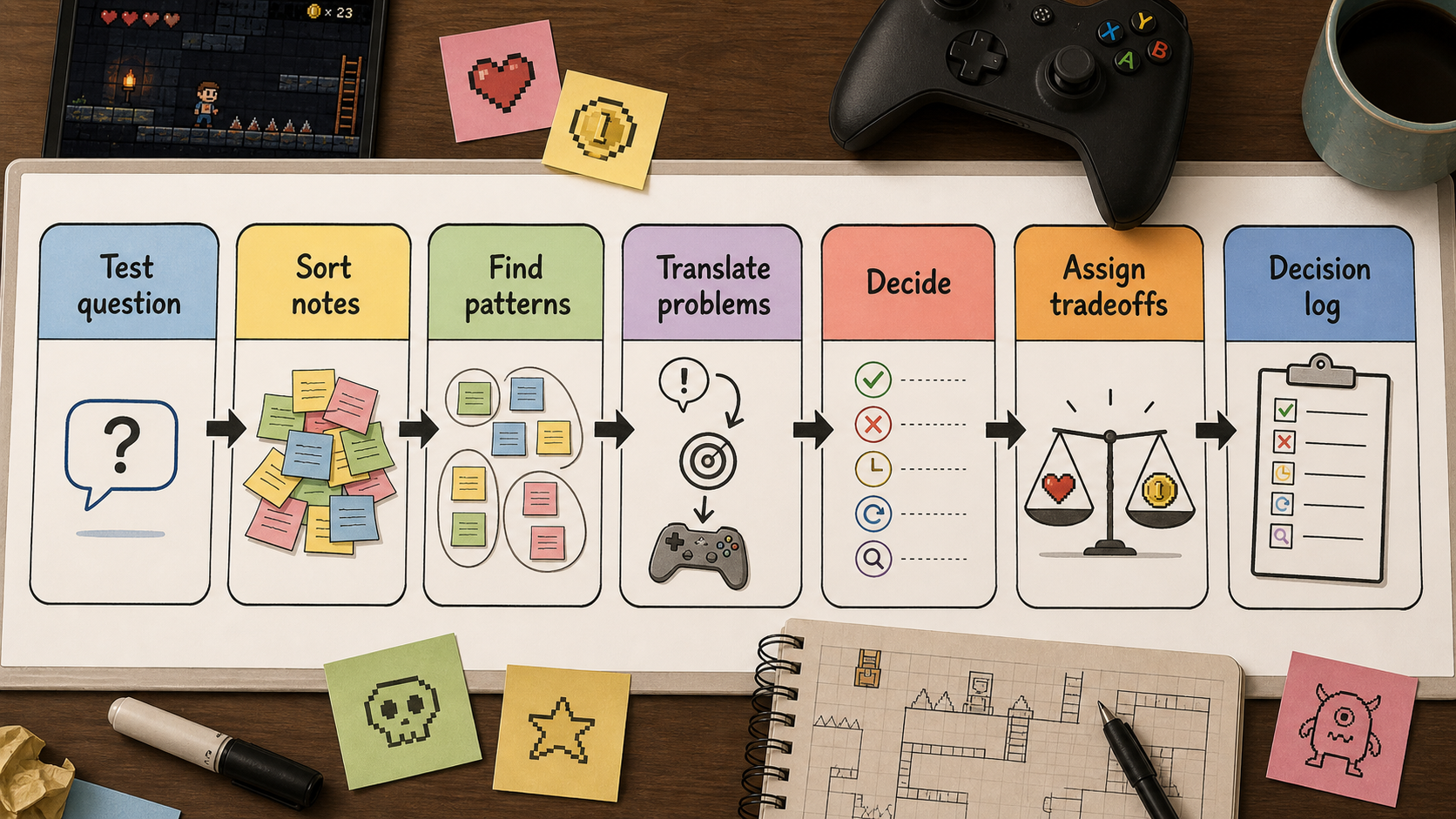
This meeting format turns raw playtest notes into decisions, cuts, and next tasks. By the end, you will have a 45-minute agenda, a five-bucket sorting system, and a decision log you can use after every playtest.
1. Schedule the meeting before the playtest starts
Put the feedback meeting on the calendar before you collect a single note.
Run it the same day if you can. Next morning is fine. Three days later is where notes start turning into vague dread, half-remembered comments, and pet-feature arguments.
The meeting does not need everyone who touched the build. Keep it small:
- The person leading the project
- The person who took notes
- The discipline owner for the area being tested
- One person with permission to say "not now"
That last role matters. A playtest feedback meeting without a scope guard becomes a feature-request meeting with better lighting.
NYU Game Center describes a simple rhythm after playtests: meet quickly, compare notes, define the main feedback, turn it into to-dos, and split out bigger design problems. That is the standard you want. Fast enough that the session is still fresh, structured enough that nobody walks away with "fix everything" as the assignment.
2. Open with the test question, not the note pile
Start the meeting by reading the original playtest question aloud.
Not "what did players think?" That question is too wide. You need the specific thing you were trying to learn:
- Can a new player understand the objective in the first two minutes?
- Does the first combat room teach dodge timing without a tutorial pop-up?
- Do players notice the interactable objects without glowing outlines?
- Is the boss readable before it is fair?
Then name what was out of scope.
Maybe the test was about onboarding, not weapon balance. Maybe it was about level readability, not whether the art style needs a new pass. Maybe it was about whether the prototype loop works, not whether the full game needs fishing.
Write the out-of-scope notes in a parking lot. Do not delete them. Do not debate them. Just keep them from hijacking the meeting.
Max Brooke, writing about playtest design, points out that feedback gets harder to use when the designer and tester are not aligned on what kind of feedback is wanted. Game Developer makes a similar point from the indie side: a playtest should focus on one or two aspects per session, with success criteria decided up front.
Your first scope-control move is not saying no. It is reminding the room what question this playtest was allowed to answer.
3. Sort notes into five buckets
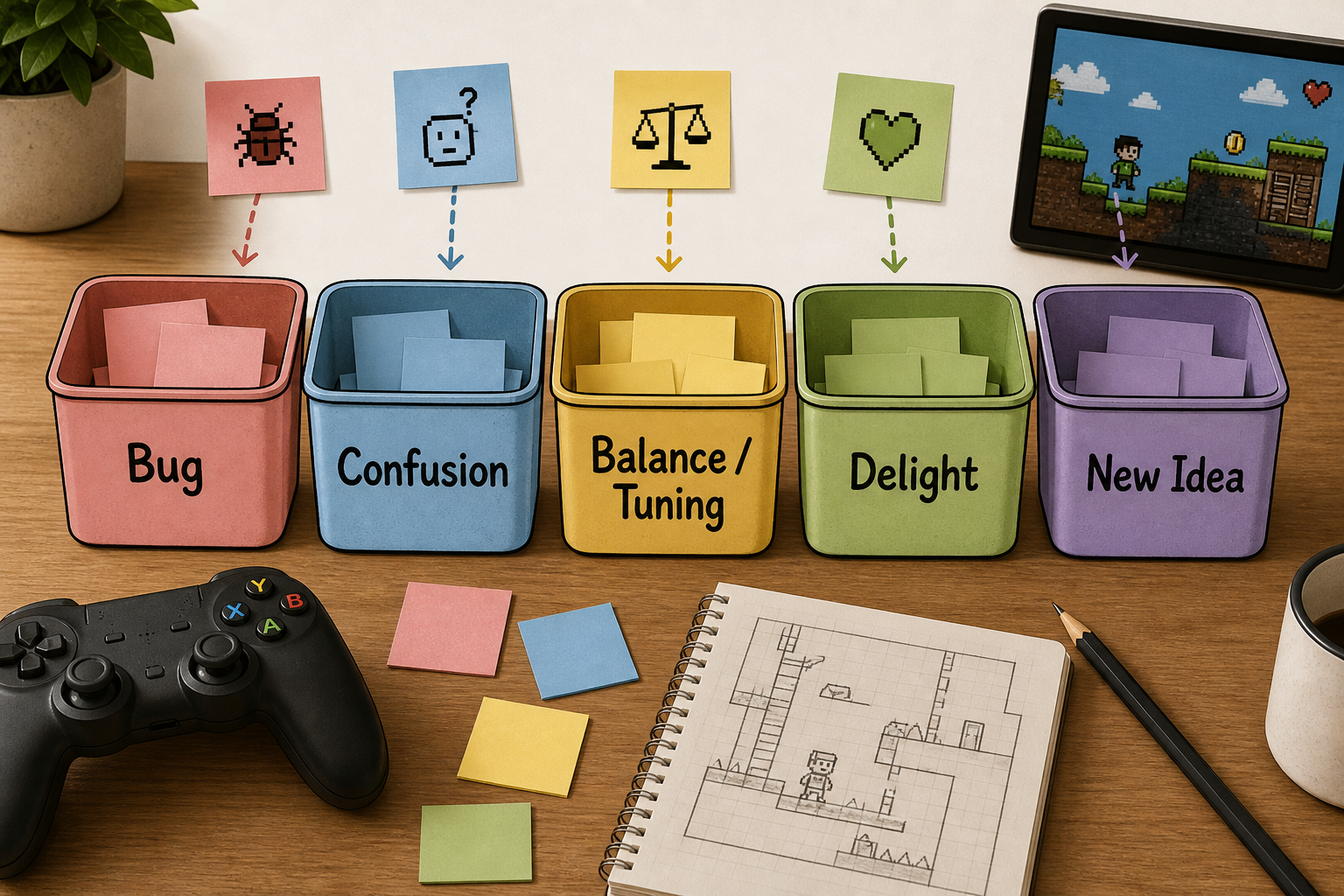
Before you decide what to fix, sort every note into one of five buckets:
- Bug
- Confusion
- Balance or tuning
- Delight
- New idea
This keeps the room honest.
A bug is something that broke. Confusion is something the player did not understand. Balance is a number or pacing problem. Delight is something players leaned into, laughed at, repeated, or talked about afterward. A new idea is the dangerous one: a player suggestion, teammate idea, or "what if we also..." note that may be useful but is not evidence by itself.
Do not debate fixes during the sort. If someone starts solving, stop them and ask, "What bucket is this?"
Also separate observation from suggestion:
- Observation: "Three testers walked past the exit door."
- Suggestion: "Add a giant arrow over the exit."
- Design problem: "The exit is not readable from the camera angle players use."
That difference saves projects.
Tracy Fullerton's playtesting guidance separates in-game observations, post-game questions, and revision ideas for a reason. The Level Design Book also pushes designers to observe behavior first, ask brief clarifying questions, and analyze after the session. Raw playtest notes are not all the same kind of object. Treating them as one pile is how a minor readability issue becomes a new navigation system.
4. Find patterns before you pick tasks
Now look for repetition.
How many testers hit the same issue? Where did they hit it? Did they recover on their own, or did they stay stuck? Was it a blocker, a major problem, a minor annoyance, or cosmetic noise?
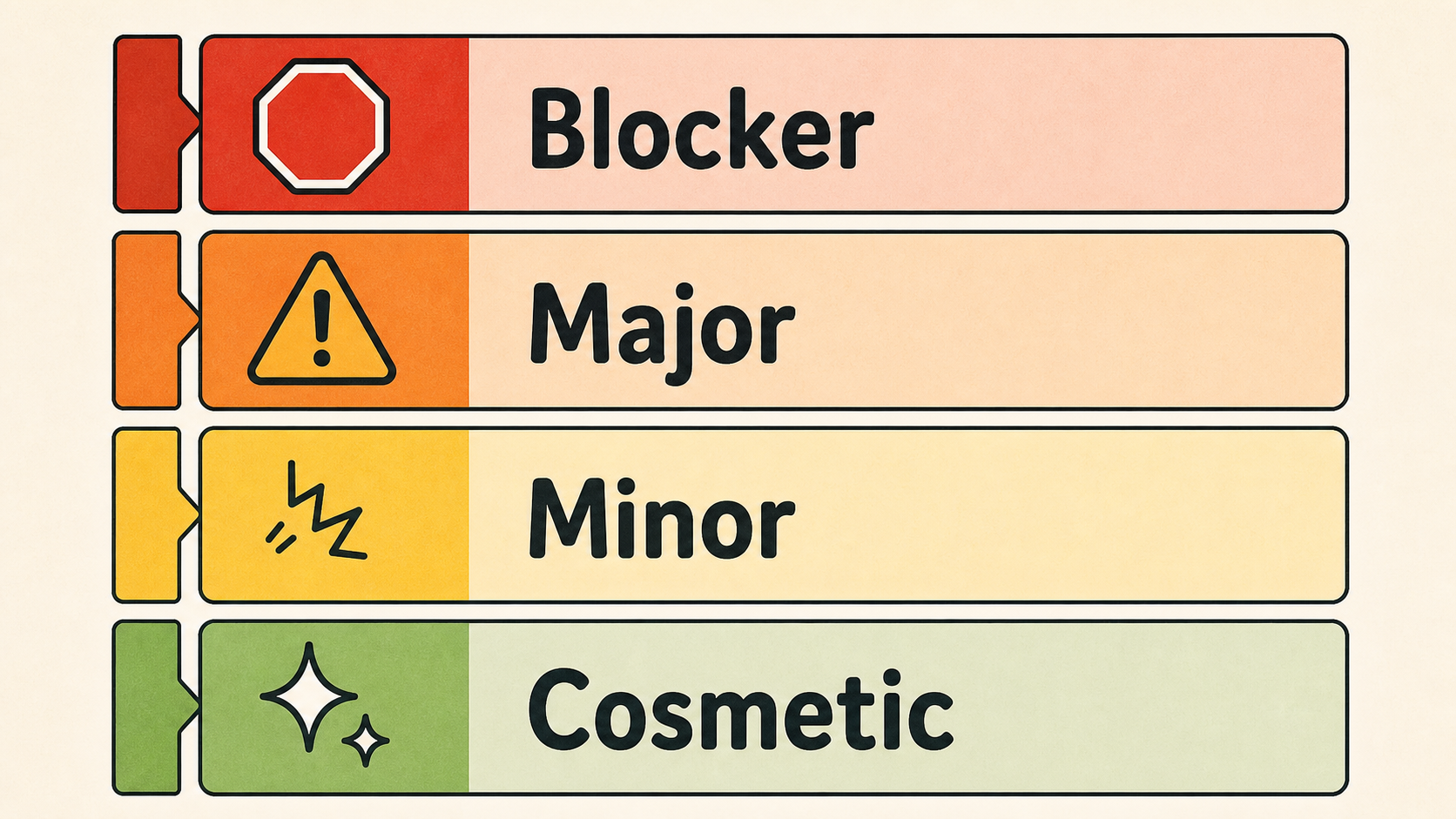
Use a simple severity scale:
- Blocker: the player cannot continue or misunderstands the core action.
- Major: the player continues, but the problem damages the intended experience.
- Minor: the player notices friction but adapts.
- Cosmetic: polish issue, wording issue, preference, or one-off rough edge.
Do not let one loud tester become a trend.
One tester saying "this needs co-op" is a note. Four testers failing to understand where to go after the first room is a pattern. One player asking for a map is a suggestion. Three players opening the pause menu because they expected a map is evidence.
This is where indie teams often get themselves into trouble. The team hears one specific solution and treats it as a task. A map. A tutorial. A new enemy type. A second resource meter. The backlog grows because nobody stopped to ask whether the note represented a pattern or just a person talking.
One transcript source puts the point plainly: playtesting does not hand players the authority to decide the whole game. Players show you where the game fails them. They do not own the design solution.
5. Translate symptoms into design problems
For each major pattern, write the symptom, then translate it into the underlying design problem.
Use this format:
| Player symptom | Likely design problem | Better task |
|---|---|---|
| "Add a minimap." | Players lose the objective after room two. | Add stronger objective signposting at the first fork and retest. |
| "Combat feels unfair." | Enemy windup is readable only after damage starts. | Increase windup frames and add a stronger audio cue. |
| "The tutorial is too long." | Players understand movement quickly but get stuck on interaction. | Cut movement instructions, rewrite interaction prompt, retest. |
| "Can you add more weapons?" | The current weapon stops creating interesting decisions after five minutes. | Tune enemy spacing and add one alternate attack test, not five weapons. |
The better task is usually smaller than the player suggestion.
That is not arrogance. It is design responsibility. The player is reporting a mismatch between expectation and experience. Your job is to find the smallest change that tests the real problem.
One transcript anecdote makes this concrete. A developer described watching players interact with blocks in a way the designer did not expect. Instead of insisting they were playing wrong, the developer adjusted the game around the behavior and found a better design path. That is good playtest response. It follows the evidence without handing the entire roadmap to the loudest suggestion.
6. Make one of five decisions for every major theme
Every major theme gets one decision:
- Accept
- Cut
- Defer
- Retest
- Clarify
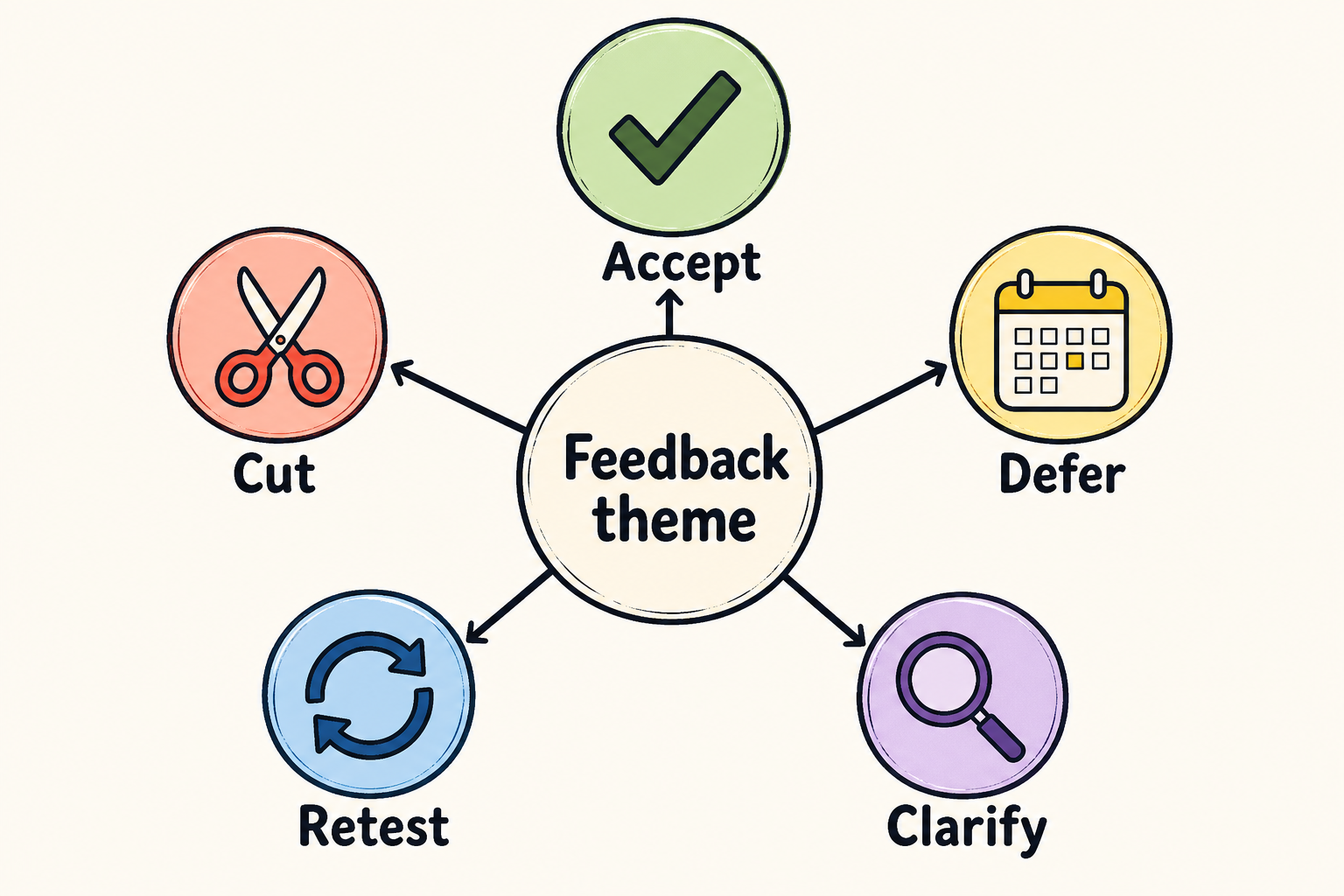
Accept means the issue goes into the next work period with an owner and due date. Cut means the problem is best solved by removing a feature, room, interaction, tutorial beat, or option. Defer means the issue matters, but not before the current milestone. Retest means the evidence is too thin and you need another session. Clarify means you need footage, a follow-up question, or a closer look at the notes before deciding.
Most teams overuse accept. That is how playtest feedback becomes scope creep.
Cut is often the better decision. If players keep misunderstanding a mechanic that barely supports the core loop, deleting it may be cheaper and cleaner than teaching it. If a room creates pathing confusion and does not add a meaningful beat, cut the room. If a UI option creates more questions than value, hide it until the game earns it.
The 2026 GDC Vault deck on playtesting for ultra-small teams frames the loop as hypothesis, playtest, synthesize feedback, take action, repeat. The key phrase is "take action", not "take every action."
Your meeting should end with fewer decisions than notes.
7. Protect the next milestone from feedback sprawl
Before any accepted task enters the backlog, ask one tradeoff question:
What moves, shrinks, or dies because this task is now in?
If the answer is "nothing," you are probably lying to yourself.
Small teams do not have spare capacity hiding under the couch. A new tutorial pass means less enemy tuning. A new UI flow means fewer level fixes. A new onboarding screen means the boss polish slips. That may be the right call, but it has to be a call.
Use this rule:
No silent adds. Every accepted playtest task must replace, reduce, or delay something else.
Write the tradeoff next to the task:
- Accepted: improve objective signposting in room two.
- Owner: Maya.
- Due: Friday.
- Tradeoff: cut optional prop pass for the same room this week.
That one line is the difference between a scoped response and a growing project tax.
If your team already runs weekly accountability calls, this becomes the "scope changes" column. If not, it is the reason to start. Our guide to accountability circles uses the same mechanism: visible commitments, visible misses, and visible renegotiation.
Feedback should change the plan. It should not invisibly expand it.
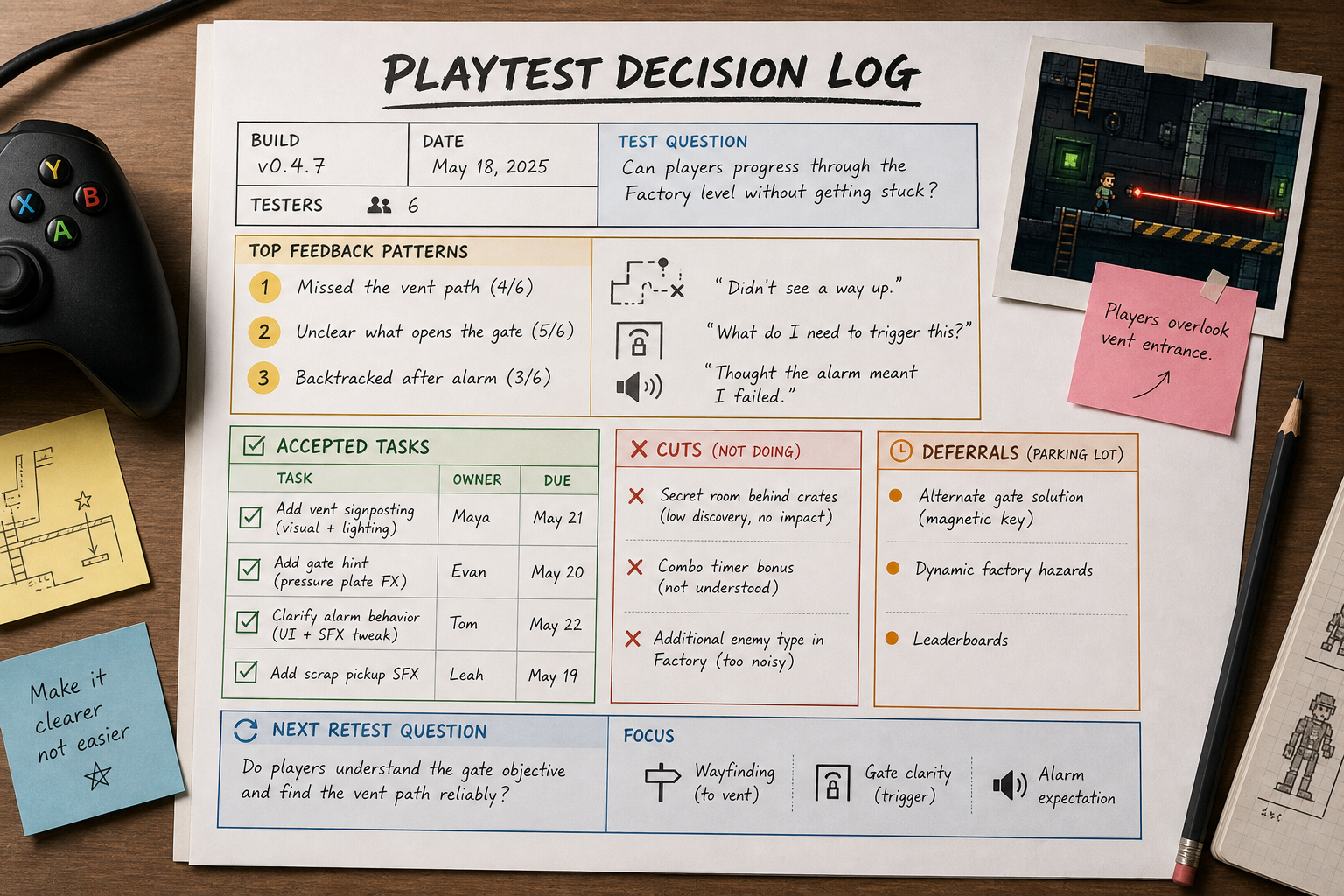
8. End with a one-page playtest decision log
End the meeting by writing a one-page decision log.
Use this template:
# Playtest decision log

Build:
Date:
Test question:
Testers:

## Top patterns
- Pattern 1:
- Pattern 2:
- Pattern 3:

## Accepted tasks
| Task | Owner | Due | Tradeoff |
|---|---|---|---|
|  |  |  |  |

## Cuts
-

## Deferrals
-

## Retest question
Next playtest should answer:
Keep it short enough that people will actually read it.
The log is not a museum of every comment. It is the record of what the team decided after looking at the evidence. That matters when someone shows up two weeks later saying, "Didn't testers hate the combat?" You can point to the actual decision: testers understood the combat, but three of five missed the dodge cue, so you changed the windup and retested.
That is a much better memory than vibes.
MIT's playtesting advice emphasizes artifacts, notes, and team discussion because the value of playtesting is not only in the session. It is in what the team can agree to do afterward. The decision log makes that agreement visible.
9. Common mistakes that turn feedback into scope creep
The first mistake is treating every suggestion as a promise. A tester asking for something does not mean you owe it to them.
The second is fixing the first loud comment before checking patterns. Strong opinions feel like evidence because they arrive with confidence. Count behavior before you count volume.
The third is letting "new idea" share a lane with blockers. A crash and a cool weapon idea do not belong in the same priority conversation.
The fourth is accepting tasks without tradeoffs. If new work does not replace old work, the schedule absorbs the lie until the project stalls.
The fifth is skipping the retest question. Every feedback meeting should produce the next thing you need to learn. If it only produces tasks, your process is slowly turning into production theater.
You do not need a heavier process. You need a sharper meeting.
10. What to do next
Run this format after your next playtest, even if the playtest is tiny. Especially if it is tiny.
One player is enough to practice the muscle. Ten or twenty players are enough to surface patterns before you add more content. More than that can help, but only if your team has a way to process the notes without drowning in them.
If the feedback points to a bloated feature list, read Scope Creep Is Killing Your Game before you add anything. If the problem is that you do not know what to test next, use The Vertical Slice Protocol. If accepted tasks keep disappearing between meetings, set up an accountability circle.
Clowdr is built around the same idea: structure turns good intentions into shipped work. A playtest can tell you what the game needs. A team with clear agreements, owners, and Friday commitments is how those decisions survive the week.