
How to Pick Your Next Indie Game Bet (Without Burning Two Years On a Lottery Ticket)
Indie game market validation isn't spreadsheets. It's sizing smaller bets across a portfolio instead of one five-year moonshot. Your next game is a bet.
Most indie devs don't pick their next game. They buy a lottery ticket. One idea, one five-year swing, sold as passion. Then the numbers hit.
The graveyard you don't see
Walk through any indie-dev gathering and count the sentences that start "I'm working on this game I've been on for...". Three years. Five years. Seven years. Note how many of those have shipped.
The visible tip of the iceberg looks like this: Celeste, Stardew Valley, Hollow Knight, Cuphead, Hades. You've heard of them because someone shipped them and millions of people bought them. They are the 0.1%.
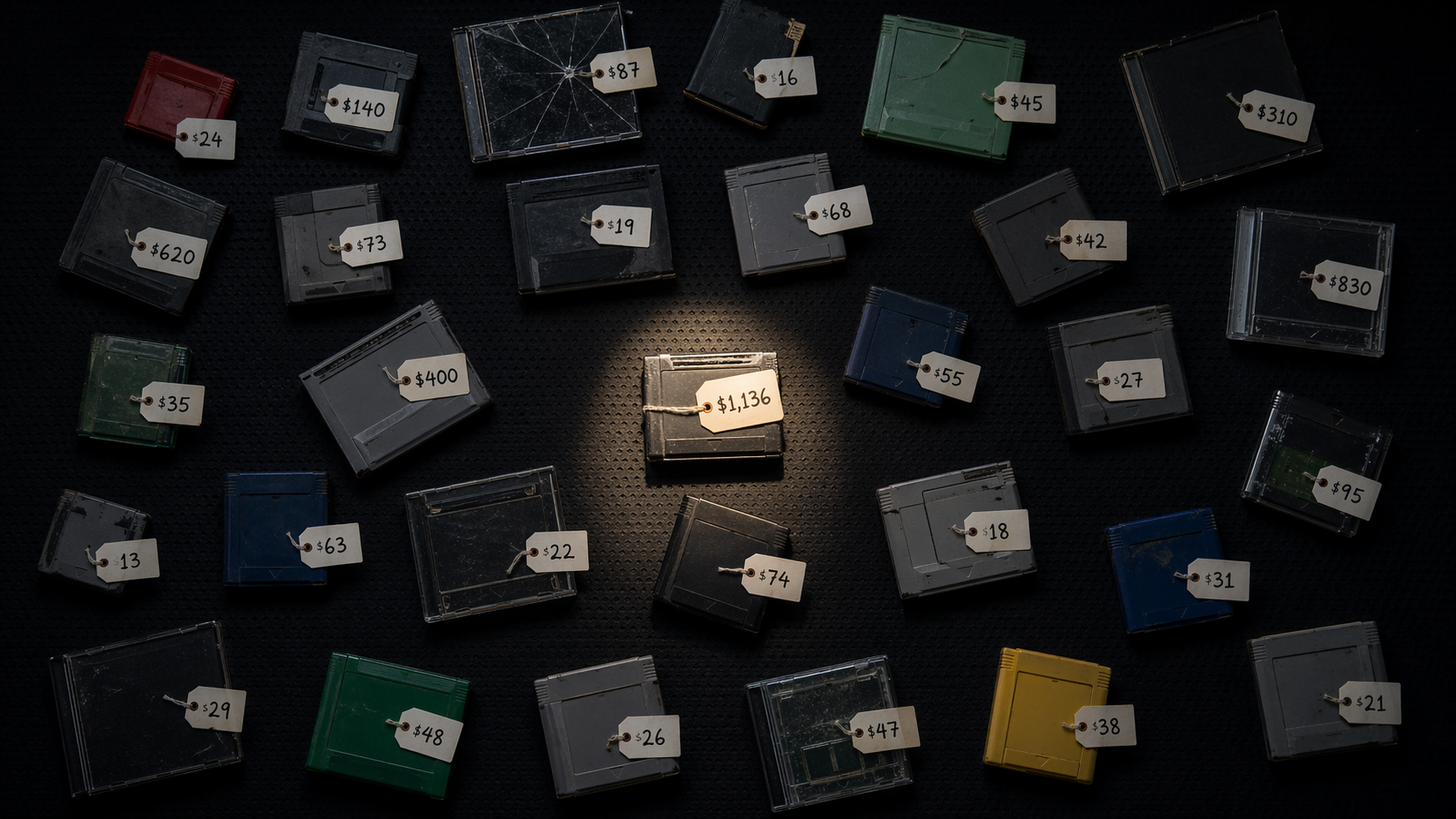
The submerged 99.9% looks like this. The median indie game on Steam earns $1,136 over its entire lifetime (How To Market A Game, Chris Zukowski). Earning $10,000 lifetime puts you in the 68th percentile. Only about 5% of released indie games ever turn a profit (Ryan Clark, GDC Vault).
Take any post-release dev journal:
"I've only cried twice in the past 6-7 years, once was when I found it too hard to medicate my mood, and the other was the day after release."
- Dev of DON'T GIVE UP (Game Developer postmortem)
That is not a warning sign. That is the median experience of shipping your first "big indie game."
The winners you know about sit on a graveyard that doesn't photograph well. You don't see the graveyard because the graveyard doesn't ship at GDC, doesn't show up on your For You page, and doesn't write Medium postmortems. It just quietly turns into years you can't get back. More on why these projects die in the first place: Why 90% of indie games die in the idea phase.
So when you sit down and ask "what should I build next?", you are not looking at your options. You are looking at the handful that made it to the surface. The tail. The outliers. The survivors.
And you are about to pick your next project the way they did. With feeling.
The golden goose isn't your game idea
Tomas Sala shipped The Falconeer solo. Not a jam build. A full commercial flight-combat game. Then, instead of disappearing into a five-year follow-up, he published Bulwark as an evolving demo. Ship early. Iterate publicly. Let strangers tell you, in near-real time, whether the bet was sized right (Sala, GDC Vault - Bulwark postmortem, retrieved 2026-04-23).
Compare that to the way most solo devs talk about "the next one." They talk about it like it is a quest item. Like the right idea is hiding in the forest, and once they find it, the next five years will pay off.
LostRelicGames puts it bluntly:
"There is often this misunderstanding with beginner indie developers where they think that Kickstarter is this kind of golden goose that you just put together a campaign, you get funded."
- LostRelicGames
The same mistake happens one layer up. Kickstarter is not the golden goose. Neither is your game idea. There is no single project that lays golden eggs on its own. What lays eggs is a practice: ship something small, get real evidence, size the next bet.
Your next game is not a passion project. It is a sized bet.
Your real currency is time, not money
The math that breaks you isn't revenue math. It is time math.
Tim Ruswick put this plainly:
"I am the guy that took four years to make a platformer... 7k first month, right? That is nowhere near profitable for a four year game."
- Tim Ruswick
Seven thousand dollars in a month isn't a nothing result. Against one month of a solo dev's time, it is decent. Against four years, it is a wage that would be illegal in most of the developed world.
Then he flips it:
"What if I can make that same amount with a game I put three months into? Suddenly that is a livable wage."
- Tim Ruswick
Same revenue. Different bet size. Different outcome.
This is the move that most indie devs never make. They compare "did I ship" versus "didn't I ship." They don't compare "how much time did I put in versus what came out." Two years of solo work is not free. Two years of solo work is an $80,000-$200,000 opportunity cost on a contractor rate, plus everything else you would have shipped in that time.
Every hour you spend on the fifth rewrite of your inventory system is an hour you did not spend on your next bet. Or the one after. Or the one that would have taught you something that would have made bet four work.
Sizing matters because time is the only thing you cannot replay. (If the scope is already eating you alive: Scope creep is killing your game.)
Portfolio beats moonshot (the movie-studio math)
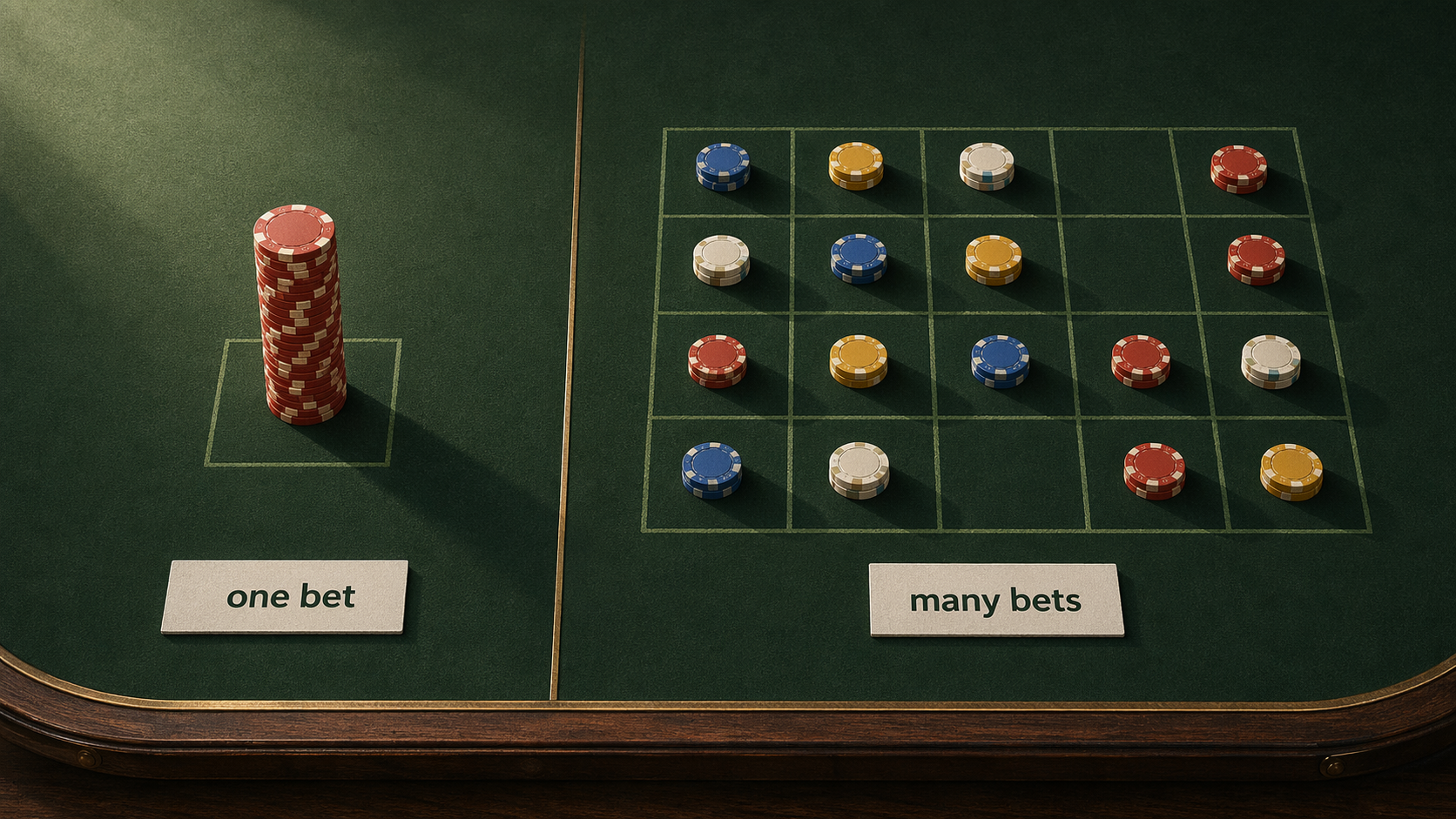
Hollywood has been doing this longer than we have. Studios know they cannot pick the one movie that saves the quarter. So they stop trying.
"The way that movie studios choose movies is not 'we're gonna pick ten and invest in 10 and hope they all make a profit.' No, one or two of those movies does really well, the rest lose money."
- Tim Ruswick
Two things happen there. They stop pretending they can predict winners. And they make sure they have enough shots at the plate that a few of them can be winners.
Game devs have already run this experiment.
Dan Cook's Spry Fox shipped 11 released projects from 31 prototypes over roughly five years. Their internal benchmark for "success" was 5 to 10 times the production cost. Roughly one in ten prototypes and one in three releases cleared it. That is an explicit portfolio strategy, written up as Minimum Sustainable Success (retrieved 2026-04-23).
Jake Birkett of Grey Alien Games has survived eleven-plus years as a full-time indie. His public playbook is shipping a run of modest, profitable games on sub-two-year cycles, not betting the studio on a breakout (GDC Vault - No Hit Wonder).
Rami Ismail, ex-Vlambeer:
"The best order of operations for any mid-scope indie game that needs funding: build quickly and quietly assuming self-publishing, pitch publishers, and only if that fails put out a store page and start marketing."
Quickly. Quietly. Then adjust the bet.
The pattern across all four of these devs is the same. Multiple releases. Shorter cycles. Each release teaches them which bet to size up next. None of them are picking their projects the way a hobbyist picks a tattoo.
Ruswick also cites a dev who shipped 30 games in two years. Most earned almost nothing. Two of them carried the whole roughly $1M total. That is what a portfolio does. Not one swing. A batch.
You don't need to ship 30 games. You need more than one. And each one needs to be a small enough bet that you can afford to be wrong.
Validation is not market research, it is evidence of a player
Most devs, when they hear "validate your idea," reach for a spreadsheet. Genre sales. Wishlist medians. Steam tags. That is useful, but it is not what validation is.
Validation is a stranger, unprompted, asking when they can play the next build.
Two things get mistaken for that. The first is taste-validation: "I like it. My friends like it. My Discord likes it." Taste-validation gets you the confidence to start. It does not tell you whether anyone you don't already know will hand you their attention.
The second is marketing-validation: "I put up a Steam page, I got 2,000 wishlists, it's going to sell." The Steam data on this has gotten uglier, not prettier. GameDiscoverCo measured median wishlist-to-first-week-sales conversion for games with 25,000+ wishlists at roughly 0.15x, with a 10 to 20 times spread across the distribution (GameDiscoverCo). Wishlists are a signal of curiosity, not a signal that someone will hand you $20.
Real validation looks like this:
"My second launch, Orbs, Orbs, Orbs, that was an absolute and total flop. And I put that down to not play testing early enough to validate the game idea."
- Chris, Hilfort Games (Indie Game Clinic)
He goes further. He couldn't find playtesters for that game. He treated that as a scheduling problem. It was actually a signal.
"It was actually really difficult to find play testers to play Obsorbs. And that should have been the huge red flag."
- Chris, Hilfort Games
Nobody was excited enough to play it for free. The market had already told him the answer. He just didn't want to hear it yet.
Real validation is a demo, in the hands of three strangers, none of whom are your friends, who come back asking when the next build drops. That is it. Everything before that is vibes.
Why bet-sizing is a team move, not a solo move
Bet-sizing is structurally a team decision, not a solo one. The "follow your passion" talk skips this part.
A six-month sized bet is co-leadable. You can bring in an artist on vertical slice. You can bring in a composer when the core loop is real. You can tell a collaborator "my Friday demo deadline is the 3rd, are you in?" and have them believe you, because three months from now is a real amount of time.
A five-year solo moonshot isn't co-leadable. Nobody can join a project with no ship date and no validation milestones, because there is nothing to join. They can offer to help. They can ghost two weeks later. You already know how that ends.
This is why the Ready Shipper reframe matters. You are not choosing between "ship alone" and "ship on a team." You are choosing between a bet small enough that someone will stake their Friday on it with you, and a bet so big that no one can commit to it without lying to themselves.
The sizing decision and the team decision are the same decision.
More on the honest tradeoffs: Solo dev vs. team.
"But what about passion?"
Steelman. A lot of the best indie games were clearly made by someone in love with their idea. Stardew. Rain World. Dwarf Fortress. There is a real argument that long, obsessive belief in one thing is the point.
I take it seriously. It still does not change the recommendation.
Most of the indie devs quoting "follow your passion" are not describing the actual failure mode. Listen to the ones two years in:
"Any passion project that becomes too much like work starts to feel like a chore and the passion for it disappears."
"Working on the SAME game for months and months and only making minor updates was not fun. It was work."
Passion is not a strategy. Passion is the fuel. Fuel runs out, especially if you picked a tank the size of a continent.
Read the postmortems honestly. The survivors of long projects all had an additional thing going for them. Early validation from strangers. A publisher deal funding the runway. A small engaged audience from a prior ship. A spouse's salary. Passion does not carry a five-year solo bet. Something else does.
Pick your bet the way a survivor would, not the way a survivor talks about it on a panel. Validation first. Scope sized to the runway you actually have. Passion is allowed, but only after those two.
The next-bet protocol
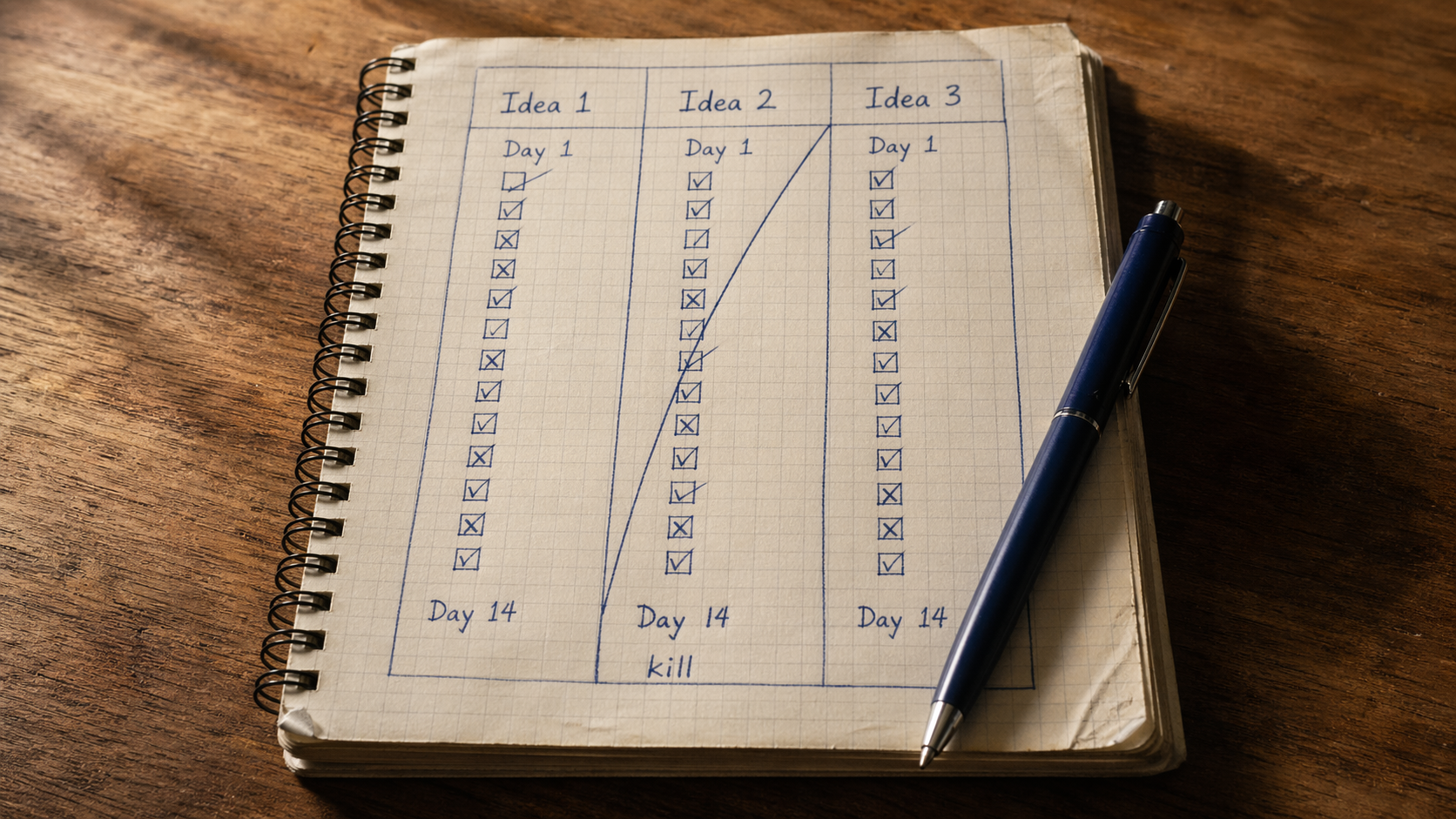
What to do this week, instead of staring at your idea list for the fourteenth time:
- Pick three candidate ideas, not one. If you can only think of one, you haven't generated enough options to choose from. Go back.
- Write a two-week prototype budget for each. Not a design document. A calendar. Two weeks of nights. What is the smallest playable version of each idea you could slap together by day 14?
- Build one of them. Ugliest version. Placeholder art. The core loop.
- Put it in front of three strangers. Not your team. Not your Discord mutuals. Strangers. Watch them play. Do not narrate.
- Write pre-committed kill criteria before the playtest. "If fewer than 2 of 3 ask to play again, I shelve this and try idea two." Decide in advance, so the sunk-cost version of you does not get a vote later.
- If it passes, invest another six weeks into a vertical slice. Not a year. Six weeks. See The vertical slice protocol for the structure.
- Bring in one collaborator at vertical slice, not at launch. An artist or a composer who will show up on Friday. Not a "co-founder." A collaborator on a sized bet.
Two weeks. Three strangers. Kill criteria. Then commit. That is the move.
Every step of this is Ismail's "build quickly and quietly," and every step is Sala's evolving demo. None of it is new. It is just not what most solo devs are doing.
What this means for you
You are not waiting for your next passion project to pick you. You are placing bets. You can size them. You can run more than one in a year. You can bring collaborators onto a bet that is small enough to actually ship, build a track record of games you actually finished, and use that track record to size up the next one.
The devs who survive eleven years in indie are not the ones who made the right lottery-ticket pick. They are the ones who ran a portfolio small enough to afford a few losses.
If you want a structure to run that portfolio on, and a collaborator who is counting on your Friday demo, sign up for Clowdr and lead your next validated bet with people who ship. Build a studio without the studio. (The longer version of the shipping playbook lives in The complete guide to finishing your indie game.)
Your next game is not a passion project.
It is a sized bet.
Size it.