
Prepare Your Final AI Production Note
Turn planned AI intent into an honest release record of actual use, human decisions, verification, provenance, rights and material changes.
- Primary Practice Area
- Production & Verification
- Editorial Format
- Production Guide
- Article Author
- Robert Trippler
- Published
- Updated
- Additional Practice Areas
- Engineering
- Art
- Audio & Composition
- Design & Writing
The Final AI Production Note connects the game's actual production to its release materials. It is required even when a team deliberately used no AI. Start with the planned note from the pitch, then update it to describe what happened in the Release Candidate.
This guide applies How We Ship, the approved Clowdr Process and ADR 0011. The record below is a suggested working structure. It is not an official submission form, and it describes no shipped Project or observed result.
Identify the candidate and the change from the pitch
Keep the build identifier beside the note so a reviewer can connect its claims to the submitted game. State where the actual AI position differs materially from the pitch. If the team changed tools, rejected an approach or chose deliberate non-use, describe that decision honestly.
The Lead submits the integrated build and publication materials as a Release Candidate. The note accompanies that submission. It does not replace the Five Proofs of Release or authorize the Lead to publish under the Clowdr brand.
Record actual use and human decisions
Describe where AI was used or deliberately not used, and which material human decisions shaped the accepted work. Connect those statements to the contributions in the candidate. A list of tools alone cannot explain why a contribution was accepted or how a person took responsibility for it.
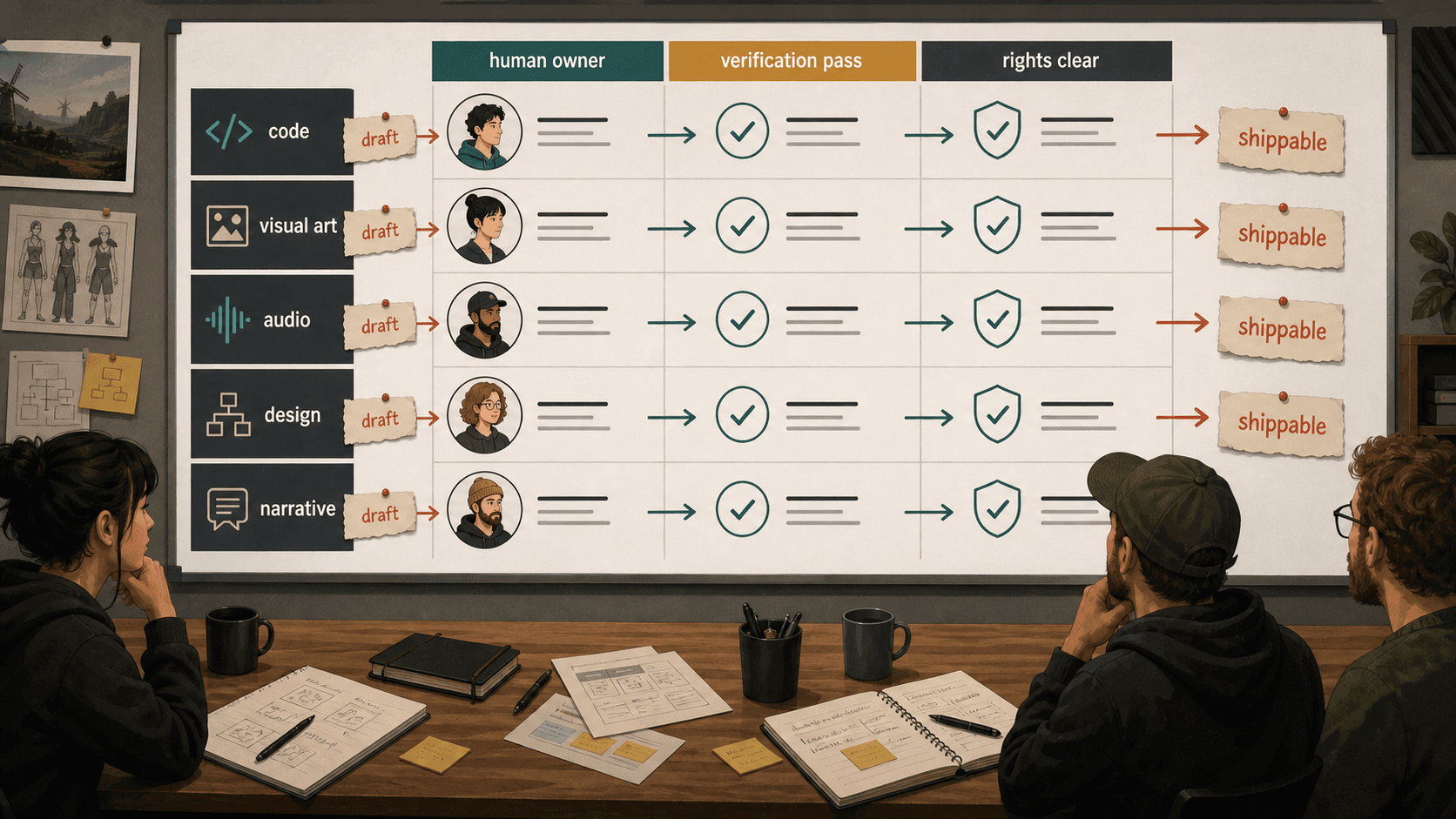
A suggested private record has one entry per material contribution or decision:
- What appears in the candidate and who owns the contribution.
- Actual AI use or deliberate non-use.
- Human changes, rejected output and the reason for acceptance.
- Verification performed, with a link to its evidence and its limits.
- Provenance, rights, required disclosures, attributions and credits.
- Material differences from the planned pitch note.
For a hypothetical music cue, the record could identify the person responsible, how it was made, which edits served the scene, and the in-game verification. That example supplies a structure, not evidence that a real cue passed a test.
Keep claims within the verification
Write what was checked and what the check supports. If a result applies only to one build or environment, keep that limitation visible. A generated asset's existence does not establish that it works in the game, that its rights are settled or that it satisfies the approved Quality Baseline.
Unresolved provenance or rights questions need resolution through Ownership Proof. Do not describe a planned check as completed. Keep the supporting records with the candidate so the note remains inspectable after a material change.
Prepare the concise public version
Clowdr publishes a concise Final AI Production Note with every Clowdr Release. Detailed Ownership Proof may remain internal where necessary. The public version should preserve an honest account of actual use or deliberate non-use, human decisions, verification and material changes without exposing private supporting material.
Compare that version with the Release Candidate, credits, required disclosures and publication materials before submission. The aim is a note that a reader can understand and a reviewer can substantiate from the linked records.
For the wider submission, use the Five Proofs of Release guide. Clowdr's Publication Review determines whether the candidate is published; an accurate note is part of that review, not a guarantee of acceptance.