
What Is a Game Dev Accountability Partner? (And How to Find One Who Doesn't Flake)
A game dev accountability partner is the smallest piece of structure that fixes indie dev burnout. How to find one who doesn't flake in two weeks.
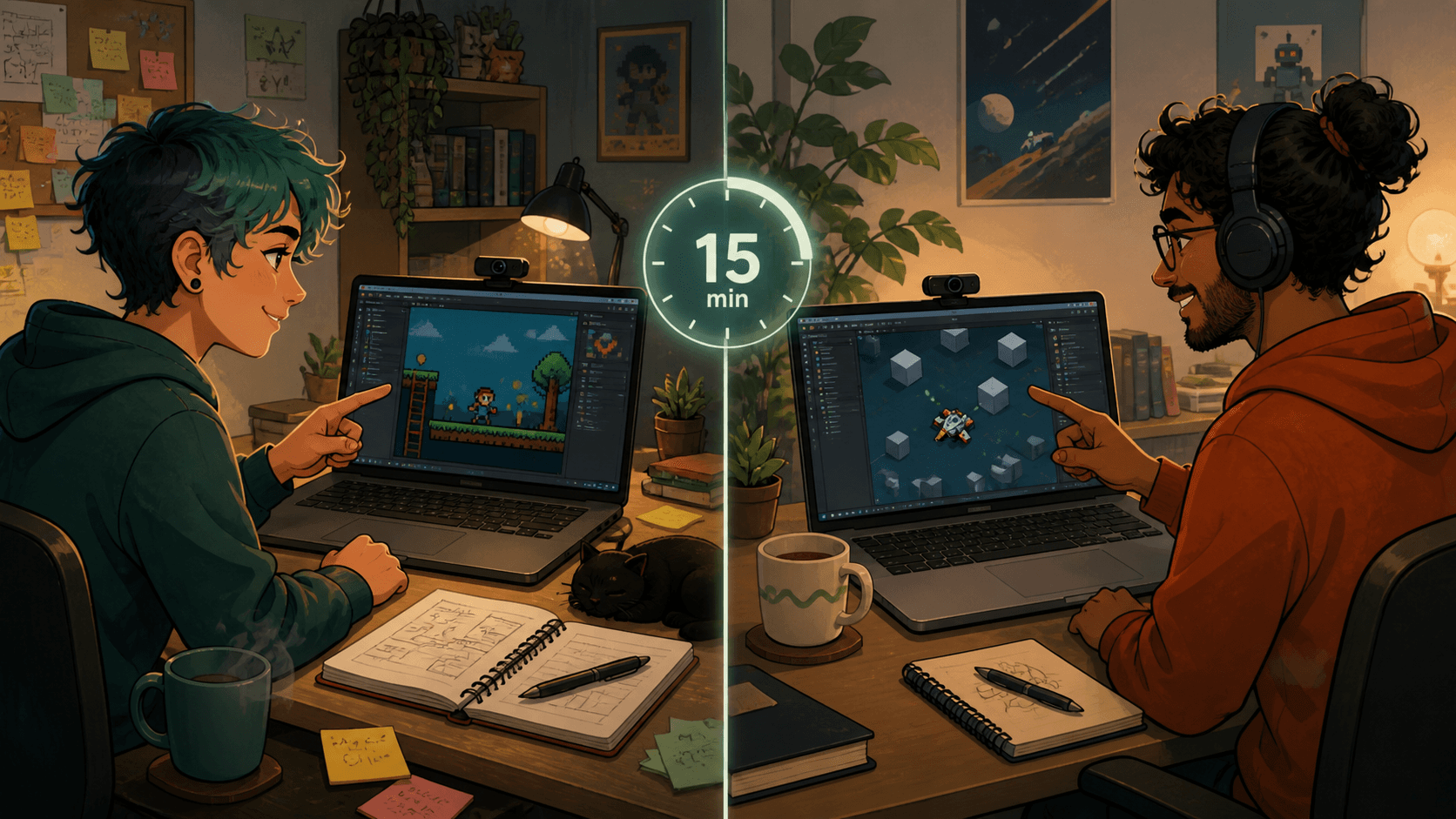
You've got the graveyard. The incremental game you bailed on in week three. The top-down roguelike that made it to one level. A Vampire Survivors clone that's been at "almost playable" for seven months. You opened the project file last weekend, stared at the scene, closed it, and felt that specific, private shame that only indie devs know. Real life won again. Real life wins a lot.
Here's the thing nobody says out loud on r/gamedev: it's not a discipline problem. It's not a willpower problem. It's a structure problem. Going solo on a creative project that takes six to eighteen months to ship, with zero external witnesses, is close to the hardest mode there is. The reason your last ten projects died isn't that you got lazy at week six. It's that week six is exactly when nobody was counting on your work, and nobody noticed when you stopped doing it.
A game dev accountability partner is the smallest piece of structure that fixes that.
You're not lazy. You're unsupported. This post is how to fix the unsupported part.
Who this is for
This post is for solo or near-solo indie devs who genuinely want to ship something, not polish it forever, not tinker on weekends, but ship, and who keep running out of momentum around week three to six. If that's you, you're in the 50% of indie devs we see most: the Stuck Starter. The project dies not because the idea was wrong but because nobody was watching.
It's also for devs partway through a project that's gone quiet. You haven't officially stopped. You just haven't opened Unity in ten days.
It's not for you if:
- You genuinely prefer to work alone and your solo projects ship. Keep doing what works.
- You're a pure hobbyist who enjoys the process without needing the finish. Accountability structures exist to apply pressure. Don't bring pressure into a hobby.
- You already have a working 3-5 person indie team with regular check-ins. You're past this. Go read our accountability-circles post instead.
Everyone else, keep reading.
The short answer: what a game dev accountability partner actually is
A game dev accountability partner is one other person who meets with you on a fixed cadence (usually weekly, sometimes twice-weekly), reviews what you shipped since last time, hears what you're scared of right now, and has committed to their own weekly shipping alongside you. You do the same for them.
Three things make it work:
- Cadence. A scheduled time on the calendar. Not "we'll sync when we can."
- Evidence. You show concrete output. A build link, a gif, a scene screenshot, a code diff. Something a stranger could look at. "I thought about the inventory system" doesn't count.
- Stakes. Mild social consequence for showing up empty-handed. Not punishment. Just the specific, quiet discomfort of saying "I did nothing this week" out loud to someone who did.
And here's what it isn't:
- Not a co-founder. Separate IP, separate projects, zero equity.
- Not a mentor. You don't need them to be more experienced than you. Symmetry is the point.
- Not a playtest buddy, though you might also playtest each other.
- Not a friend you vent to. Venting is fine. It's not the structure.
Why it works for indie devs specifically
Generic productivity content will hand you the stat everyone has heard: "people are 65% more likely to complete a goal if they commit it to someone, and 95% if they schedule a meeting." Problem: nobody can find the actual study that produced those numbers. It's productivity-blog folklore that has been recycled for two decades. If you see it, quietly move on.
The real number is from a 2015 study out of Dominican University by Gail Matthews. Participants who sent weekly written progress reports to a friend hit over 70% of their goals. Participants who only thought about their goals privately hit 35%. That's the source worth citing, and the gap it measures, roughly double the completion rate, is the one that matters. A later goal-setting seminar summary of the study reports the same pattern: written goals plus weekly accountability beat private intention by a wide margin.
Indie game dev amplifies that gap for three reasons generic accountability content doesn't cover:
Horizon length. You're building on a 6-to-18-month timeline with no paycheck, no deadline, and no boss. Classic motivation research (Wood, Quinn & Kashy, 2002, on habit and context) shows about 43% of daily behavior is performed habitually in the same cue context. A scheduled weekly check-in is a cue context. It gives your brain a stable peg to hang "I work on the game" on. Willpower without cues collapses inside of a month.
Invisibility. For weeks at a time, indie dev work produces nothing an outsider can see. A shader refactor that took three evenings looks, from the outside, exactly like doing nothing. Tell a partner what you shipped and it becomes real. "The time can kind of blur together if it's just doing a text file, but if you're communicating it outside of yourself as to what you're doing next..." That's the mechanism: the work becomes visible before the game is finished.
Mental load. GDC's evidence-based mental-health sessions have made the pattern public for years: burnout, anxiety, and depression rates in game development are high enough to deserve structural answers, not another pep talk. Solo devs get the loneliest version of it. A Game Developer postmortem of the solo-dev game The Last Humble Bee described the multi-year process as "dark nights of the soul" and came back to the same rescue mechanism: habit plus one other human beats willpower. One other human is the smallest possible dose. It's still the dose that works. GDC Vault's An Evidence-Based Mental Health Model for Game Developers makes the broader case for treating mental health in games as an environmental problem, not a private weakness.
There's a second, quieter mechanic behind all this:
"What's usually really happening is that we actually are more concerned about helping them achieve their goals than we are about helping us achieve our own. A lot of us will do more things for other people than we will for ourselves."
You'll ship because they're counting on you. That's not a weakness. That's how humans are built. A partner turns the bug into a feature.
The flake problem (and why most pairings die in two weeks)
Here is the part most advice skips. Most accountability partnerships don't die because the structure is flawed. They die because both people drift off in the same two-week window, and nobody wants to be the first to say "we haven't actually talked in a month."
There's a satirical post on r/INAT that has been sitting near the top of the subreddit for years: "I'll ghost you in around 2 weeks as everyone loses interest." It has 77 upvotes because everyone reading it has done it or had it done to them.
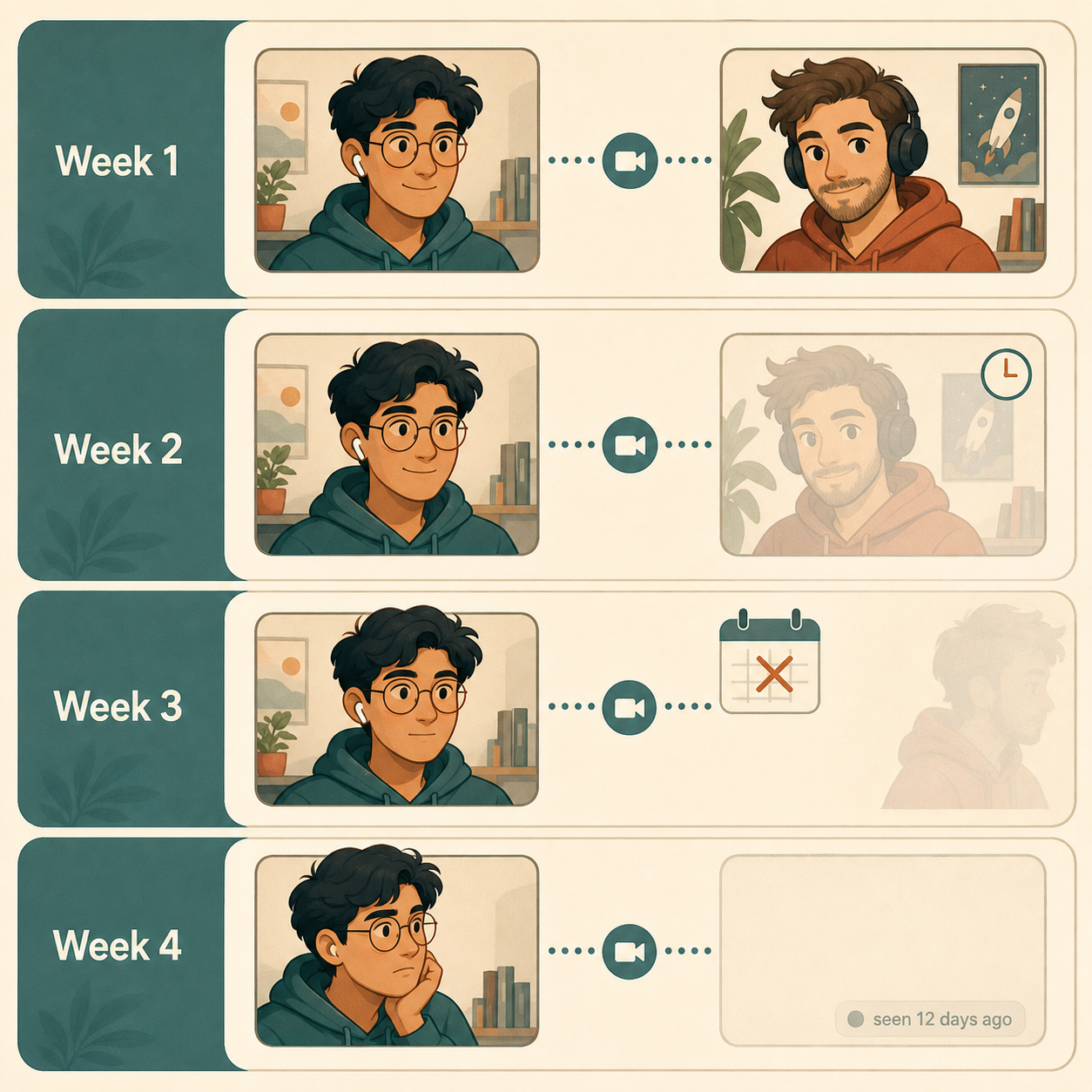
Three specific failure modes to watch for:
Gym-buddy collapse. You and your partner both started strong. By week three, their output is visibly slipping. You have a choice: drag them (exhausting) or ignore it (cadence dies). "It's like the classic problem of a gym buddy where they kind of give out way before you do and the struggle becomes trying to either drag them or give up on them, and then it's kind of weighing on you." If you're trying to drag someone, the partnership is already over. They just haven't told you.
Sympathy spiral. Your partner shows up with a hard week. Real life won. You soften, of course. Next week they're still stuck. You soften again. By week four, neither of you is shipping and the check-in has turned into a venting session. Ending here without structure is how a partnership becomes a coffee date and then becomes nothing.
Cadence drift. You skip a week because something came up. They skip the next one. Neither of you re-anchors it. The weekly check-in becomes "let's sync soon." Three weeks later nobody has messaged anyone. The partnership has silently ended.
The single best early-warning signal is the two-week echo: if one of you says "I'm still stuck on the same thing as last week" twice in a row, stop doing updates. Switch the meeting into a debugging session about why the work isn't moving. If you don't, cadence drift is usually one month away.
What a partner who won't flake actually looks like
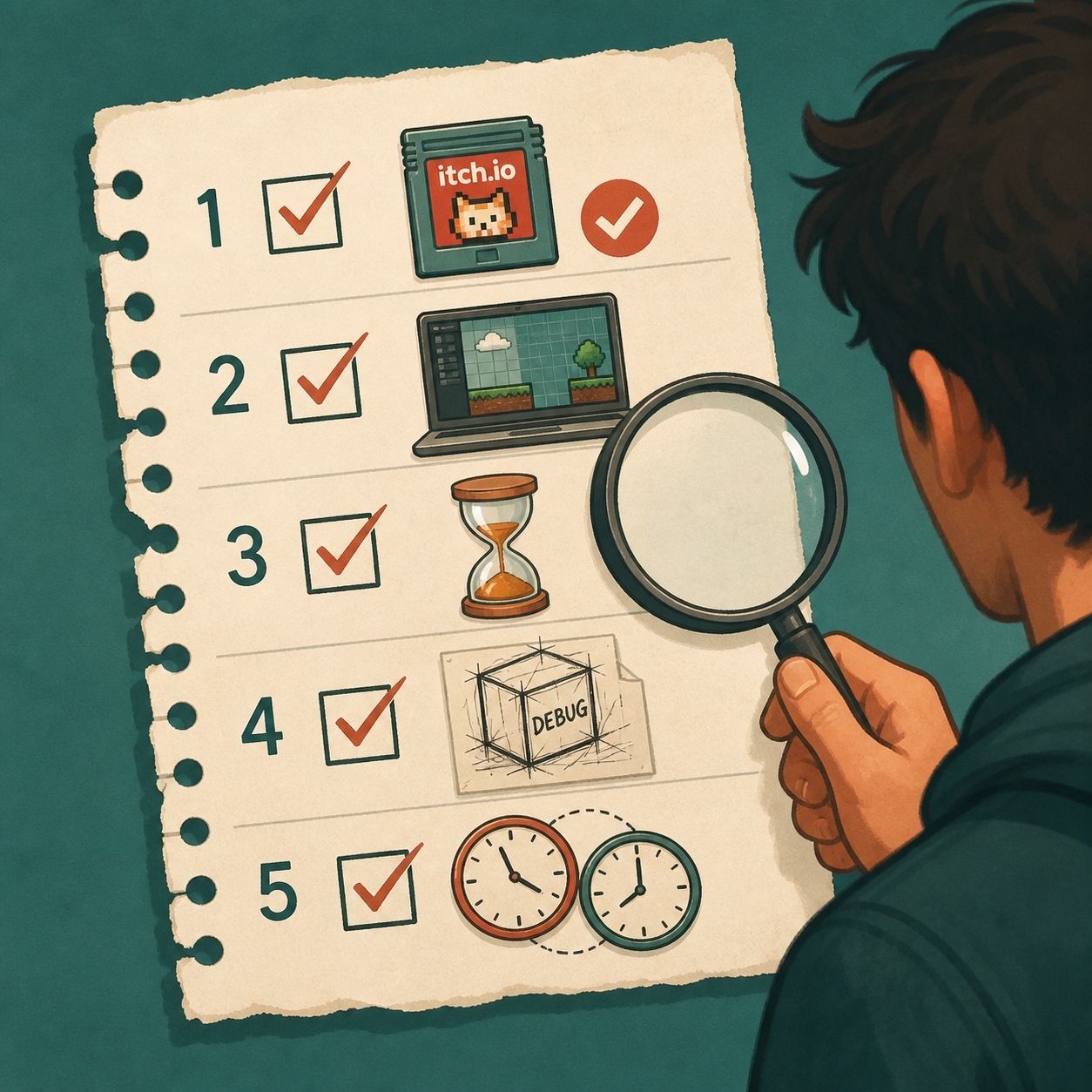
Most advice will tell you to look for "similar goals" and "aligned values." That's soft signal. Useful, but not enough. Here's the hard signal: what you should actually vet before agreeing to a partnership.
Evidence of past shipping, however small. A jam game on itch.io. A ship-it Friday thread with four weeks of progress gifs. A repo with commits across more than one weekend. If they've never finished anything, not even a jam, they're not ready to be your partner. That's not a judgment. It's that they haven't yet learned the thing a partner is supposed to help you practice.
A visible current project. Not "I have an idea for an RPG." A scene you can load. A build you can download. A devlog with at least one entry. If their project is vaporware, the weekly check-in will also be vaporware.
Matched time availability. Indie dev is almost always part-time. From an Indie Hackers post looking for a partner: "Full time employed, not enough free time, building on the side/part time." That's most of us. If you have four hours a week and they have twenty, the partnership will feel unbalanced within a month. Ask about real available hours up front.
Willingness to show WIP uncomfortably early. Ask them to send you the messiest build they currently have, the one with the debug cube and the purple-untextured everything. If they say "let me clean it up first," the partnership will die of perfectionism. If they send it, you've found someone who understands that the partnership is for work-in-progress, not polish showcase.
Time zone overlap or async tolerance. At least one weekly window where you're both awake. If you're full async, set up a shared doc with a 48-hour response norm so nobody is left hanging.
What you do not need to match on: genre, engine, experience level. Symmetry of commitment matters far more than symmetry of craft.
How to actually find one (five places that work for indie devs)
Most advice tells you "look in online communities." Useless. Here are the five that actually produce partners for indie devs, with trade-offs.
1. Game jam post-mortems and jam Discords. Best single source. Anyone who submitted a completed entry to Ludum Dare, GMTK Jam, or a 7DRL has demonstrated they can finish under pressure. Reply to their devlog, say what you liked about their entry, mention you're looking for a weekly partner, propose a two-week trial. Response rate is high because the filter already happened.
2. Devlog regulars on Twitch and YouTube. Devs who stream or video-log consistently have built the habit of showing work publicly. The cost of that habit is roughly the same as the cost of a weekly check-in. Look in the chat and comments of devlog creators whose content you already follow; the other regulars are likely candidates.
3. Scoped subreddits, but not r/INAT. r/INAT is poisoned for partner-finding. The signal-to-noise ratio is the worst in game dev. Instead, look at r/gamedev's weekly "what are you working on" threads, r/solodevelopment, and r/IndieDev. These are places where the conversation is about the work, not about assembling teams. Comment consistently for two or three weeks before you ask for anything.
4. A structured platform. Platforms like Clowdr exist because the above three are slow and flaky. You pay to skip the vetting, because everyone on the platform has already committed to showing up. If four hours of Reddit comment-scraping per week is time you don't have, this is where that time comes back.
5. A past jam teammate who showed up. The most underrated option. If you did a jam with someone who pulled their weight, just ask. "Hey, want to do a low-commitment weekly check-in on our separate projects?" You already know their cadence holds. The trust problem is solved. Propose the 15-minute weekly format and start next Friday.
Wherever you find them, always start with a two-week trial. Explicit. "Let's do two weekly check-ins. After the second one, either of us can walk away, no guilt." This single framing prevents more ghosting than any other move.
The minimum viable partnership (running it in 15 minutes a week)
You don't need a framework. You need a shared doc, a build link per side, and a 15-minute weekly call.
The doc. One Google Doc or Notion page. Two columns or two sections, one per person. Three fields each, overwritten weekly:
- Shipped this week. One-line summary plus a link or gif.
- Scaring me right now. The thing you're avoiding. Name it honestly.
- Shipping next week. One to three items. Small enough that you could finish one in a bad week.
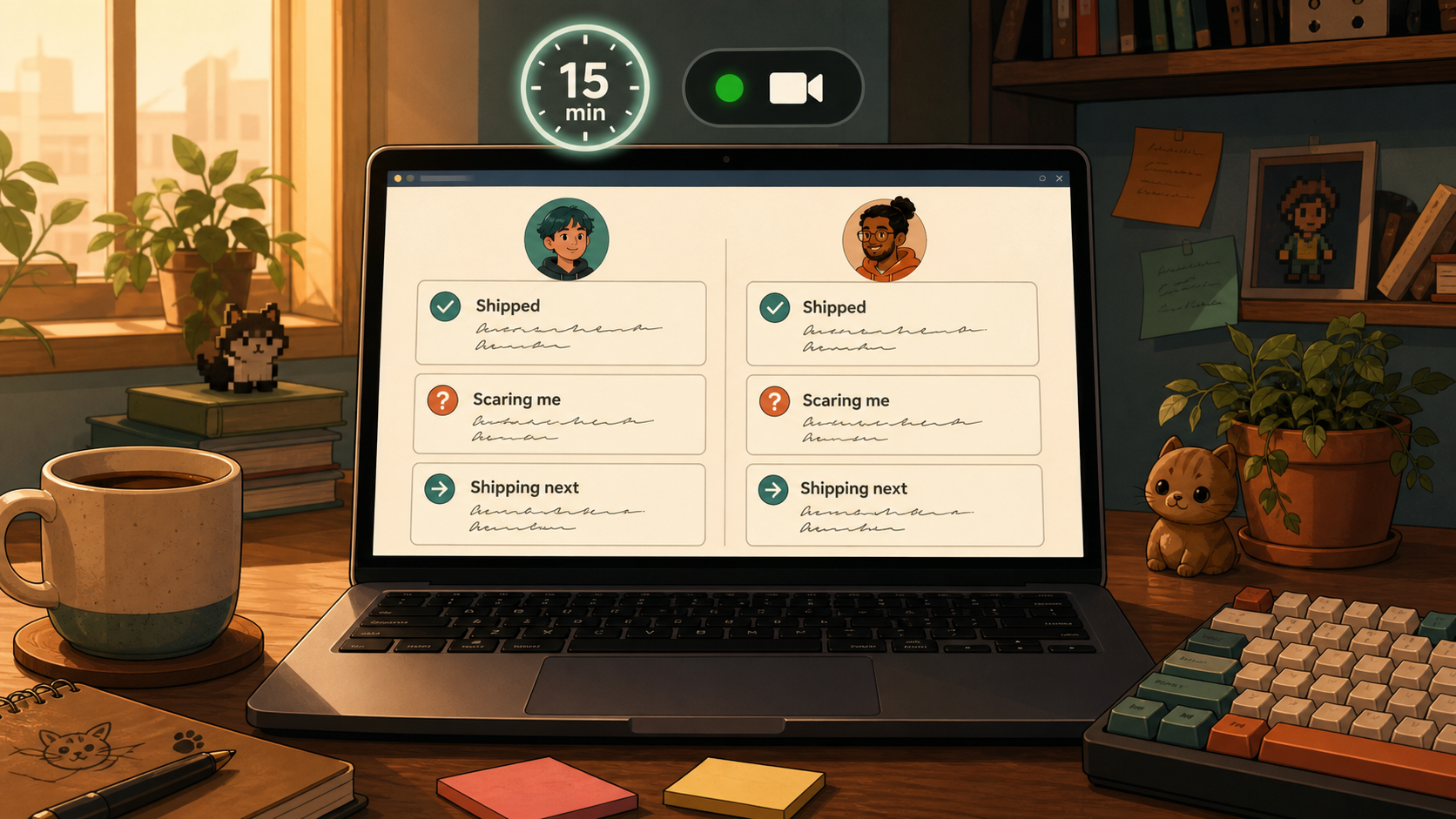
Fill it in the day before the call.
The call. 15 minutes, video on, once a week, same time. Each person gets six minutes: two on what shipped, with the gif on-screen if possible; two on the scary thing; two on the plan for next week. Three minutes of overflow. That's it. If it stretches to 45 minutes, you're having a creative-talk meeting, not an accountability check-in. Great. Schedule that separately.
The two-week echo rule. If you or your partner say "still stuck on the same thing as last week" two weeks running, drop the updates and use the whole 15 minutes on why the work isn't moving. Is the task actually smaller than you thought? Is there a skill gap? Is it avoidance? Is real life winning harder than usual? Name it. This is the shift from update mode to risk-mitigation mode, and it's the single most important rescue move a partnership has.
Committing out loud matters. "Having to maintain a schedule and present on a weekly basis not only helps with motivation, but it also shows that there are people who want to see you succeed." The point isn't the report. The point is being known to be trying.
That's the whole thing. 15 minutes a week, one shared doc, one call. If it feels too lightweight, you've designed it right. Heavy structures die. Light ones persist.
When a 1:1 partner is no longer enough
Three signals it's time to graduate to a small accountability circle:
You now need feedback from multiple domains. Your partner is a solo dev like you, but your project needs art direction review and audio feedback and they can't give you either. A circle of three to six, ideally with a mix of disciplines, can.
You're ready to commit money or time that needs more than one witness. Buying a Steam page, locking a release window, hiring a contractor. These decisions benefit from being stated to a group. A partner can cheer them. A circle can stress-test them.
Your partner got flaky despite the vetting. It happens. Real life wins, their project dies, they drift. A circle survives single dropouts in a way a pair cannot. If you find yourself on partner number three in six months, the problem isn't your partners. You need more redundancy than a pair provides.
The bridge is a post of its own. If you're at this point, read our accountability-circles guide next. A circle is the same contract, scaled to three-to-six.
How to try this in your project
Three actions you can take today. Not in a month. Today.
Action 1. Find one person who fits the "past shipping, visible project, matched hours" criteria. Message them with this: "Hey, I saw [specific thing about their work]. I'm looking for a low-commitment weekly accountability partner on separate projects: 15 minutes a week, video on, we show each other what shipped. Want to trial it for two weeks, then decide?" Don't overthink the message. If they say no, they say no. You'll ask three before one says yes.
Action 2. Pick one piece of evidence they must show you next Friday. Not "tell me what you did." A build link, a gif, a screen recording, a repo commit. If they can't produce evidence, the partnership won't work and you'll have learned that in one week instead of three months.
Action 3. Put a 15-minute meeting on the calendar. Friday works for most indie devs because it's the end of the week and the work is freshest. Use whatever video tool they already have open.

If the hard part is finding the person, and you're tired of Reddit and the jam post-mortem rabbit hole, sign up for Clowdr. We pre-vet partners on exactly the signals above: evidence of past shipping, visible current project, real available hours. Then we pair you with someone who's already committed to the weekly check-in. You skip the three rounds of awkward DM vetting. Your first partnered check-in happens next week.
One other person counting on you by Friday. That is the structure. That is the whole post.